BRASIL 247 / MORE
COP31: Brazil proposes public solutions to lead climate action in the Global South
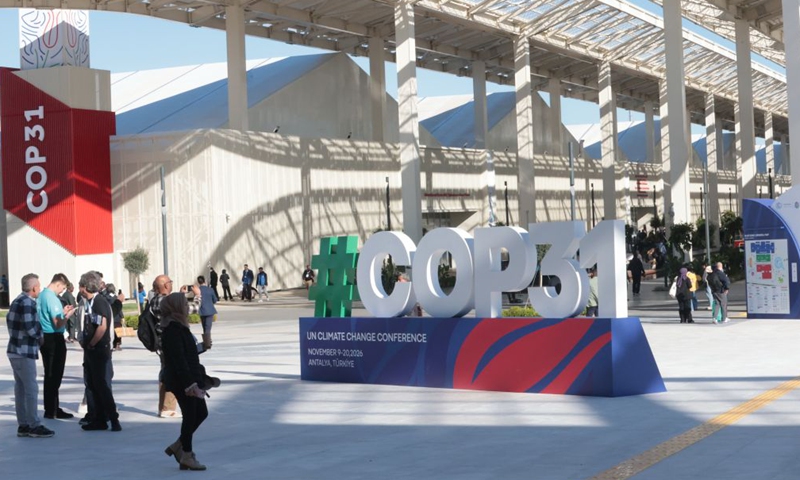
Photo: Xinhua
Brazil's Ministry of Management and Innovation in Public Services (MGI) is taking part in the 31st United Nations Climate Change Conference (COP31), held from November 9 to 20, 2026, in Antalya, Türkiye. The ministry is presenting Brazilian experiences aimed at strengthening state capacity and developing public solutions for a just climate transition. According to Brasil 247, its participation focuses on four main areas: sustainable public procurement, digital transformation and data, territorial and environmental management, and stronger government institutions capable of implementing climate policies.
Brazil's participation follows COP30, held in Belém in 2025, and seeks to advance discussions on addressing the climate crisis and implementing commitments under the Paris Agreement. The Brazilian government has identified the need to improve countries' ability to plan, coordinate and implement public policies as a central challenge in achieving environmental targets.
Brazilian technology and shared infrastructure in the Global South
As part of the digital transformation and data agenda, Mariana Brito, a program director at the ministry, participated on November 16 in a panel titled "Scaling Global South Climate-Tech via a Shared Data Infrastructure."
Organized by the South-South Collective for the Climate (S2C2) and the Climate Collective Foundation (CCF), the event will examine ways to expand the sharing of data, digital tools and technical knowledge among countries in the Global South.
Brito presented the Rural Environmental Registry (RER), the international version of Brazil's Rural Environmental Registry (CAR). The discussion will also address progress under the Solutions Acceleration Plan (SAP) for Digital Public Infrastructure (DPI) and Digital Public Goods (DPG) supporting climate action.
Launched during COP30, the initiative is led by Brazil in partnership with Norway, India, Co-Develop and the Digital Public Goods Alliance (DPGA).
Public procurement as a driver of sustainable development
Government purchasing power is another major component of Brazil's agenda at COP31. Public procurement can influence production standards, support low-carbon technologies and encourage markets to expand the supply of environmentally sustainable goods and services.
A central priority is implementing the Belém Declaration on Sustainable Public Procurement, introduced during COP30 in 2025.
By the end of October 2026, the declaration had attracted 47 signatories, including eight national governments, five Brazilian states and 34 Brazilian municipalities.
The initiative will be discussed on November 17 at the Brazil Pavilion during a panel titled "From Commitment to Implementation: The Belém Declaration on Sustainable Public Procurement as a Driver of Inclusive and Sustainable Growth."
Proposed by the United Nations Environment Programme (UNEP), the event will bring together representatives from the Brazilian ministry, the United Nations Industrial Development Organization (UNIDO), partner institutions and signatory countries.
The program includes the presentation of a report prepared by the Institute for Innovation and Public Purpose (IIPP) at University College London (UCL), with contributions from economist Mariana Mazzucato.
The study outlines practical approaches to implementing the Belém Declaration and strengthening the role of government procurement in promoting sustainable economic growth.
Integrating climate commitments into government procurement
The ministry is also participating in discussions related to Objective 22 of the COP31 Action Agenda, which focuses on public procurement. It shares responsibility for one of the sector's solutions acceleration plans.
On November 16, the ministry is scheduled to join international authorities and market representatives at the event "From Commitment to Purchasing Power: Ministers Showcase Progress on Climate-Integrated Public Procurement."
Brazilian representatives will present developments under the National Public Procurement Strategy for Sustainable Development.
On November 18, Deputy Executive Secretary Adauto Modesto Jr. is expected to represent the Brazilian government at the panel "Procurement Must Lead: Turning Nigeria's Climate Ambition into Implementation."
Organized by Nigeria's Bureau of Public Procurement (BPP) and the Chartered Institute of Procurement & Supply (CIPS), the discussion will highlight Nigeria's accession to the Belém Declaration and the potential of government purchasing policies to support climate objectives.
Digital platforms and identification systems for environmental policies
Among the technological developments presented at COP31 is the Data Sharing Platform (DSP), designed as a new transparency module for the Rural Environmental Registry within the international catalog of the Digital Public Goods Alliance.
Brazil's Rural Environmental Registry was introduced as a Digital Public Good in 2025, making source code, modules and open standards available to other countries interested in developing their own forest monitoring and environmental management systems.
The initiative aims to facilitate the adaptation of Brazilian digital solutions to different national circumstances while supporting international cooperation on environmental governance.
Another report, developed in partnership with the World Bank, examines the use of digital identification systems as Digital Public Infrastructure for climate action.
The document explores how these systems can support environmental policies, citizen identification, service integration and government coordination during extreme weather events and climate-related emergencies that cross national borders.
Environmental compliance and international cooperation on rural registries
On November 10, Giovanna Aguiar, the ministry's general coordinator for Rural Environmental Registry systems management, participated in the panel "SeloVerde and CAR: Advancing Environmental Compliance and Deforestation-Free Supply Chains."
Organized by WWF-Brazil, the event included representatives from the Federal University of Minas Gerais (UFMG) and the Brazilian state governments of Minas Gerais, Bahia and Piauí.
The discussion focused on digital tools designed to improve access to information about the environmental status of rural properties and strengthen compliance and traceability across agricultural supply chains.
These systems also support Brazil's roadmap for halting and reversing deforestation and forest degradation.
Strengthening state capacity for ecological transformation
The Brazilian ministry is placing particular emphasis on the institutional capabilities governments need to implement climate policies.
On November 17, it will organize the panel "The Implementing State: How to Shape Policies, Investments, Technology and Instruments to Ensure Ecological Transformation" at the Brazil Pavilion.
The event will feature a policy position paper developed with support from the consultancy Maranta, drawing on discussions with the COP30 Presidency and Brazil's Ministry of Foreign Affairs.
International participants will include Princess Abze Djigma, co-chair of the Paris Committee on Capacity-building under the United Nations Framework Convention on Climate Change (PCCB/UNFCCC); Izabella Teixeira, from the Brazilian Center for International Relations (CEBRI); German government representative Marcel J. Dorsch; and economist Mariana Mazzucato.
The discussion will examine how public institutions can coordinate investments, technology and policy instruments to support the ecological transition.
Broader international agenda at COP31
The ministry's participation also extends to discussions organized under the United Nations Framework Convention on Climate Change (UNFCCC) and other multilateral institutions.
On November 11, Giovanna Aguiar participated in the "Axis 6 Synthesis" roundtable, while Gabriela Maretto, from the ministry's Secretariat for Management and Innovation, is scheduled to attend the "Axis 6 Results Presentation Meeting" on November 13.
Maretto is also participating on November 13 in the event "Unlocking Markets for Low Carbon and Near Zero Industrial Products - The Power of Procurement," organized by UNIDO and the University of Oxford.
The discussion examines how public procurement can stimulate demand for industrial products with lower greenhouse gas emissions and help develop markets for cleaner production technologies.
On November 14, Maretto is scheduled to take part in a meeting of UNEP's Multistakeholder Advisory Committee on Sustainable Public Procurement.
The meeting will focus on developing metrics, indicators and common terminology to guide sustainable public procurement policies and improve their implementation across different countries.
Brazil's participation in these initiatives forms part of its broader COP31 agenda to strengthen public institutions, expand international cooperation and develop practical tools for implementing climate commitments, particularly among countries in the Global South.
(Reported by Brasil 247 on November 16, 2026)
