ARTS / CULTURE & LEISURE
Thousands of birds alight thanks to biodiversity
Yellow River meets blue sea
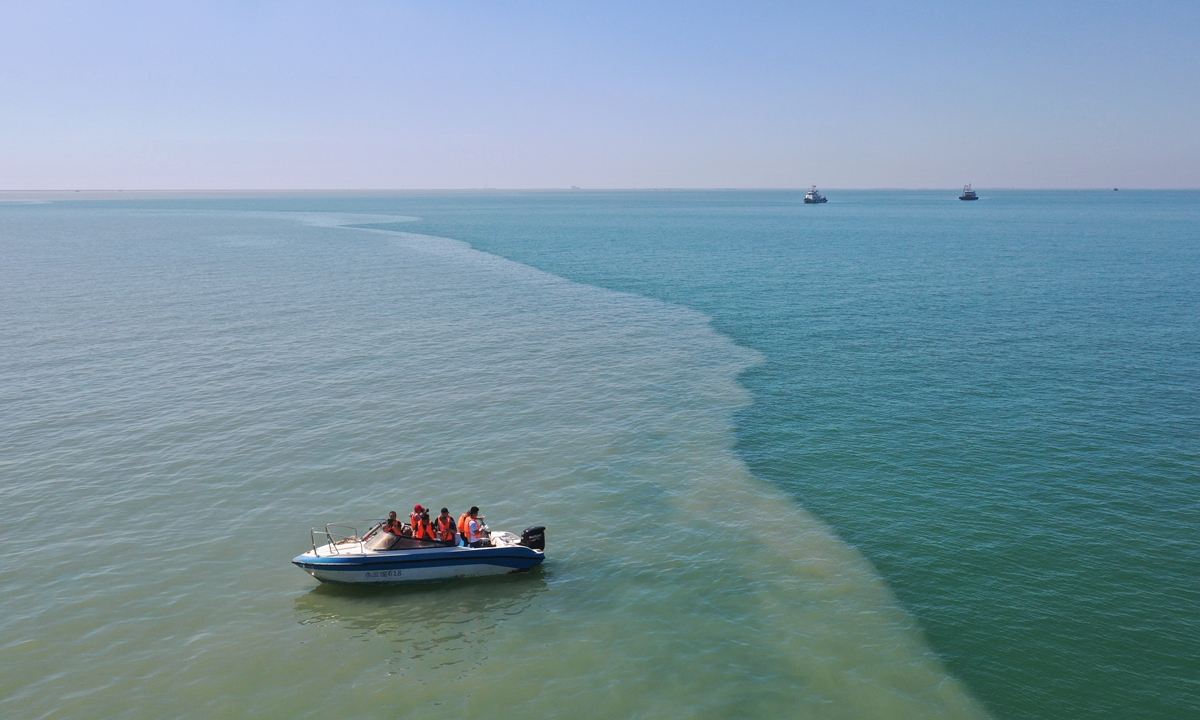
A boat sails near the mouth of the Yellow River in Dongying, East China's Shandong Province.
Driving toward the end of the Yellow River, visitors from Beijing marveled at the endless stretch of white reed flowers swaying in the breeze under a blue sky. Along the roadside stretched a vast area of wetland near the estuary of the Yellow River in Dongying, East China's Shandong Province.
Yet what attracted them most was the confluence of the river and the sea, as well as the migrating birds that fly there each season. On an early winter morning, tourists got on boats to head toward the Yellow River estuary.
The Yellow River, known as the "Mother River" of the Chinese nation, originates in the Bayan Har Mountains in Qinghai Province, and then travels through nine provinces and autonomous regions, before finally flowing into the Bohai Sea in Shandong. The 5,464-kilometer-long river, also the second longest in China, carries silt from the Loess Plateau downstream. It surges forward and builds up the Yellow River Delta in Dongying, known as the youngest land in China. When there is enough water flowing down the river, its estuary will extend into the sea.
After an hour's boat trip along the river, visitors felt a surge of excitement when they finally spotted a sharp line separating the yellow and blue water: The ochre and the cerulean waters flow and mingle, gradually softening the boundary between the river and the sea. After a 10-minute stay at the spot for photos, the boat turned back, leaving the visitors wanting more. "I'm so lucky and thrilled to witness such a breathtaking view today," a tourist surnamed Wang told the Global Times. "I actually came here in late October, but didn't make it this far due to bad weather."
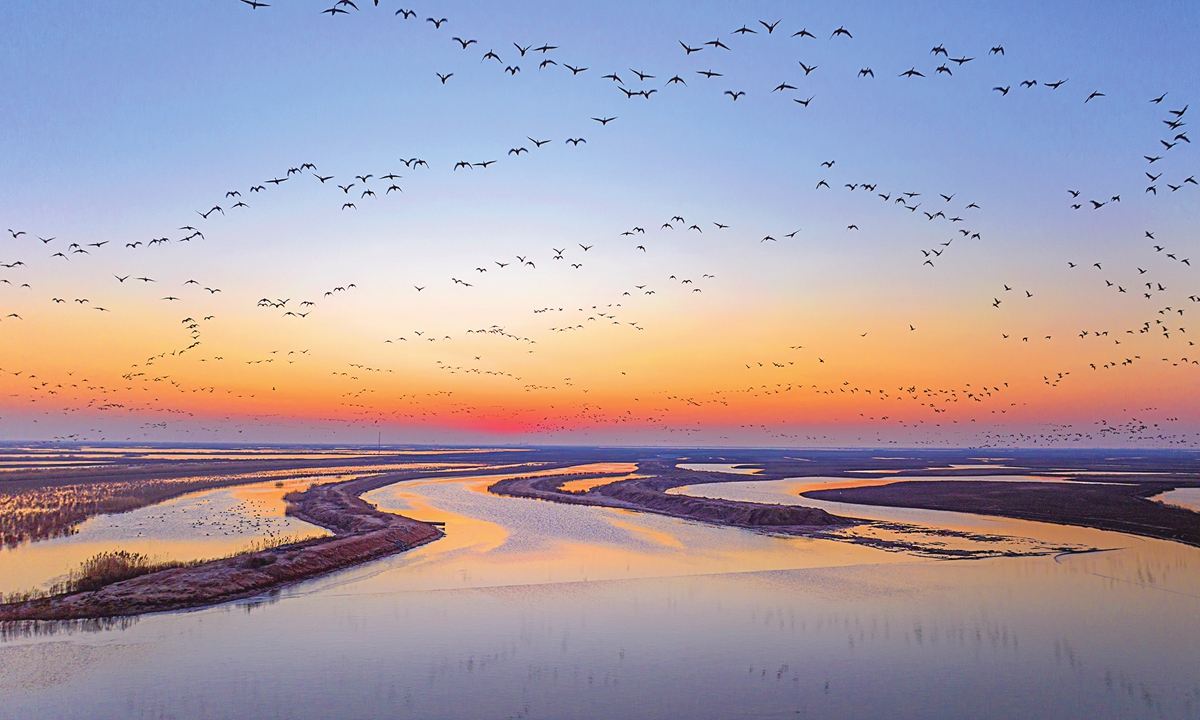
A flock of birds gathers where the Yellow River meets the Bohai Sea in the Yellow River Delta National Nature Reserve in Dongying, East China's Shandong Province. Photos: VCG
Wings fill the sky
Yet even such a wonderful scene cannot quench the visitors' thirst if they end up missing the "bird wave," especially in November, the best season for birdwatching.
In the afternoon, visitors arrived at one of the major spots in the Yellow River Delta, waiting for the spectacle. Hearing a deep, continuous roar of beating wings rising suddenly from the mudflats, they saw a massive swarm of waterbirds take flight together, their wings filling the sky. The flock kept shifting shapes: Sometimes stretching into a big "swallow," and sometimes gathered into a large "cloud," skimming low across the endless wetland. It is said that a "bird wave" can consist of more than 100,000 birds at its peak, mostly Baikal teal, a small East Asian duck.
This spectacle can be attributed to the healthy ecosystem of the wetland: a complete food chain, safe habitat, and unrestricted migration paths. Among the world's nine migratory flyways, the Yellow River Estuary spans the East Asian-Australasian Flyway and the Pacific Flyway. It serves as a critical bottleneck and stopover site for migratory birds. Due to its rich bird populations, the estuary has been recognized as a hot spot for Asian biodiversity. It is one of the world's three major breeding grounds. The Yellow River Estuary hosts China's largest breeding population of Oriental white storks, which give the region the title "Hometown of the Oriental white stork in China." More than 80 of the nearly 100 Dalmatian pelicans in Asia stop over here and great bustards spend the winter along the Yellow River with the estuary serving as a key wintering ground. Additionally, seven crane species can be found at the estuary, making it one of the world's richest habitats for cranes.
"It is such a blessing that we can watch the grand bird wave on this trip," a woman surnamed Ning, who happened to come at the right time and intended to stay for another night just to experience this wonder, told the Global Times.
Enduring protection
Yet behind the flocks in flight lies years of sustained efforts in ecological conservation and control of the Yellow River. Local authorities have taken various measures, including ecological water replenishment, connecting water systems and restoring tidal flats, while strictly preventing pollutants from entering the river, which have steadily improved water quality at its estuary. As the water grows clearer, diverse habitats such as tidal creeks, shallow pools and marshes have recovered.
On November 2, China's central government issued important instructions, reemphasizing the strategic requirement of "prioritizing protection while advancing governance," and continuously striving to make this mother river ever more beautiful, according to the Xinhua News Agency. In October 1992, the Yellow River Delta National Nature Reserve was officially established, and in 2021 the Yellow River Estuary National Park was initiated.
As of November, notable achievements have been made in the governance of the Yellow River Estuary: The number of bird species in the nature reserve has risen to 407 from 187; a total of 860 million cubic meters of ecological water replenishment has been implemented, 74,000 mu (4,933 hectares) of new wetlands added, 53,000 mu of suaeda salsa restored. The water quality of the main course of the Yellow River has remained steady at Class II, according to the Shandong Yellow River Delta National Nature Reserve Administration Committee official website.
The Yellow River flows on, and migratory birds return faithfully year after year. Only by guarding the clear waters and sheltering wetland wildlife over the long run can we keep the Yellow River safe and beautiful so that this mother river can nourish this land and benefit generations to come.
RELATED ARTICLES