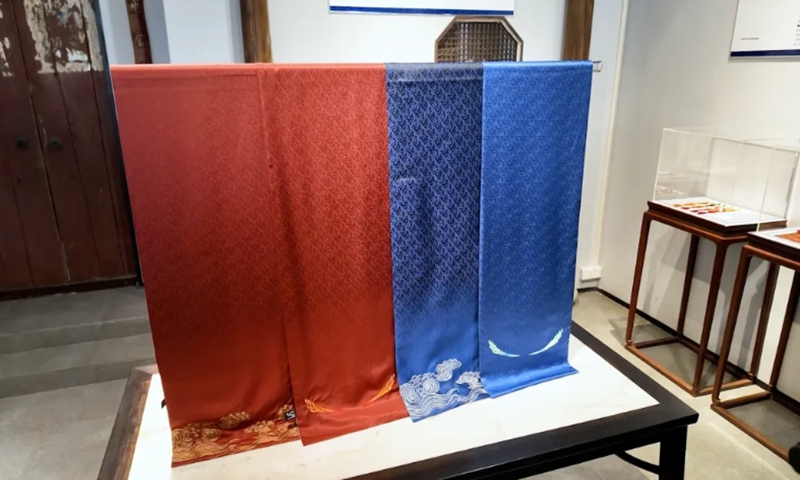
The scarves worn by leaders and representatives from the 21 APEC member economies at the 33rd Asia-Pacific Economic Cooperation (APEC) Economic Leaders' Meeting in Shenzhen, South China's Guangdong Province Photo: Chinanews.com
Scarves featuring four of China's national intangible cultural heritages (ICH) drew attention at the 33rd Asia-Pacific Economic Cooperation (APEC) Economic Leaders' Meeting in Shenzhen, South China's Guangdong Province, on Wednesday, as leaders and representatives from the 21 APEC member economies wore them for a group photo ahead of the meeting.
The scarves, presented in two color schemes -blue and red - were made using traditional Chinese Song brocade and Xiangyunsha silk, also known as gambiered Guangdong gauze. Their designs drew inspiration from the APEC "China Year" logo, which features 21 interwoven feathers symbolizing the 21 member economies harnessing momentum and rising together toward shared prosperity.
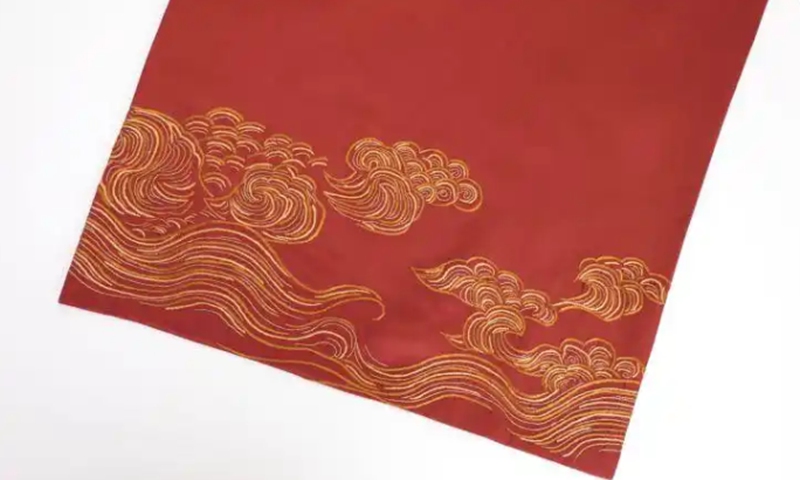
The red scarf worn by leaders and representatives from the 21 APEC member economies at the 33rd Asia-Pacific Economic Cooperation (APEC) Economic Leaders' Meeting Photo: Courtesy of the scarves' design and production company
According to Jiang Yuehua, the scarves' chief designer, their distinctive feature lies in bringing together four national-level ICH techniques: Song brocade weaving, the dyeing and finishing of Xiangyunsha silk, Suzhou embroidery and Guangdong embroidery, Chinanews.com reported.
The front of the scarves features auspicious cloud patterns rendered through an interplay of solid and subtle forms. The background motifs incorporate the kapok flower, bougainvillea and traditional cloud patterns, reflecting the cultural character of the Lingnan region and echoing the historical legacy of the Maritime Silk Road. The designs also convey traditional Chinese aspirations for peace and prosperity.
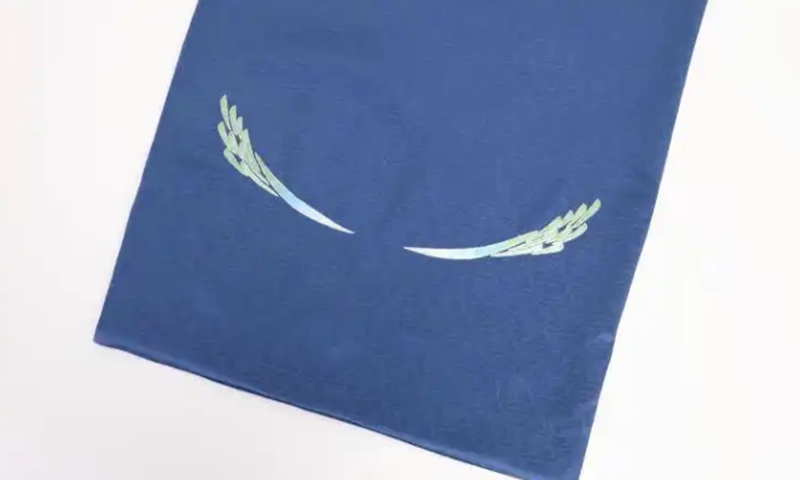
The blue scarf worn by leaders and representatives from the 21 APEC member economies at the 33rd Asia-Pacific Economic Cooperation (APEC) Economic Leaders' Meeting Photo: Courtesy of the scarves' design and production company
Song brocade, together with Yun brocade, Zhuang brocade and Shu brocade, is recognized as one of China's four major traditional brocade varieties and is often hailed as the "crown of brocades." Xiangyunsha, meanwhile, is a traditional silk fabric produced through an age-old plant-based dyeing and finishing process originating in the Lingnan region of South China.
The decorative embroidery combines the refined techniques of Suzhou embroidery, known as Su Xiu, and Guangdong embroidery, or Yue Xiu, bringing together two regional embroidery traditions in a single design.
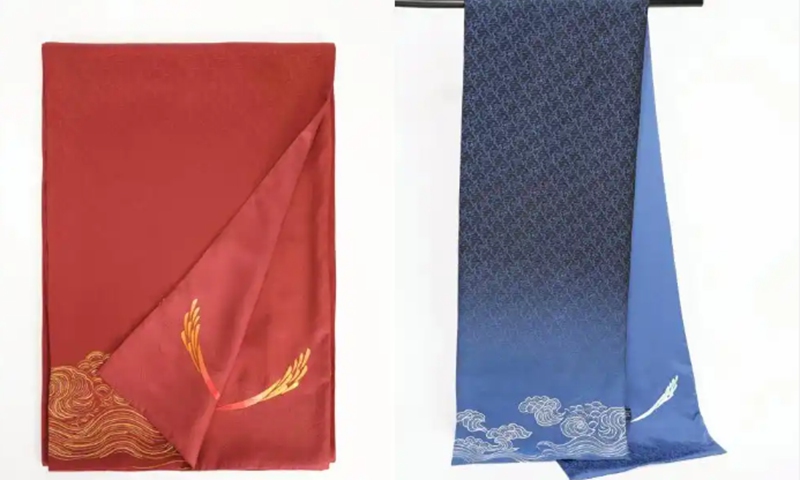
The scarves worn by leaders and representatives from the 21 APEC member economies at the 33rd Asia-Pacific Economic Cooperation (APEC) Economic Leaders' Meeting Photo: Courtesy of the scarves' design and production company
The APEC leaders' group photo, often referred to as the meeting's "family photo," has become a distinctive tradition of the economic forum.
Over the years, the group photos have offered host economies an opportunity to showcase their cultural heritage through clothing, turning traditional attire and craftsmanship into a visual expression of cultural identity and international exchange.


