ARTS / CULTURE & LEISURE
Poetry Shines in Chang’an: Openness, a skill practiced for 1,000 years
By Li Xundian and Published: Nov 19, 2026 10:11 PM
Editor's Note:
One city; half of the Complete Tang Poems. Poetry is the light that has never gone out in the city of Chang'an, even after 1,000 years. Poetry Shines in Chang'an, a bilingual series from the Global Times, makes poetry a bridge to link the historical depth of the Silk Road's starting point to the vitality of the open hub and city of innovation Chang'an known as today's Xi'an. From the street life of Chang'an portrayed in the rise and fall of poetic tones to freight trains and sister cities reaching the world, the openness, ease and affection in these lines of poetry mirror the ancient city's present and its future horizon. Together they present to the world a Chinese city that is reliable, admirable and respectable.
What did openness look like in the Tang Dynasty (618-907) capital? The famous poet Li Bai wrote of gallants riding on white horses with silver saddles who, having "trampled the fallen blossoms," went "laughing into the wine shops of the Hu girls." The eighth century poet Wang Han wrote of "grape wine in a goblet of night-glowing jade," with the pipa - a foreign instrument at the time- urging drinkers on. Grapes came from the Western Regions, the cup arrived in China by the Silk Road. However, by the time they became part of Wang's poem, they were no longer seen as exotic.
"Open Xi'an" is not just some slogan. It has been practiced, in verse and in daily life, for more than 10 centuries.
Over 1,000 years later, the city has picked up the thread and put it on rails.
At the Xi'an International Port, orange cranes rise and fall without pause. On October 30, the X8469 train, carrying auto parts, plush toys and household goods, left for Duisburg in Germany, pushing the number of China-Europe freight trains traveling from Xi'an past 5,000 in 2026. For eight straight years, it has ranked first nationally in trips, cargo volume and loaded-container rate, with corridors reaching over 200 cities in 45 countries and regions. Landlocked Shaanxi Province posted 797.84 billion yuan in foreign trade in the first nine months of 2026, up 111.1 percent.
Even the skies are busier. A total of 101 international passenger and cargo routes link 73 cities in 47 countries, and airport cargo and mail volume grew 53.7 percent. In October, the China International Friendship Cities Conference drew 700-plus guests from 61 countries to Xi'an.
Openness, though, needs a gentler carrier than steel.
On November 9, at the Guanzhong Academy, 15 young sinologists from 14 countries pushed open an old wooden door for a five-day camp called "Reading Tang Poetry on Site." They walked to the Forest of Steles, the Giant Wild Goose Pagoda, the Western Market and Daming Palace, reading poems where they were written. A digital poetry map was available online: tap a location and a voice recited a line. The city stopped being a chapter in a textbook and became a space the participants could navigate and understand.
Bai Zhexiang, a Belarusian sinologist, has spent eight years translating ancient poets Meng Haoran, Li Bai and Du Fu into his native language. "Tang poems use few words but carry deep meaning; the difficulty lies in the transfer of meaning between languages," he told the Global Times. "They hold feelings that cross time, a vehicle for dialogue between East and West, past and present."
Xi'an has not merely hung poems on its city walls. The Complete Tang Poems holds nearly 50,000 works; more than 20,000 concern Chang'an, and the old name appears over 1,400 times. Verses sit on steles along the Tang city wall, by Qujiang pond and in subway reading corners, creating an image the city calls "poetry paths toward Mount Zhongnan, the heart settles in Chang'an."
Tang poet Wang Changling once wrote, "The green mountains share one cloud and rain; the bright moon was never two lands' apart." Trains, airports and sister cities are turning "two lands" into one.
Peking University literature professor Zhang Yiwu offered a sharper observation. "Tang poetry tells us that openness should be written as a life you can keep living, not a one-time gesture," he said in an interview. "How a society treats strangers is measured by whether it can write them into its own sentences."
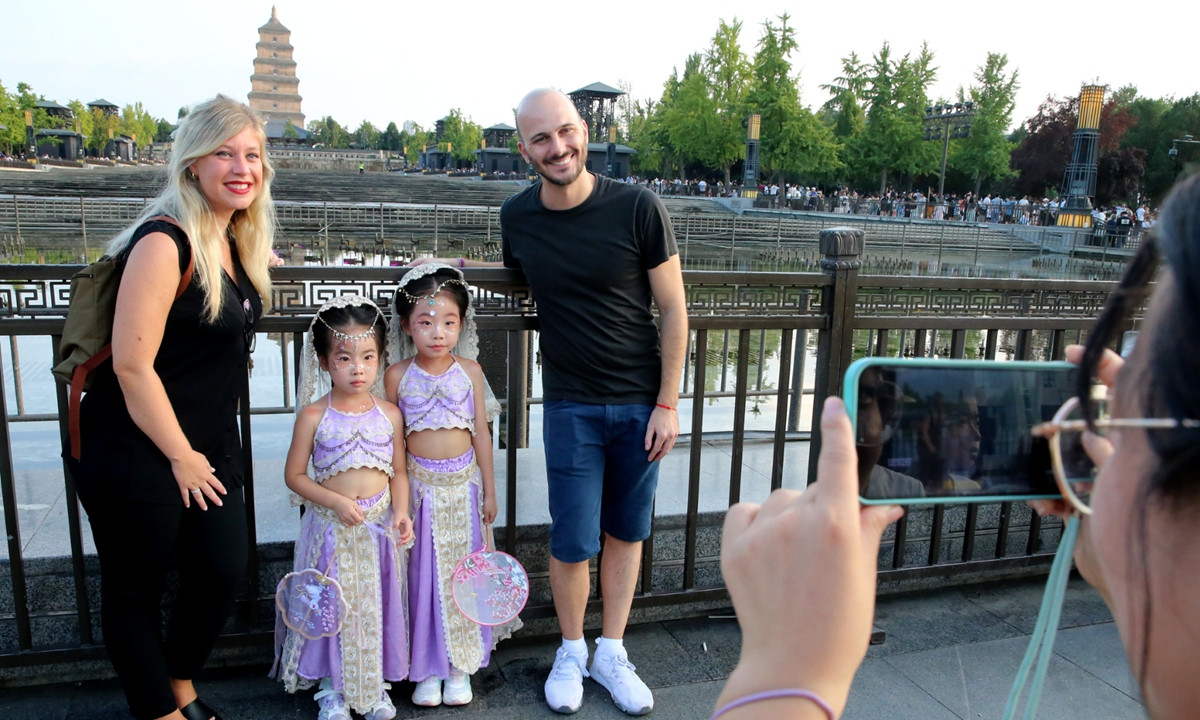
The idea lands differently in Chang'an. A thousand years ago, people came to seek scriptures, to trade, to write poems. Today traditional Hanfu clothing and business suits can be found in shops in the same alley, and books in different languages sit under the same moon, truly a version of the verse "one moon over Chang'an, 10,000 households washing clothes" seen in modern life.
APEC speaks of hard and soft connectivity. Xi'an's answer to that has two layers: Trains and ports are the hard, poetry and imagery the soft. The hard gives a city scale; the soft gives it warmth; poetry gives that warmth a shape.
"Within the seas, a true friend; at the edge of the world, still a neighbor." Over a thousand years ago, Chang'an used the line to see off travelers. Today, partners across the Pacific recognize the same feeling in it. Community, in the end, is reading an unfamiliar name into the same Tang verse.
Back under the Giant Wild Goose Pagoda, the young scholars finished the poem. Openness is not a new invention, just a skill this city has practiced for 1,000 years.
One city; half of the Complete Tang Poems. Poetry is the light that has never gone out in the city of Chang'an, even after 1,000 years. Poetry Shines in Chang'an, a bilingual series from the Global Times, makes poetry a bridge to link the historical depth of the Silk Road's starting point to the vitality of the open hub and city of innovation Chang'an known as today's Xi'an. From the street life of Chang'an portrayed in the rise and fall of poetic tones to freight trains and sister cities reaching the world, the openness, ease and affection in these lines of poetry mirror the ancient city's present and its future horizon. Together they present to the world a Chinese city that is reliable, admirable and respectable.
Photo: VCG
On Wednesday, the 33rd APEC Economic Leaders' Meeting opened in Shenzhen. Under the theme "Building a Asia-Pacific Community to Prosper Together," leaders from 21 member economies put openness, innovation and cooperation at the top of their agenda. Openness defines Shenzhen today. Over 1,000 years ago, in Chang'an, it was life itself.What did openness look like in the Tang Dynasty (618-907) capital? The famous poet Li Bai wrote of gallants riding on white horses with silver saddles who, having "trampled the fallen blossoms," went "laughing into the wine shops of the Hu girls." The eighth century poet Wang Han wrote of "grape wine in a goblet of night-glowing jade," with the pipa - a foreign instrument at the time- urging drinkers on. Grapes came from the Western Regions, the cup arrived in China by the Silk Road. However, by the time they became part of Wang's poem, they were no longer seen as exotic.
"Open Xi'an" is not just some slogan. It has been practiced, in verse and in daily life, for more than 10 centuries.
Over 1,000 years later, the city has picked up the thread and put it on rails.
At the Xi'an International Port, orange cranes rise and fall without pause. On October 30, the X8469 train, carrying auto parts, plush toys and household goods, left for Duisburg in Germany, pushing the number of China-Europe freight trains traveling from Xi'an past 5,000 in 2026. For eight straight years, it has ranked first nationally in trips, cargo volume and loaded-container rate, with corridors reaching over 200 cities in 45 countries and regions. Landlocked Shaanxi Province posted 797.84 billion yuan in foreign trade in the first nine months of 2026, up 111.1 percent.
Even the skies are busier. A total of 101 international passenger and cargo routes link 73 cities in 47 countries, and airport cargo and mail volume grew 53.7 percent. In October, the China International Friendship Cities Conference drew 700-plus guests from 61 countries to Xi'an.
Openness, though, needs a gentler carrier than steel.
On November 9, at the Guanzhong Academy, 15 young sinologists from 14 countries pushed open an old wooden door for a five-day camp called "Reading Tang Poetry on Site." They walked to the Forest of Steles, the Giant Wild Goose Pagoda, the Western Market and Daming Palace, reading poems where they were written. A digital poetry map was available online: tap a location and a voice recited a line. The city stopped being a chapter in a textbook and became a space the participants could navigate and understand.
Bai Zhexiang, a Belarusian sinologist, has spent eight years translating ancient poets Meng Haoran, Li Bai and Du Fu into his native language. "Tang poems use few words but carry deep meaning; the difficulty lies in the transfer of meaning between languages," he told the Global Times. "They hold feelings that cross time, a vehicle for dialogue between East and West, past and present."
Xi'an has not merely hung poems on its city walls. The Complete Tang Poems holds nearly 50,000 works; more than 20,000 concern Chang'an, and the old name appears over 1,400 times. Verses sit on steles along the Tang city wall, by Qujiang pond and in subway reading corners, creating an image the city calls "poetry paths toward Mount Zhongnan, the heart settles in Chang'an."
Tang poet Wang Changling once wrote, "The green mountains share one cloud and rain; the bright moon was never two lands' apart." Trains, airports and sister cities are turning "two lands" into one.
Peking University literature professor Zhang Yiwu offered a sharper observation. "Tang poetry tells us that openness should be written as a life you can keep living, not a one-time gesture," he said in an interview. "How a society treats strangers is measured by whether it can write them into its own sentences."
The idea lands differently in Chang'an. A thousand years ago, people came to seek scriptures, to trade, to write poems. Today traditional Hanfu clothing and business suits can be found in shops in the same alley, and books in different languages sit under the same moon, truly a version of the verse "one moon over Chang'an, 10,000 households washing clothes" seen in modern life.
APEC speaks of hard and soft connectivity. Xi'an's answer to that has two layers: Trains and ports are the hard, poetry and imagery the soft. The hard gives a city scale; the soft gives it warmth; poetry gives that warmth a shape.
"Within the seas, a true friend; at the edge of the world, still a neighbor." Over a thousand years ago, Chang'an used the line to see off travelers. Today, partners across the Pacific recognize the same feeling in it. Community, in the end, is reading an unfamiliar name into the same Tang verse.
Back under the Giant Wild Goose Pagoda, the young scholars finished the poem. Openness is not a new invention, just a skill this city has practiced for 1,000 years.
RELATED ARTICLES