China's emerging industries grow strongly in first three quarters, led by AI, aerospace
Tech innovation, private sector drive industrial upgrading, new growth: expert
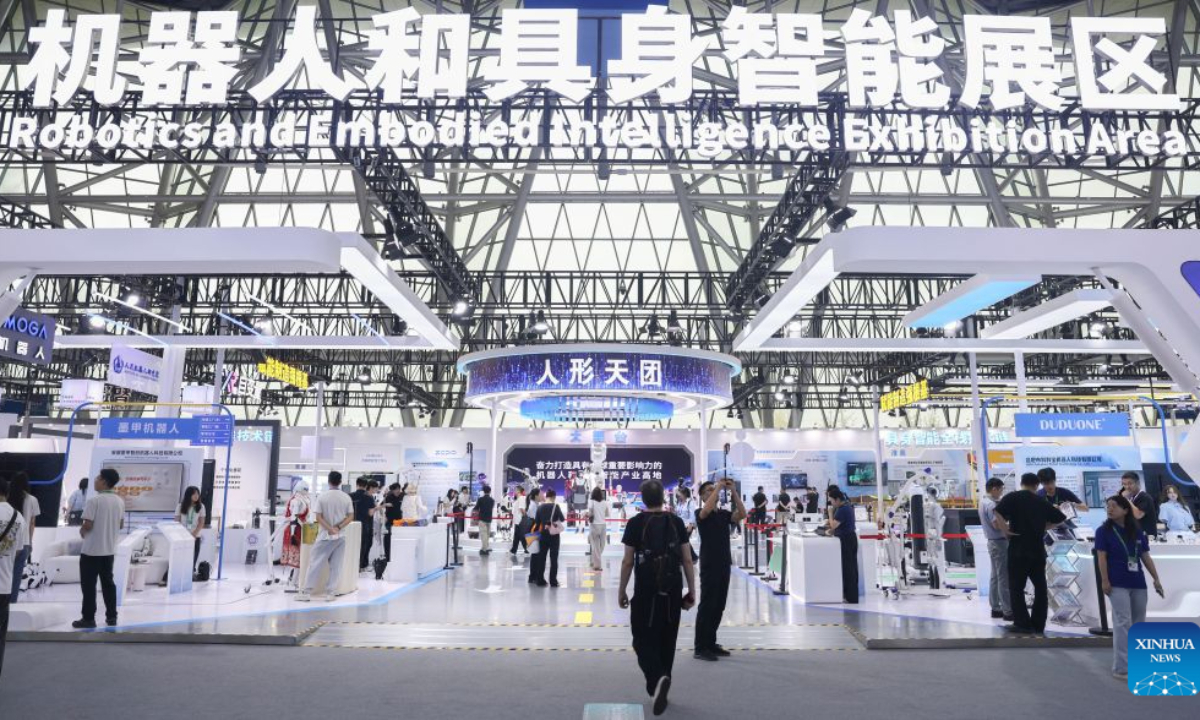
This photo taken on Sept. 20, 2026 shows the robotics and embodied intelligence exhibition area at the 2026 World Manufacturing Convention (WMC) in Hefei, east China's Anhui Province. (Xinhua/Chang Nengjia)
China's emerging industries and advanced manufacturing sectors kept up strong growth in the first three quarters of 2026. New business registrations in aerospace, integrated circuits and artificial intelligence (AI) rose notably, according to data released by the State Administration for Market Regulation (SAMR) over the weekend.
The figures underscore the accelerating growth of China's innovation-driven economy, with technological breakthroughs, expanding industrial applications, and comprehensive manufacturing supply chains creating new opportunities for businesses, a Chinese expert said.
The expert noted that the continued expansion of emerging industries, particularly the strong participation of private enterprises, will provide fresh impetus for China's industrial upgrading and high-quality economic development.
The number of registered enterprises operating in the country's "four new" economies - new technology, new business patterns, new development modes, and new industry - was up 5.6 percent year-on-year as of the end of September, the SAMR said in a statement on Saturday.
Among emerging industries, newly registered enterprises engaged in spacecraft and launch vehicle manufacturing surged 73.3 percent year-on-year during the January-September period, while those in integrated circuit manufacturing increased 21.1 percent.
Frontier technology sectors recorded rapid expansion. The number of newly registered enterprises in generative AI reached 90,000 in the first nine months, up 28.1 percent year-on-year, while the humanoid robotics sector saw 170,000 new registrations, an increase of 9.5 percent, according to the SAMR.
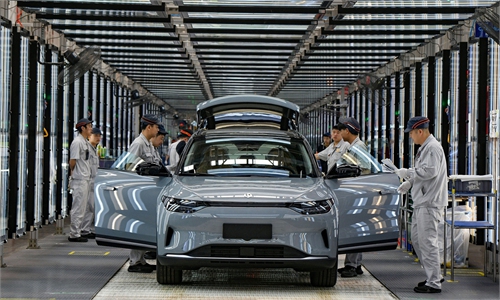
Advanced manufacturing continued to expand, with 218,000 new enterprises registered nationwide. Eastern China accounted for 138,000 of these registrations, up 2.6 percent year-on-year, underscoring the region's important role in supporting industrial development.
Notably, private enterprises remained a major driving force, accounting for 199,000 newly registered advanced manufacturing businesses, an increase of 0.2 percent from a year earlier.
Among the 13 categories of advanced manufacturing, four recorded growth rates exceeding 4 percent in new business registrations. These included advanced petrochemical and chemical materials manufacturing, up 5.1 percent; frontier new materials manufacturing, up 5 percent; and high-end equipment manufacturing, up 4.2 percent.
The rapid expansion of enterprises in emerging industries reflects a broader shift in China's economic growth drivers, as technological innovation increasingly translates into new industrial activities and business opportunities, Hu Qimu, a professor at the Maritime Silk Road Institute of Huaqiao University, told the Global Times on Sunday.
Hu said that the strong growth in aerospace and integrated circuit manufacturing shows how technological advances are driving demand across industrial supply chains. "This creates opportunities not only for leading manufacturers but also for smaller companies specializing in components, equipment and supporting services," the expert said.
China's advantage lies not only in its expanding technological capabilities but also in its comprehensive industrial system, according to Li Changan, a professor at the Academy of China Open Economy Studies at the University of International Business and Economics. This situation "allows emerging technologies to move more efficiently from research and development to manufacturing and commercial applications."
The expansion of the "four new" categories is also creating employment opportunities. For example, in Shenzhen, South China's Guangdong Province, about 28,000 new jobs were created in sectors involving new technologies, industries, business formats and business models during the first half of 2026, equivalent to about 150 jobs per day, the Xinhua News Agency reported in July.
Private enterprises have also stepped up their innovation efforts. According to a report released in July, the number of private enterprises operating in the "four new" sectors grew by more than 6 percent year-on-year in 2025. Research and development intensity among listed private enterprises was 1.6 percentage points higher than the overall market level.
The continued development of emerging industries will depend increasingly on how effectively technological innovation can be translated into productivity gains and sustainable commercial applications, rather than simply on the number of newly established enterprises, Li told the Global Times.
As China pursues industrial upgrading, technological innovation, manufacturing strength and private-sector dynamism are expected to play an increasingly important role in creating new growth drivers and strengthening the resilience of the economy, said Li.
RELATED ARTICLES