ARTS / CULTURE & LEISURE
From pest to prized coffee picker, a Brazilian bird tells the story of a forest
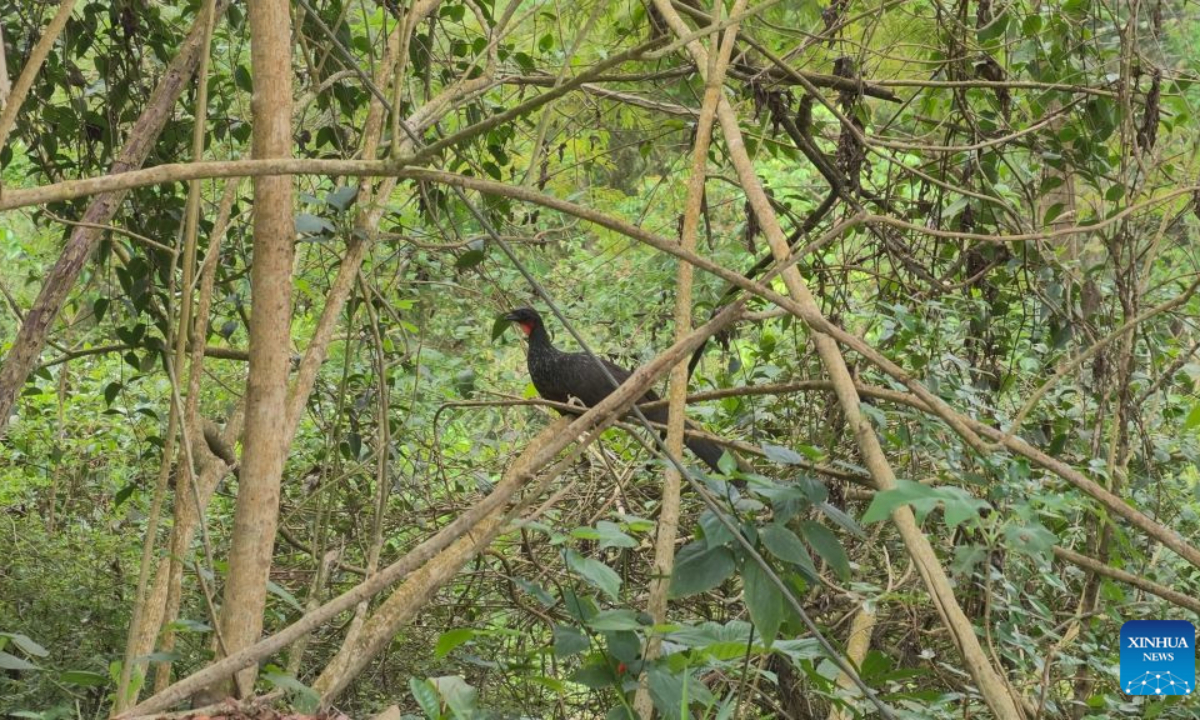
This photo taken on Sept. 25, 2026 shows a jacu bird in Espirito Santo state, Brazil. (Xinhua/Wu Nian)
A dark-feathered jacu hops among the branches at Camocim coffee farm in the southeastern Brazilian state of Espirito Santo, its distinctive red throat standing out against the green foliage. Here, trees shelter both coffee plants and birds once unwelcome for feeding on their fruit.The coffee cherries are still unripe. When harvest season arrives, the birds seek out the ripest fruit, workers say. The beans recovered from their droppings have become one of the farm's most valuable products.
"It turns out the jacu is a natural perfectionist," said Rogerio Lemke, the farm's agricultural supervisor. "It only eats the cherries at peak ripeness."
The jacu's journey from crop raider to prized picker began with a reforestation effort that predated coffee cultivation by decades.
Logging and agricultural expansion, particularly coffee cultivation, drove extensive forest loss in Espirito Santo during the last century, according to a publication on the state's threatened species released by Brazil's National Institute of the Atlantic Forest.
However, Camocim's history took a different course. After purchasing the property in 1962, its owners spent decades planting trees, protecting springs and restoring the soil, according to the farm's account.
Their efforts included a mix of native and introduced species, such as eucalyptus, pines and sweetgums. Over time, the trees formed a leafy canopy, creating a habitat for birds and other wildlife.
Coffee cultivation did not begin until 1996, more than three decades after the tree-planting effort began. Instead of clearing the land for coffee plantations, the farm chose to grow coffee among the trees.
Today, about 70 hectares of the 300-hectare estate are planted with Arabica coffee. Palms and citrus trees grow alongside the coffee plants, while fallen leaves form a natural cover over the soil.
For Lemke, the trees are an integral part of the farm's production system. Their shade helps moderate temperatures around the coffee plants, while fallen leaves decompose and enrich the soil with organic matter. The farm says it grows coffee without synthetic fertilizers or chemical pesticides.
"Trees are the coffee plant's natural companions," he said. "In an era of unpredictable weather, this ecosystem is our best insurance."
At Camocim, restored tree cover brought jacu birds back, but their appetite for ripe coffee cherries initially made them unwelcome visitors.
Farm owner Henrique Sloper drew inspiration from Indonesia's Kopi Luwak, a coffee made from beans that have passed through the digestive system of civets. In 2006, Camocim began collecting beans excreted by jacu birds, launching its own distinctive bird coffee.
According to Lemke, the birds digest the fruit's pulp but leave the beans intact. Workers collect the droppings by hand, then dry and further process the recovered beans before roasting.
At the drying facility, Lemke compared the collected material to pe de moleque, a traditional Brazilian peanut brittle. The finished coffee, the farm says, has floral notes and delicate fruity acidity.
Production remains limited. The farm estimates its annual output of jacu coffee at roughly 1 to 2 metric tons, with retail prices reaching 1,600 Brazilian reais (about 269 U.S. dollars) per kilogram. Most of the coffee is exported to Europe, North America and Asia.
What was once seen as a threat to the coffee harvest has become one of its most unusual assets. Beneath the canopy, coffee plants and jacu birds continue to share the same ground, each playing a different part in the farm's ecosystem.
