SPORT / FOOTBALL
CFA unveils blueprint to reshape youth football, prioritize technical development
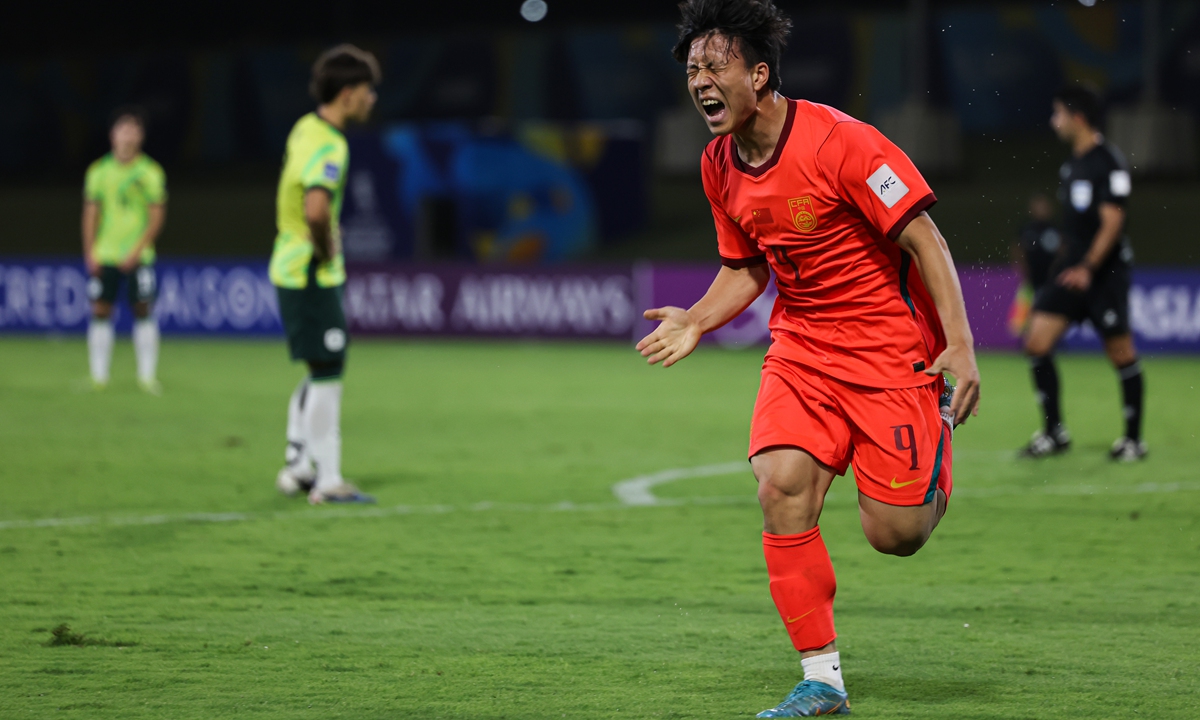
China's Xie Jin celebrates after scoring a goal against Australia at the U17 Asian Cup on May 19, 2026 in Jeddah, Saudi Arabia. Photo: VCG
The Chinese Football Association (CFA) on Monday unveiled its "Red Print" plan, a nationwide framework aimed at unifying youth football development, coaching methods and playing styles as China seeks to strengthen the foundations of its player development system.
The plan is designed to provide a common technical framework for youth player development across the country, covering training methods, competition structures, talent identification, coach education and sports science, according to the CFA.
The initiative comes as China continues to struggle to establish itself as a competitive force in international men's football.
The senior men's national team has so far made just one FIFA World Cup appearance in 2002. Meanwhile, China's U17 men's team returned to the FIFA U17 World Cup after a 21-year absence this year, offering a boost to the country's youth football development efforts.
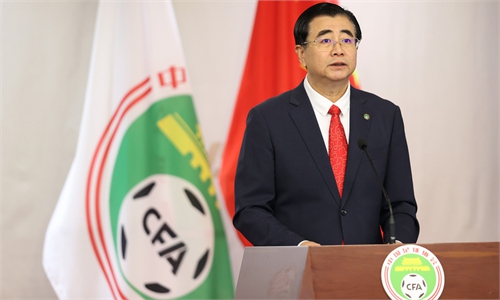
Speaking at the unveiling ceremony, CFA President Song Kai stressed the importance of building a strong youth development system, saying that "the strength of the national team always depends on the depth of its youth development foundation."
Chris Van Puyvelde of Belgium, the technical director of the CFA, said Monday that China should not simply copy the football models of other countries but develop an approach suited to its own circumstances.
He said the CFA would adopt a technical-first approach, developing technical skills alongside the ability to perform under physical pressure. Young players would be encouraged to keep possession under pressure, find solutions in tight spaces, pass accurately at high speed and demonstrate creativity in decisive moments.
Van Puyvelde, who previously served as technical director of the Belgian and Moroccan football associations, returned to work with the CFA in 2025 and was tasked with leading the further development of the plan.
In a preface to the "Red Print", Song said the contrast between progress at youth level and the gap facing the senior team had prompted reflection on the direction of Chinese football.
"We must play attractive, technical football, not results-first football based on simply kicking the ball long," Song wrote. "The ball must stay at our feet if we are to make our way in the world."
He argued that technical development, particularly through youth training, was fundamental to China's efforts to rebuild its football system.
Song cited Belgium's shift toward attacking football and England's move away from a long-ball approach as examples of how a clear technical direction can help reshape a national playing identity.
For younger players, the plan calls for less emphasis on results-based elimination and greater attention to frequent touches of the ball, one-on-one duels, small-sided games and independent decision-making.
The plan also seeks to improve coordination between school football, grassroots training programs, local youth teams and national squads, so that players can progress through different stages without having to repeatedly adapt to conflicting coaching philosophies and technical requirements.
The CFA also plans to establish a nationwide implementation network based on a five-tier youth development system and restructure competitions at different levels so that matches better serve player development, talent identification and training.
Song acknowledged that the framework would need to evolve through practical experience, stressing that its value lay not in immediate perfection but in setting a consistent direction for the future.
"The significance of the Red Print does not lie in how perfect it is today, but in providing Chinese football with a technical direction that can be maintained for 10, 20 or even more years," Song wrote.
Global Times
RELATED ARTICLES