ARTS / MUSIC
Ryan Fleur on 53 years of the Philadelphia Orchestra’s China ties
Continuing a legacy
By Published: Nov 23, 2026 08:41 PM

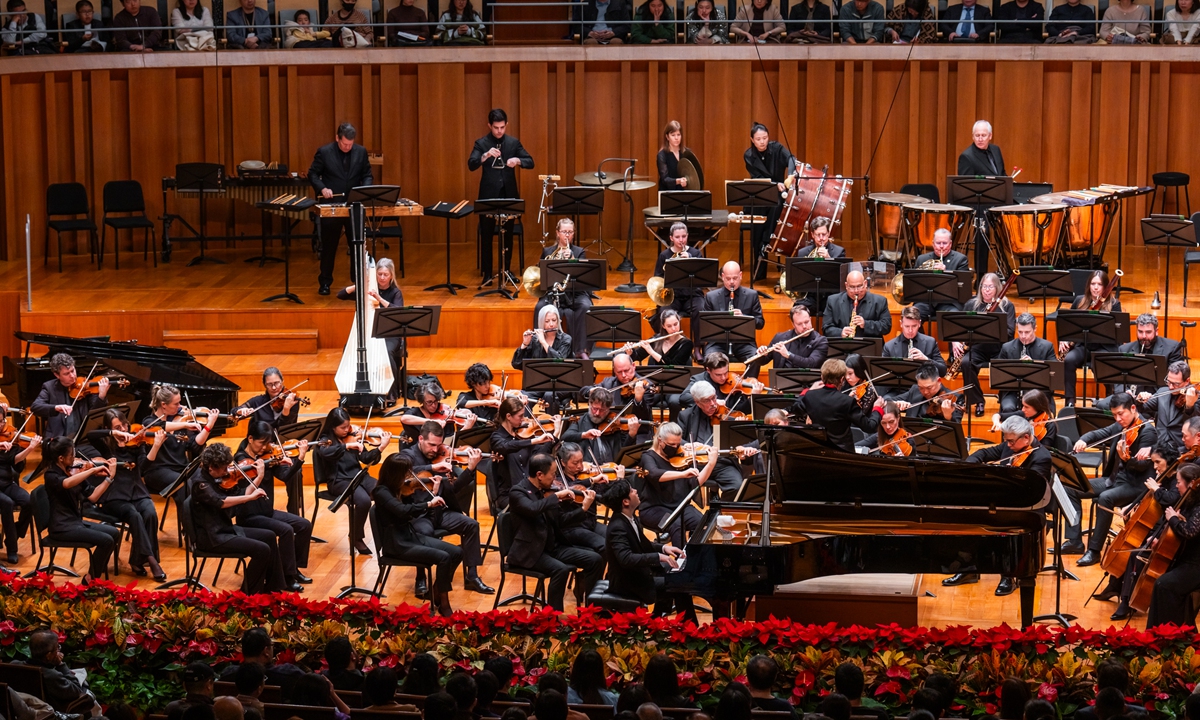
The Philadelphia Orchestra performs at the National Centre for the Performing Arts (NCPA) in Beijing on November 14. Photo: Courtesy of the Philadelphia Orchestra
In September 1973, when the Philadelphia Orchestra became the first US ensemble to perform in China, Ryan Fleur was not in the room. Neither were most of the hundred musicians he now oversees. By his own count, only two of them were.A memory held by two people, half a century on, ought to have thinned into an anecdote, but it hasn't. The two are still in the orchestra, and the legacy they carry is now being handed to players who were not born when the orchestra first flew to Beijing.
"Part of what makes the orchestra continue being great is that when someone new joins, the traditions and history and most important lessons get passed on," said Fleur, now the President and CEO of the Philadelphia Orchestra, in an exclusive interview with the Global Times on the orchestra's 14th visit to China, the most by any US orchestra.
The distance between the oldest inheritance and the newest is the core of the story. Violinist Davyd Booth was 23, a last-minute replacement, when the orchestra flew to Beijing in 1973. Violinist Eliot Heaton joined in 2024 and is on his third China trip.
What actually passes between them, in Fleur's telling, is not a style of playing. It is the habit of heading out of the concert hall and bringing music to people. "When we're performing on stage, we connect with audiences that are seeking us out," he said. "It's also important for us to meet people where they are."
The 14th visit ended on November 21. It originally kicked off in Haikou, Hainan Province, on November 11 and 12, then moved to the National Centre for the Performing Arts (NCPA) in Beijing on November 14 and the Beijing Performing Arts Center the following night. Its residency, begun with the NCPA in 2012, now in its 14th year, has brought players into schools, master classes and public squares across Haikou, Beijing, Shenzhen and Shanghai.
Marin Alsop, its principal guest conductor, led the tour. The Chinese pianist Zhang Haochen was soloist in Haikou and Beijing, performing in programs from Mozart and Beethoven to Dvorak and Stravinsky.
Where the real work happens
Fleur came to Philadelphia in 2012, after nine years running the Memphis Symphony Orchestra, where his goal had been to make an ensemble part of its city rather than an ornament inside it. "I had brought a unique experience of finding ways for an orchestra in its city to not just give great performances on stage, but to find ways to connect with its audiences off stage," he said. "So when it became time for us to start traveling regularly to China, it made a whole lot of sense to try to mix all of that together."
In China, that has meant appearing "in museums, at iconic locations, in schools and universities through master classes, side-by-side performances," he said, work that is "all about having us as people connect with the people of China." On stage, the audience comes to the orchestra; in a side-by-side, the players sit beside their hosts. "As people," he said, "not as institutions."
Keeping relationships going
Fleur put the visit in the language of official occasions. "Music has a unique ability to bring people together across cultures, languages, and borders, creating connections that can endure over generations," he said. "We look forward to returning to China and continuing this remarkable tradition of musical exchange through performances and engagement with students, musicians, and communities."
Asked what he would build next, and what the relationship might look like in 2050, once the 1973 generation is gone, he described it as a network rather than a project. "We've built a number of strategic partnerships and close collaborators in China. And some of them date back to 1973. Some of them date back 15 years. Some of them are newer," he said, citing the China National Symphony Orchestra, the NCPA and the Guangdong tourism and culture departments. "There's a responsibility that if we want to keep connecting in China, to keep those relationships going... It's those keeping and cultivating those relationships that's going to keep our ability to be able to connect with the people of China."
'Gallop of Warhorse' encore
Beethoven's Pastoral went into the 1973 program at the request of China. "In general, the piece of music that we are so closely associated with China is Beethoven's 6th Symphony [Pastoral]," Fleur said.
"But on this tour, when we're making music, some of the encores where we are playing Chinese-inspired pieces or actual Chinese folk songs, et cetera, those are the things that exhibit true cultural exchange," he said. "We come with decades and decades of Western training and then turn it around and play local, Eastern inspired music. That's what I hope people will remember."
One of those encores had a name. "We have prepared a very good encore of a Chinese piece called Gallop of Warhorse," said Heaton, who also loves Chinese classics including Jasmine Flower.
Playing it was the harder part. "We don't always know what is the right style — like how to slide between the notes, or how to do the decorations," he said. "For Western music, we learn all of that from performing, but we don't learn this about Chinese music. Luckily, we have many Chinese colleagues in the orchestra who are able to show us what is the right style."
The differences between the two countries, Heaton said, are real without being the whole story. "There are many differences between American and Chinese culture ... but when we're listening to a piece of music together, we all understand it the same way," he said. "The way we feel when we hear music, I think, is the same."
Fifty-three years ago the cultural exchange opened with a symphony the host had asked for. This month their performance closed with a Chinese encore the orchestra had prepared on its own.
RELATED ARTICLES