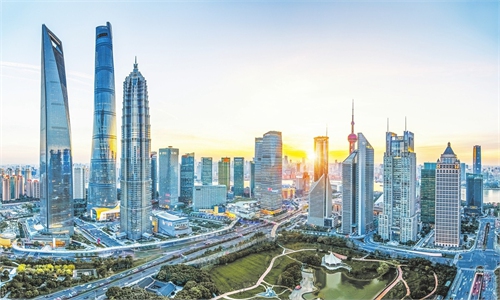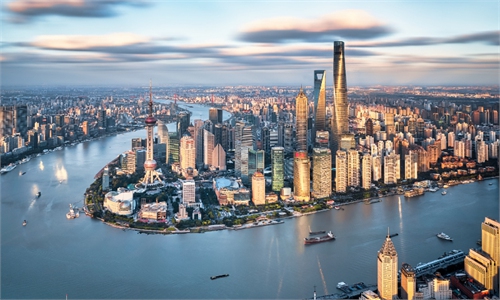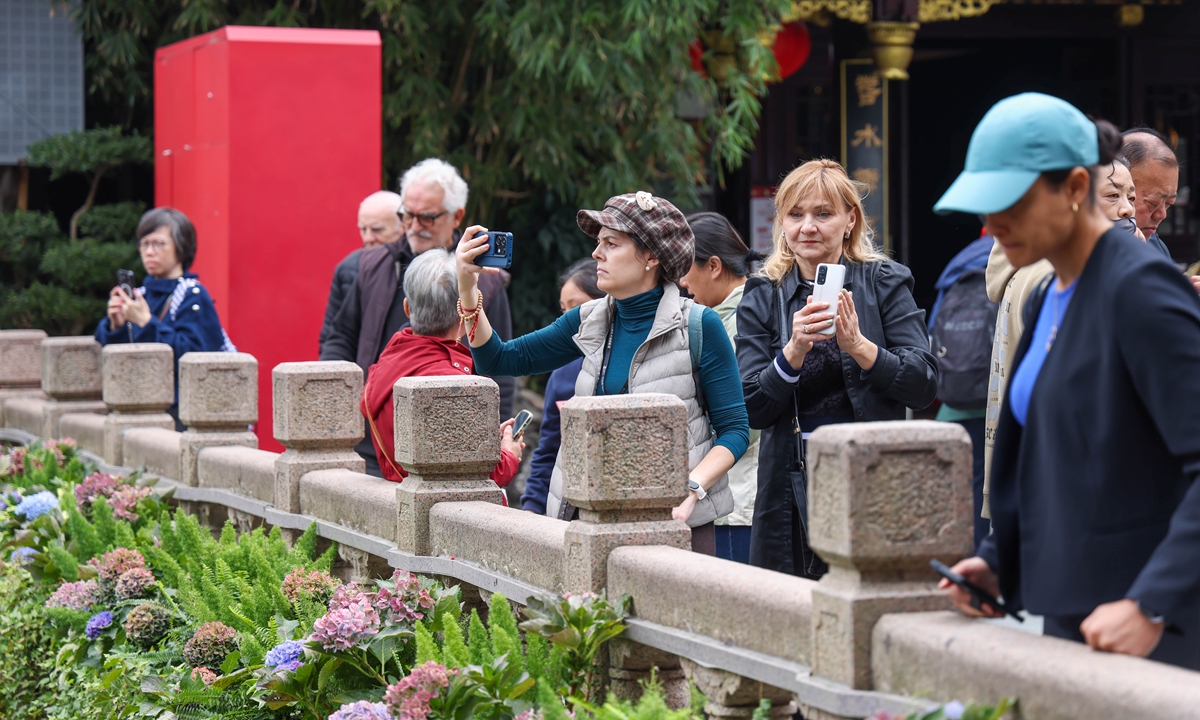
Tourists visit Yu Garden in Shanghai on November 12, 2026. Photo: VCG
What does an open city look like in practice? Shanghai recorded 6.26 million visits by foreign tourists in the first three quarters of this year, up 29.5 percent year-on-year. For the full year of 2025, Shanghai recorded 7.23 million visits by foreign tourists - a new all-time high.
The composition of visitor origins has become increasingly diverse, with South Korea, Russia, the US, Thailand, and Malaysia ranking among the top source countries. Meanwhile, the number of visitors from long-haul markets in Europe and the US has also shown a steady recovery.
Chinese President Xi Jinping, also general secretary of the Communist Party of China Central Committee and chairman of the Central Military Commission, stressed during an inspection tour in Shanghai in 2023 that Shanghai should comprehensively deepen reform and opening-up from a higher starting point, urging the city to devote significant energy to promoting pioneering reform and opening-up on all fronts.
Today, Shanghai is steadfastly expanding high-level opening-up, winning over admirers through its own substantial strengths.
The convergence of multiple major events is one of the direct drivers of this recent surge in inbound travel. With the World Artificial Intelligence Conference, the WorldSkills Competition, the China Shanghai International Arts Festival, and the China International Import Expo - among others - taking place, the city is seeing a steady influx of business professionals, competitors, and tourists from all corners of the globe.
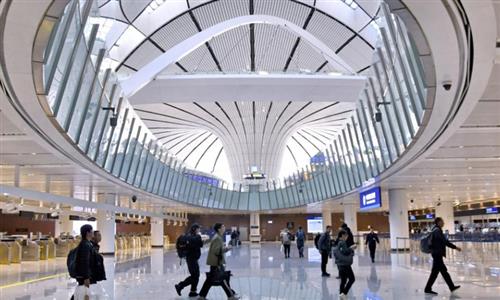
This surge in inbound tourism also reflects the continued strengthening of Shanghai's role as an international aviation hub and a gateway for cruise travel. With a route network connecting to over 50 countries and regions, Shanghai Pudong International Airport has become a key transit point for foreign visitors arriving in China. Furthermore, leveraging its status as a cruise homeport, the Port of Shanghai welcomed more than 51,000 foreign visitors arriving by cruise ship in the first half of this year, an increase of 37.8 percent compared to the same period last year.
In addition to the metropolis's own strengths, Shanghai is accelerating the development of a comprehensive, barrier-free service support system for inbound visitors.
At the 2026 Shanghai Masters, international spectators accounted for approximately 30,000 visits - about 12 percent of the total attendance. "I was worried that payment methods might be an issue in China, but I received a pleasant surprise the moment I stepped out of the airport," said Jason, a visitor from the UK and a regular at the Shanghai Masters. He was given a "Shanghai Pass" - a versatile card that can be used not only for public transportation but also for cultural and tourism activities, shopping, and dining.
It's worth noting that foreign tourists' Shanghai trips are evolving into immersive, in-depth experiences: discovering intangible cultural heritage at Yu Garden, tracing the city's transformation along the Bund, or browsing for unique, homegrown Chinese products in Xintiandi.
In the South Bund area, a bespoke tailoring center has gained popularity on overseas social media platforms for its high-quality, reasonably priced custom garments, with 60 percent of its clients coming from abroad. In the first half of this year, the center collaborated with the local neighborhood on a "micro-renewal" project, which included the installation of a foreign currency exchange machine in the lobby.
"Many of our 'repeat customers' send over their tailoring requirements even before they arrive in Shanghai," said Li Guangming, a veteran tailor with over 20 years of experience in the market.
From the "fleeting footfall" of tourists to the "lasting presence" of entrepreneurs, Shanghai's appeal is rooted in an ever-evolving open ecosystem and a business environment that continues to improve.
A decade ago, Peter Hrapko, a former Slovak transport ministry official, was drawn to China's vast multimodal transport market during a visit related to the Belt and Road Initiative. Last year, he returned to Shanghai with a new technology to compete in an international innovation and entrepreneurship contest, where he qualified for a 600,000 yuan grant from the Shanghai municipal fund for technological innovation by small- and medium-sized enterprises. This March, he signed an agreement with a science park in Shanghai's Baoshan district to localize the horizontal intermodal container handling system he brought.
"The 600,000 yuan is more than just a prize; it's a 'vote of confidence' we've received here in Shanghai," Hrapko said. Following the competition, a range of supporting services kicked in: the organizer actively helped his team connect with potential clients and facilitated both the formal establishment of his business and the practical implementation of his technology.
With initiatives such as the pilot program for one-person companies (OPCs) established by foreign individuals, and the extension of equal support standards to both overseas and local sci-tech innovation projects, a series of policy breakthroughs has made Shanghai a prime destination for overseas entrepreneurs.
Multinational companies continue to view Shanghai favorably and deepen their commitment to the Chinese market. On November 18, Shanghai held a ceremony to present certificates to the 43rd batch of regional headquarters and research and development (R&D) centers of multinational corporations, with 30 regional headquarters and 15 foreign-invested R&D centers receiving recognition.
Shanghai possesses an excellent scientific research ecosystem, which provides a constant source of vitality for L'Oréal's global co-creation efforts, said Xavier Blin, vice president of L'Oréal Research & Innovation China.
In the first three quarters of this year, 4,720 new foreign-invested enterprises were established in Shanghai, with the actual utilization of foreign capital reaching $13.2 billion, a year-on-year increase of 9.4 percent. Notably, foreign investment in scientific and technical service industries grew by 40 percent, and the share of foreign investment directed toward high-tech sectors continued to rise steadily.
This was compiled and translated by Global Times reporter Ma Jingjing based on an article published by the People's Daily on November 24, 2026.
RELATED ARTICLES