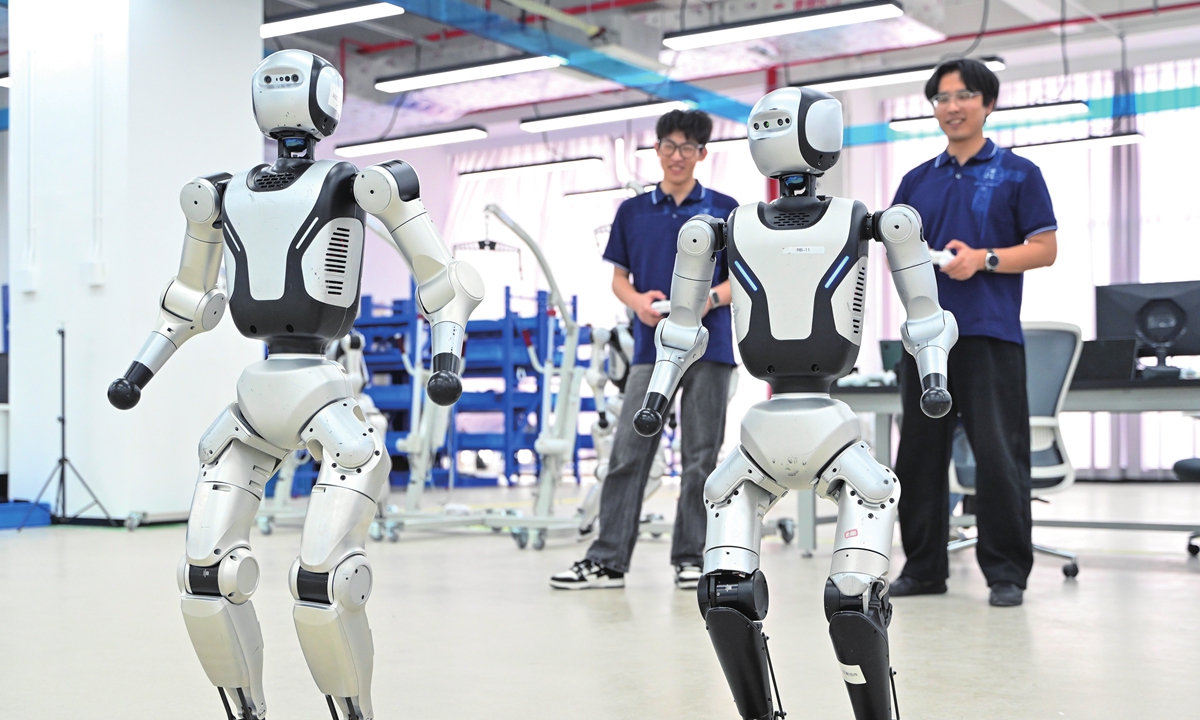
Humanoid robots undergo testing and debugging at Shenzhen's first humanoid robot pilot production line in South China's Guangdong Province on April 12, 2026. Photo: VCG
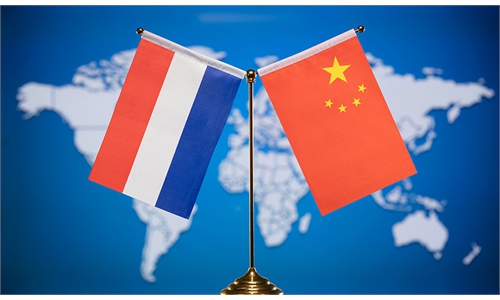
As the global trade environment grows more complex and the US pushes for tighter restrictions on chip exports, Dutch Foreign Minister Tom Berendsen's visit to China from Monday to Wednesday has significance beyond diplomacy. He began his trip in Shenzhen, visiting innovative companies and meeting representatives of Dutch businesses. The decision to place business and technological innovation at the center of the visit sends a clear signal of how seriously the Netherlands views economic and technological cooperation with China, as well as opportunities this cooperation offers Dutch businesses.
What is happening in Shenzhen? The story is unfolding on two fronts. The first is the city's tech-driven economic growth. In the first 10 months of this year, Shenzhen's foreign trade exceeded 5.25 trillion yuan ($787.8 billion), with imports reaching 2.54 trillion yuan, up 73.7 percent year-on-year. This growth reflects not just demand for foreign goods, but also the expanding industrial activity behind China's technological advances. As a window into China's tech-driven economy, Shenzhen offers foreign businesses more than a market: it offers opportunities to become part of the country's evolving industrial landscape.
The second front is technological. China's advances in artificial intelligence (AI) are no longer a matter of aspiration. Just a few months ago, domestically developed AI chips were reported to have successfully supported the full-parameter post-training of a 1.6-trillion-parameter AI model. China's semiconductor industry still has ground to cover, but the progress it has made is increasingly difficult to dismiss. Its growing capabilities are giving China greater strategic leverage in global semiconductors and chipmaking-equipment trade.
Whether or not Berendsen's visit brings these broader developments into focus, they are unfolding in the city he chose to visit first. Shenzhen offers a glimpse of an economic reality that the Netherlands cannot afford to overlook. China is not only a vast market for foreign businesses, but also an increasingly capable source of technological innovation. As global technology trade becomes increasingly complex, understanding both dimensions of this development matters for the Netherlands.
The two countries' economic ties extend well beyond semiconductors. Their practical cooperation is advancing steadily in fields such as agriculture, water management, environmental protection and science and technology, while people-to-people exchanges continue to deepen. Across these sectors, commercial ties and industrial supply chains are becoming increasingly intertwined, creating benefits for both sides. The growing economic value of this cooperation to the Netherlands deserves greater recognition.
The Netherlands has growing economic interests in China, and semiconductors are one area where those interests closely intersect with China's interests. The Netherlands should take China's legitimate concerns over trade in semiconductors and chipmaking equipment seriously and address them through dialogue. A sound approach should take proper account of China's legitimate interests, rather than allow external pressure to dictate the Netherlands' policy.
ASML's exports to China have long drawn market attention. Berendsen's visit to Shenzhen and his discussions in Beijing offer an opportunity for the Netherlands to approach the issue more constructively. Exports to China serve ASML's commercial interests and those of the wider Dutch economy.
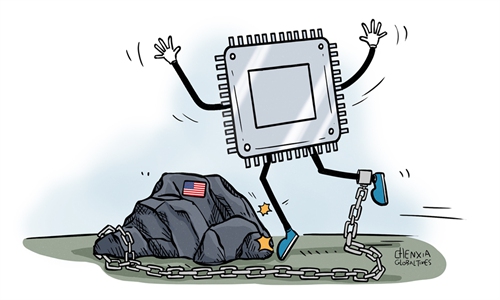
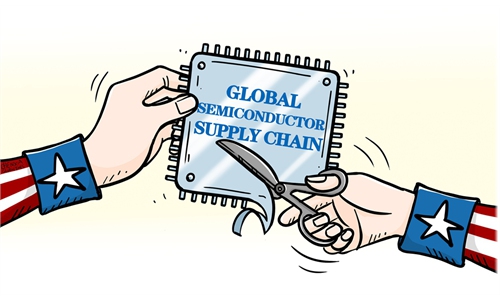
The current political climate in Washington may fuel calls for tighter restrictions on chip exports to China, adding to the pressure on the Netherlands. But US policy calculations do not necessarily align with Dutch economic interests. Cooperation with China brings tangible benefits to Dutch businesses. The Netherlands has good reason to weigh those benefits on their merits, rather than let pressure from Washington dictate its choices.
AI is advancing at extraordinary speed, and Shenzhen offers a glimpse of how quickly the technological landscape is evolving. The question for the Netherlands is not simply how to respond to external pressure, but how to retain its place in an industry moving so fast. Pragmatic engagement with China and a willingness to address differences while expanding cooperation would give the Netherlands more room to pursue its own economic and technological interests in a changing world.
RELATED ARTICLES