China's super-large tunnel boring machine 'Jianghai' completes 7.46-km underwater crossing under Yangtze River
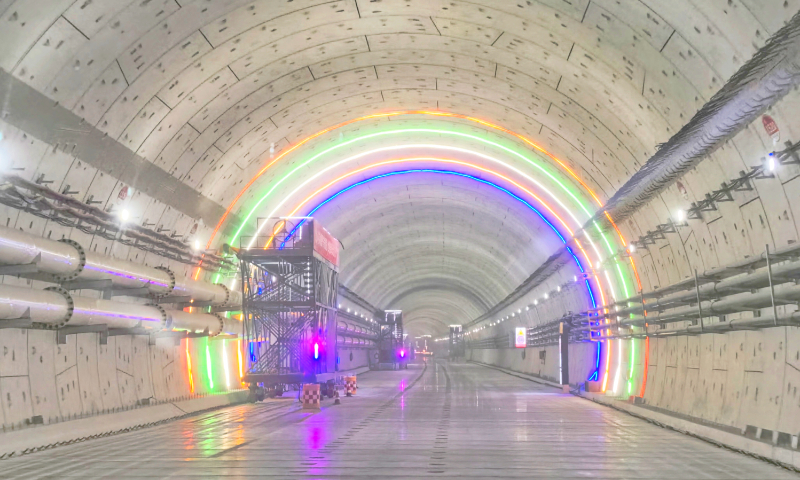
The section of the Haitai Yangtze River Tunnel that needs to be excavated using a tunnel boring machine in Suzhou, East China's Jiangsu Province. File photo: VCG
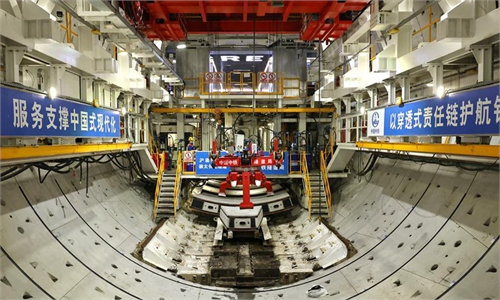
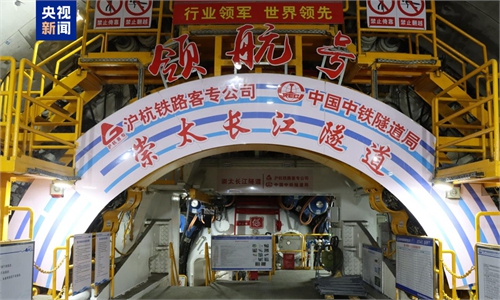
China's domestically developed 16-meter-class super-large-diameter shield machine Jianghai finished a 7.46-kilometer underwater tunneling run beneath the Yangtze River on Thursday, after about 14 months of tunneling. This represents a milestone for the Haitai Yangtze River Tunnel, which is set to become the world's longest cross-river highway shield tunnel. The project is now entering the final phase of tunnel excavation.
The successful river crossing validates China's capability to deploy and operate super-large-diameter shield equipment under some of the most complex underwater conditions. It also clears a critical path toward the timely overall breakthrough of what is expected to be the world's longest cross-river highway shield tunnel.
It also set new records of 7.46 kilometers of continuous tunneling beneath the riverbed and a maximum monthly tunneling advance of 664 meters.
As the project lies in the heart of the Yangtze River Delta, one of China's most economically dynamic regions, which includes Shanghai, the completion of the tunnel will significantly cut travel times among cities in the region and thus strengthen the "one-hour economic circle."
The Jianghai tunnel boring machine (TBM), weighing more than 5,000 tons, began its drive in April 2025. Workers guided it through three demanding phases: steady entry into China's longest river, a long downhill advance to the deepest point - 75 meters below the riverbed - and an uphill climb with attitude adjustments to exit the water, according to China Railway 14th Bureau Group, the builder of the tunnel.
Working conditions were extreme. The mixed soft-soil strata under the Yangtze River are highly permeable. At the lowest point, water and earth pressure reached 7.5 bar - equivalent to the weight of about 51 cars per square meter. Even minor deviations in the machine's posture risked water and sand inrushes or ground instability.
Project teams relied on advanced digital monitoring, continuous 24-hour parameter tracking via a smart shield-control platform, atmospheric-pressure cutter changing, and other techniques to maintain millimeter-level control.
The Haitai Yangtze River Tunnel links Haimen District in Nantong city on the north bank of the Yangtze with Taicang and Changshu on the south bank, both in East China's Jiangsu Province.
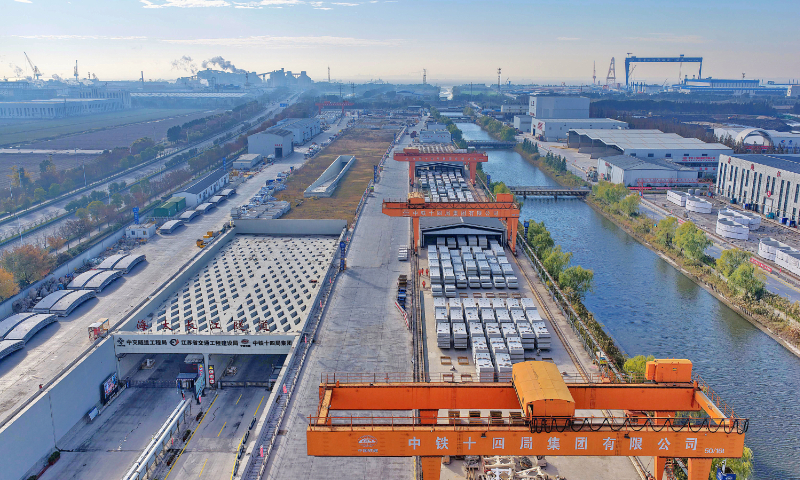
An aerial view of the entrance of the Haitai Yangtze River Tunnel, in Nantong's Haimen District, East China's Jiangsu Province, on November 26, 2026 Photo: VCG
The full route measures 39.07 kilometers and is being built to bidirectional six-lane expressway standards with a design speed of 100 kilometers per hour. The under-river section alone stretches 11.185 kilometers, with 9,315 meters being excavated using a TBM, according to media reports.
The tunnel is expected to ease pressure on the existing Sutong (Suzhou-Nantong) Bridge across the Yangtze River, significantly cut travel times between Nantong and southern Jiangsu as well as Shanghai, and strengthen the "one-hour economic circle" of the Yangtze River Delta core area.
Global Times
RELATED ARTICLES