EU reportedly shuts China out of quantum procurement; move of protectionist nature, may slow own devt: expert
By Published: Nov 26, 2026 11:29 PM Updated: Nov 27, 2026 12:26 AM

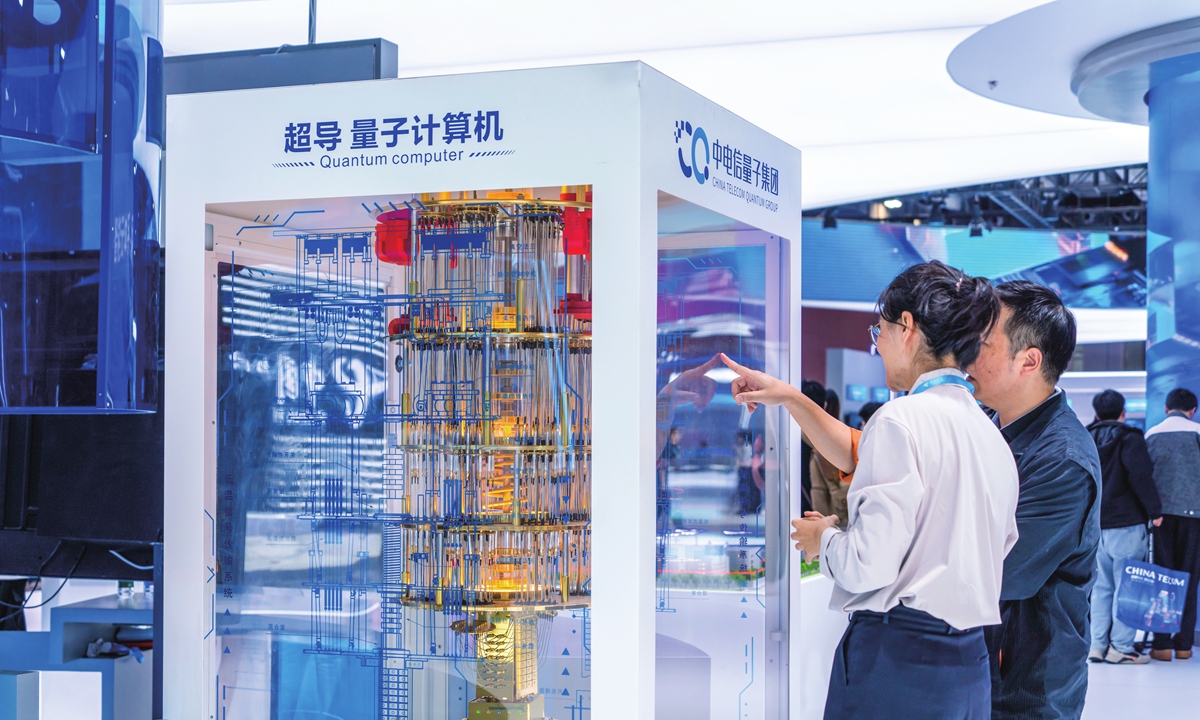
Audiences observe a superconducting quantum computer at the Digital-Intelligent Technology Ecosystem Conference 2025 in Guangzhou, Guangdong Province, on December 5, 2025. Photo: VCG
The EU has reportedly singled out Chinese suppliers from procurement in its freshly unveiled initiative to develop its quantum sector. Chinese analysts and industry insiders said that the move is blatant discrimination against Chinese companies and reflects a growing trend in the EU to politicize trade and economic matters. Excluding Chinese suppliers that can offer cost-effective solutions may slow the EU's quantum development, they warned.
On Wednesday, the European Commission unveiled the Quantum Act, a framework aimed at converting Europe's quantum research into products and services.
The act is intended to bolster European quantum research and industrial capacity, catalyze investment in public procurement while supporting European companies, the European Commission said in a post.
"Given the possible impact of quantum technologies for security and the Union's strategic interests and technological autonomy, it is necessary to restrict procurement procedures to products, systems and services that are provided by Union controlled entities," the draft legislation said, per Reuters.
It said entities from third countries with which the EU has a respective reciprocal partnership as well as those signed up to the World Trade Organization's general procurement agreement could also bid for tenders.
As the WTO agreement on procurement does not include China, Chinese companies are set to be excluded, according to the SCMP.
Chinese analysts criticized the EU plan, which they said is outright protectionist.
The exclusion of Chinese companies is outright discrimination, and the EU has in recent years rolled out similar regulations that on the surface claimed to be fair and open but in reality, contained provisions that target Chinese companies, Huo Jianguo, a vice chairperson of the China Society for World Trade Organization Studies in Beijing, told the Global Times on Thursday.
Quantum technology is a nascent industry that major powers have heavily invested in. Exclusive measures against Chinese companies will inevitably undercut the international cooperation essential to the sector's development. "Discrimination against Chinese firms will only hold back the EU's own progress in quantum technology," Huo said.
In a statement responding to Global Times inquiry on Thursday, the China Chamber of Commerce to the EU (CCCEU) acknowledged the necessity of the EU's push to build a domestic quantum industry and secure its supply chains. The CCCEU noted, however, that the quantum technology is still at an early stage of industrialization and depends heavily on global research collaboration and division of labor along the industrial chain. As such, exclusionary procurement rules risk forming closed technological blocs and driving up the cost of innovation, the CCCEU said.
It should be noted that the procurement-access arrangements currently apply only to specific public procurement covered by the act, which is still under legislative review and leaves room for further consultation, the CCCEU said. "We call on the EU to adhere to the principles of reciprocity and non-discrimination, properly balance industrial security with open cooperation, keep channels for market-oriented procurement and research exchanges between China and the EU open, avoid bloc-based fragmentation in frontier technologies, and jointly safeguard an open global innovation ecosystem."
Quantum equipment from China offers advantages in terms of performance specifications and cost-effectiveness, Guo Guoping, director at the Anhui Quantum Computing Engineering Research Center, told the Global Times on Thursday.
"The EU is not a monolithic bloc, so while Chinese firms might miss out on certain government incentives within the EU, they can still compete effectively by offering high-quality, affordably priced products, much like the case with new-energy vehicles," the expert said.
In the long term, Chinese quantum computing companies should prioritize independent, self-reliant technological development. They should also focus on fostering cooperation, exchange and ecosystem-building with countries in the Global South, Guo said.
It is essential to fully leverage China's comprehensive industrial supply chain, manufacturing capabilities, and cost advantages, while also tapping into the vast user bases and markets found both within China and across the Global South, noted Guo.
The EU is home to 32 percent of the world's quantum companies, higher than 25 percent in the US and 5 percent in China. It trails, however, in terms of quantum patents, with the bloc accounting for just 6 percent compared with 23 percent in the US and 46 percent in China, according to a report last year from the EC.
Since the beginning of this year, the EU has introduced revisions to the Cybersecurity Act, the Industrial Accelerator Act and the Public Procurement Act. Under the pretexts of cybersecurity and industrial development, the bloc is pursuing protectionism by repeatedly introducing discriminatory provisions and continuously tightening market access conditions, He Yadong, a spokesperson of China's Ministry of Commerce, said on September 17.
China urges the EU to abide by WTO rules, keep its market open, revise these discriminatory provisions in the proposed legislation, and create a fair, transparent and non-discriminatory business environment for companies investing and operating in the EU, He said.
RELATED ARTICLES