China's industrial profit growth hits five-month high as high-tech manufacturing leads gains
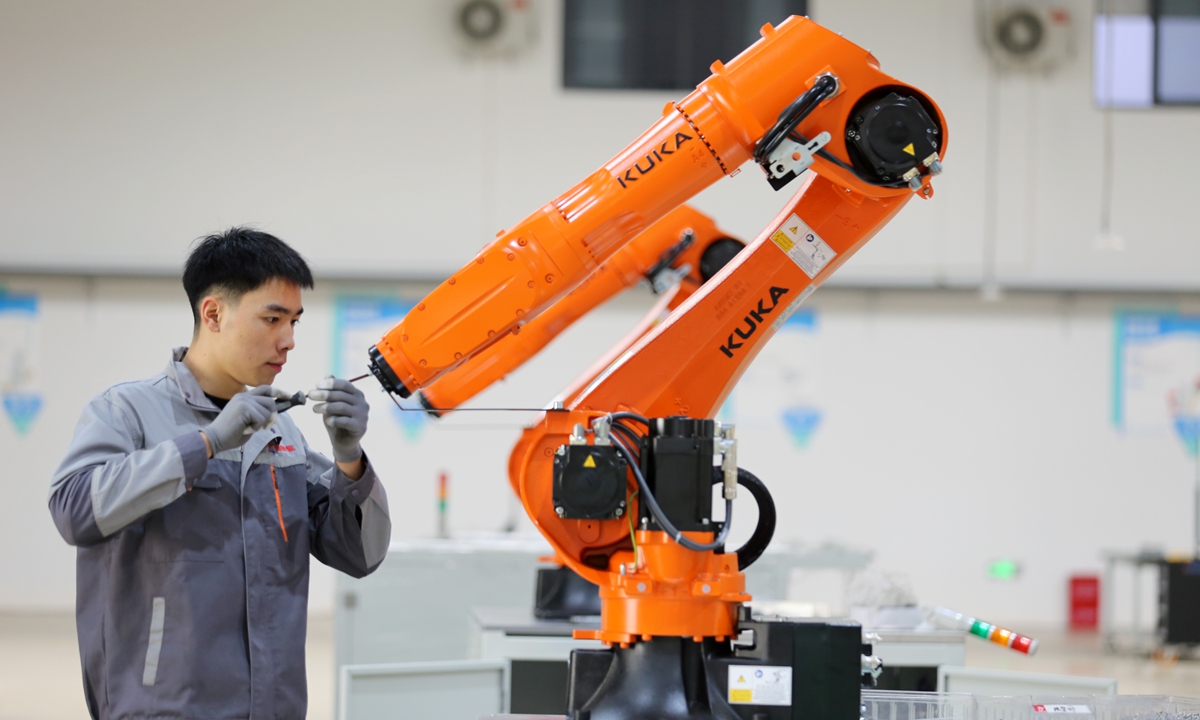
A technician tests an industrial robot at a manufacturing workshop in Leshan, Southwest China's Sichuan Province, on November 12, 2026. Since the start of the fourth quarter, local authorities have stepped up efforts to improve the business environment and enhance support services to help companies meet their full-year targets. Photo: CNS photo
China's industrial profits grew at their fastest pace in five months in October, official data showed on Friday. High-tech manufacturing continued to lead profit growth in the first 10 months, highlighting the growing economic contribution of technological innovation and industrial upgrading.
As the first year of China's 15th Five-Year Plan (2026-30) draws to a close, the changing composition of industrial earnings points to a broader shift in the country's growth drivers, with emerging industries increasingly delivering tangible economic returns and laying the groundwork for growth in 2027, experts said.
Large industrial enterprises above designated size recorded combined profits of 6.74 trillion yuan ($1.01 trillion) in the first 10 months of the year, up 16 percent year-on-year, with the growth rate accelerating by 0.5 percentage points from the first nine months, according to the National Bureau of Statistics (NBS). In October alone, profits rose 20.1 percent year-on-year, up from 14.4 percent in September.
Operating performance also improved. Revenue growth reached 6.7 percent, and the profit margin rose by 0.45 percentage points to 5.69 percent. Costs per 100 yuan of operating revenue fell by 0.42 yuan.
Su Jian, director of the National Center for Economic Research at Peking University, told the Global Times on Friday that the latest figures point to a reversal of the downturn in industrial earnings seen in recent years. "The rebound has been driven by rising demand for artificial intelligence (AI) computing power, a recovery in industrial product prices and a relatively low base from a year earlier," he said.
Profits in high-tech manufacturing surged 50.9 percent in the first 10 months, outpacing overall industrial profit growth by 34.9 percentage points. Profits in the electronics industry doubled year-on-year, contributing 9.7 percentage points to overall industrial profit growth, according to the NBS.
Song Ding, a senior researcher at the China Development Institute, a Shenzhen-based think tank, told the Global Times on Friday that the strong performance of high-tech industries reflects a broader shift in China's growth drivers. As traditional sources of growth, such as property and infrastructure weaken, emerging industries are playing an increasingly important role in sustaining economic expansion, backed by policy support and demand from both domestic and overseas markets.
Growing demand for AI computing power has boosted earnings across industrial supply chains. Profits in computer system manufacturing jumped 410 percent, while the large-scale construction of AI computing centers drove profit growth in optical fiber and optical cable manufacturing by 670 percent and 150 percent, respectively, Yu Weining, chief statistician at the NBS' industrial statistics department, said in an accompanying analysis.
Rapid growth in the AI and new-energy industries has driven strong demand for metals such as copper and aluminum and pushed up their prices. Profits in nonferrous metal mining and nonferrous metal smelting and rolling rose 60.2 percent and 71.7 percent, respectively, Yu said.
China's comprehensive industrial system allows new demand to generate profits at multiple stages of domestic supply chains, Su said, while its vast domestic market provides ample opportunities for the commercial application of new technologies.
AI is also changing the economics of manufacturing itself. Song noted that the growing use of AI and robotics on factory floors is enabling manufacturers to produce more at lower costs. With the large-scale industrial adoption of AI still in its early stages, there is considerable room for further productivity gains.
Despite a decline in overall fixed-asset investment, investment in electronic circuit manufacturing and integrated circuit manufacturing rose 59.6 percent and 13.8 percent, respectively, in the first 10 months, according to NBS data released on November 16.
Maintaining investment in high-tech industries, from research and development to manufacturing, is crucial for China to stay competitive amid intensifying global technological competition, Song said. He added that as technological advances expand China's capacity to produce goods and services, greater economic benefits could be realized by ensuring that productivity gains are more widely shared.
China's manufacturers are increasingly competing on the strength of their technology and supply chains rather than primarily on cost. Industrial upgrading and trade diversification are helping to reduce exposure to risks in individual overseas markets, according to Su.
Both experts noted, however, that stronger overall industrial earnings do not mean that businesses across all sectors are benefiting equally. The next priority is to extend the recovery in profitability to more industries and translate stronger corporate earnings into higher household incomes and consumption, they said.
China has been taking steps to stimulate domestic demand and improve the business environment. Its 2026 consumer goods trade-in program, covering products ranging from automobiles to home appliances and smart devices, is aimed at boosting consumer spending and generating additional demand for industrial products.
Li Zhen, vice chairman of the State-owned Assets Supervision and Administration Commission of the State Council, attended a meeting on business integration among centrally administered state-owned enterprises (SOEs) on Friday. Li called on the SOEs to consolidate and streamline business segments with overlapping operations, excess capacity or low-price competition, the Securities Times reported.
Looking ahead, Su said a sustained recovery in industrial profits could give businesses more room to invest and innovate, helping build momentum for economic growth in 2027.
RELATED ARTICLES