Chinese chipmakers, AI model companies urged to join hands from the very beginning to overcome development hurdles
Closer chip-model coordination
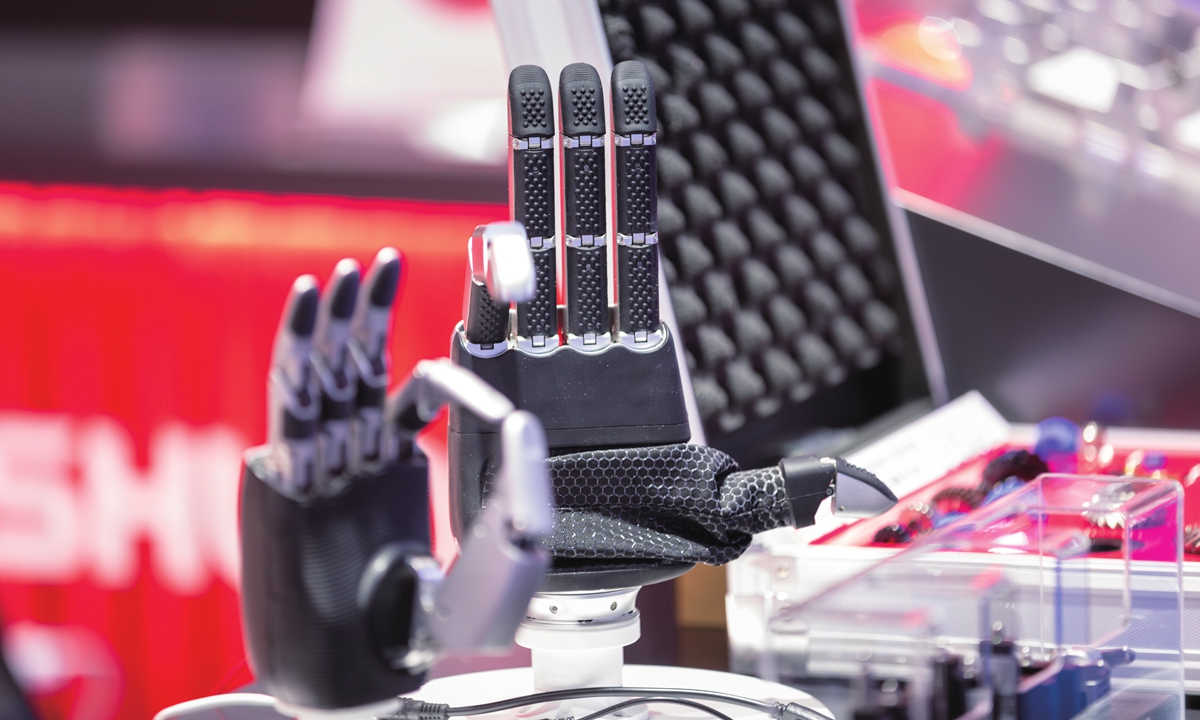
A dexterous robotic hand is on display at the 23rd China International Semiconductor Expo in Beijing, on November 12, 2026. The exhibition showcases core segments across the entire semiconductor industrial chain, including equipment, materials, design, manufacturing, and packaging and testing. Photo: VCG
How quickly can domestically-made chips support a homegrown AI model? For SenseTime's latest model, support was available from launch: more than 10 Chinese chipmakers completed the so-called "Day 0" adaptation for SenseNova Loop-9B, showing that the country's AI industry is moving beyond isolated breakthroughs toward closer coordination between hardware and software developers.
SenseNova Loop-9B was released on November 17. Domestic computing platforms from Biren Technology, Cambricon, Hygon, Kunlunxin, Moore Threads, MetaX, as well as Huawei's Ascend, were adapted on the day of the model's release, enabling it to run on a wider range of domestic computing platforms.
The development comes as Washington expands restrictions on China's access to advanced chips, even extending controls to cover some overseas data centers that supply significant computing capacity to Chinese companies. For example, Nvidia said it was not assuming any data center computing revenue from China in its fourth-quarter outlook.
Yet domestic model developers and chipmakers are working together to keep models running, improve performance and integrate AI into more industries. The shift matters not simply because more chips would support a new model, but because hardware and software adaptation is taking place earlier in the development cycle.
Now, market demand for AI computing is growing rapidly. The China Academy of Information and Communications Technology (CAICT) projected China's intelligent computing service market will exceed 130 billion yuan ($19.51 billion) in 2025. Average daily token consumption in China surged to approximately 500 trillion in June 2026, nearly four times the level recorded in December 2025, reflecting the rapid expansion of AI applications and growing inference demand.
Ecosystem coordination
"Day 0" adaptation allows a chip platform to support a model from the very beginning. It is not plug-and-play: different chips still require optimization for operators, memory and parallel computing. But it can shorten the path from model launch to customer testing.
The challenge is daunting. CAICT said that chip architectures and software ecosystems remain relatively closed, making it costly for enterprises to move models between computing platforms. It identified heterogeneous-chip compatibility as a major obstacle to more flexible use of AI computing resources, Chinese experts noted.
Chen Jing, vice president of the Technology and Strategy Research Institute, told the Global Times that China's AI industry was entering a stage of systematic hardware-software coordination.
Model developers are increasingly optimizing models around domestic chips' computing operations, memory and interconnection characteristics, while chipmakers are bringing drivers, compilers, operator libraries and parallel-computing strategies into the model release process, Chen said. The goal is to achieve reliable performance at a lower cost and with less maintenance, he said.
Ma Jihua, a veteran technology industry analyst, told the Global Times that domestic chips and AI models could meet market demand. As customers adopt domestic platforms, real-world feedback can help improve chip performance, software compatibility and system stability, Ma said.
Ma said that some domestic computing clusters established workflows covering pre-training and post-training, while cloud service providers and AI developers were showing greater interest in building computing centers using domestic chips. A larger inference market could generate revenue, application experience and customer demand to support the development of mid- and high-end training chips.
The shift gives customers more choice: if one model runs on several domestic platforms, businesses are less likely to be locked into one hardware supplier or software ecosystem. Therefore, interoperability and cross-vendor cooperation become more valuable.
Restrictions spur innovation
The push for closer domestic cooperation is unfolding as US chip controls disrupt the supply chain. A rule issued by the US Bureau of Industry and Security on November 19 requires licenses for certain transfers of advanced chips to overseas data centers that supply significant volumes of compute to companies headquartered in destinations including the Chinese mainland and Macao.
In its November 17 results announcement, Nvidia forecast its fourth-quarter revenue to reach $130 billion, but said the outlook assumed no data center computing revenue from China. The guidance underscores uncertainty surrounding access to US-based advanced chips, industry observers noted.
However, domestic chips are increasingly used in AI model training. Zhipu AI offers a good example of domestic alternatives being tested at scale. The company, whose affiliates were added to the US Entity List in January 2025, said its GLM-5.3-Flash model ran entirely on a cluster of 100,000 domestically produced chips during a stealth trial. The model processed 62 trillion tokens before its formal release, according to Zhipu.
Chen said the current wave of "Day 0" adaptation helps improve access to computing resources for inference. Training models with extremely large parameter counts requires enormous computing capacity, high-bandwidth memory, advanced packaging, and high-speed interconnection among processors.
But Ma cautioned that closer coordination and integration may not be enough to eliminate China's overall computing gap overnight.
AI and semiconductors are global industries, and no economy has traditionally controlled every link of these industries' supply chains. Restrictions have raised uncertainty and costs, but also encouraged Chinese firms to coordinate investment and address weaknesses, Ma said.
China's task now is to turn faster AI adaptation into reliable performance, cut costs and sustain market demand, and do its utmost to produce advanced chips, software, and manufacturing equipment, Ma said.
RELATED ARTICLES