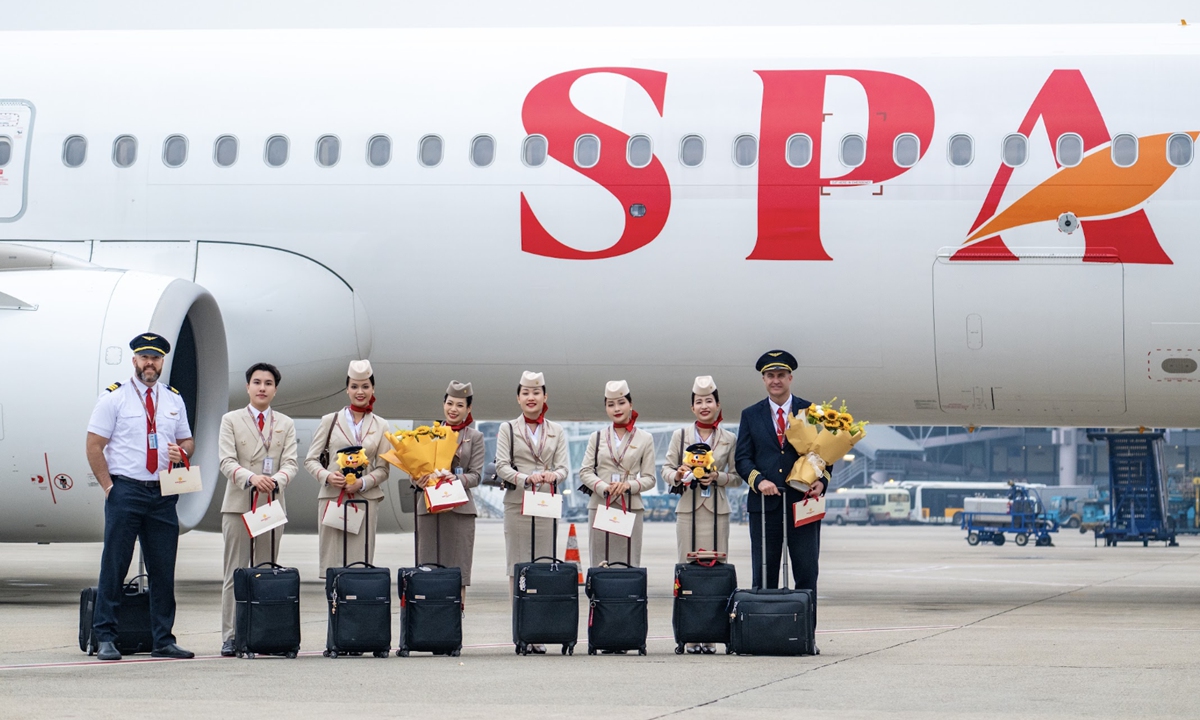
Photo: Courtesy of Sun PhuQuoc Airways
China Eastern will launch a thrice-weekly Fuzhou-Singapore service on December 12, the second nonstop link between Fuzhou and Southeast Asia, after the carrier opened its Fuzhou-Kuala Lumpur route in December of last year.
The launch is the latest in a wave of new China-Southeast Asia flights by carriers on both sides, as travel demand and visa-free policies drive capacity growth.
Sun PhuQuoc Airways began nonstop Shanghai-Hanoi flights on November 27, its fourth route to the Chinese mainland after Chengdu-Ho Chi Minh City, Chengdu-Phu Quoc and Shanghai-Ho Chi Minh City. The service is also the Vietnamese carrier's third international route out of Hanoi, following Seoul and Hong Kong, extending its international network from the capital.
The new route comes as trade and tourism ties between Vietnam and China continue to deepen.
China is Vietnam's largest trading partner, with annual two-way trade exceeding $200 billion. The Yangtze River Delta, anchored by Shanghai, plays a significant role in investment and supply chains and has close links with northern Vietnam's industrial hubs, including Bac Ninh, Hai Phong and Thai Nguyen, according to the information the carrier shared with the Global Times.
Vietnam is exceptionally well positioned to respond to these changing expectations, with its rich culture, diverse destinations and wide range of tourism experiences. Bringing Vietnam's tourism industry closer to the Chinese market therefore creates meaningful opportunities not only for travelers, but also for tourism businesses and industry partners in both countries, according to Simon Peachey, the Regional Chief Operating Officer for China, Australasia and RCIS at VFS Global.
The Vietnam National Authority of Tourism (VNAT), in partnership with VFS Global, recently hosted a tourism promotion conference in Beijing, vowing to further promote China-Vietnam tourism exchange and cooperation.
Data from VNAT showed that China remains Vietnam's largest source market for international tourists. In 2025, Vietnam welcomed over 5.28 million Chinese visitors, an increase of 41 percent year-on-year. In the first 10 months of 2026, Vietnam received approximately 4.4 million Chinese visitors—accounting for about 22.5 percent of the total number of international arrivals—a figure exceeding that of the second-largest source market by more than 1 million.
The Vietnam route is one piece of a wider winter-season build-out. Under the 2026-27 winter timetable, which runs from October 25 to March 27, carriers on both sides have continued to boost frequency on China-Southeast Asia routes.
Beyond Fuzhou, China Eastern is adding flights from Shanghai to Bali, Male, Bangkok and Chiang Mai. Shanghai-Bali will gain an extra daily flight from December 17, and Shanghai-Male will go daily from January 22, 2027.
On August 20, China added Kyrgyzstan and Vietnam to its 240-hour visa-free transit program, bringing the total number of countries eligible for this policy to 57. These measures are part of China's broader efforts to boost international travel and exchanges.
Global Times