
HOME >> BUSINESS
More Chinese investors eye North Korean market amid stable political, economic climate
By Huang Ge and Chi Jingyi Source:Global Times Published: 2019/7/2 22:08:40
Stable political, economic climate adds to attraction
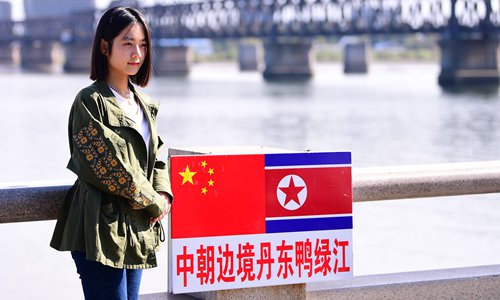
A tourist takes a photo near the border between China and North Korea in Dandong, Northeast China's Liaoning Province in October 2018. Photo: VCG
An increasing number of Chinese entrepreneurs have been eyeing the North Korean market since last year after it vowed to boost economic growth as a top priority, with corporate representatives saying that rich resources, stable political and economic environment and labor advantages are major attractions.
More representatives of Chinese businesses have gone to North Korea to seek opportunities and more interest could be sparked as a result of the historic meeting between the leaders of North Korea and the US over the weekend, according to insiders.
US President Donald Trump met with North Korea's leader Kim Jong-un on Sunday and became the first sitting US president to visit North Korea, though very briefly, sending signals for easing tensions between the two countries.
After the meeting, Chinese investors may be even more eager to tap into opportunities in the North Korean market, a tour organizer who organizes Chinese business delegations to North Korea, told the Global Times on Tuesday.
Most Chinese entrepreneurs know little about the country and hope to get more information such as investment policies, cooperation projects and business environment through first-hand observation, said the organizer, who requested anonymity.
"We organized such trips every month from February to May and we will hold one in July and another in September. One group consists of at least 10 people," she said. "By comparison, we only organized two trips a year to North Korea in the past," she said.
The five-day trip, which costs no more than 20,000 yuan ($2,907) per person, starts from Beijing. Most of the trip is spent in the capital of Pyongyang, and members meet local officials to learn about foreign investment policies.
"Chinese investors in North Korea are mainly private enterprises and individuals," an investor in North Korea who asked to remain anonymous told the Global Times on Monday.
"There are many favorable factors for investing in North Korea. For example, its domestic political environment is stable, and the state implements a high degree of unified governance over the social, economic, cultural and other fields," said the investors, who started doing business in North Korea in 2004 and has invested in mineral resources and light industry.
The national planned economic management system makes North Korea less vulnerable to global economic fluctuations. There are few taxes and the rates are low, he said. "Labor costs are low and a relatively high level of education, as well as a strong work ethic."
The investor said that North Korea has geographic advantages as it is close to China, South Korea, Japan and the Russian Far East. There are 600 million people living near North Korea within a radius of 1,000 kilometers and 1.5 billion people within a radius of 2,000 kilometers.
Chinese investors who are interested in North Korea are from varied sectors including power equipment, cable and cultivation, as well as highly specific segments like marble-cutting blades.
In the past, light industries such as textiles predominated, according to the tour organizer.
"According to my communications with North Korean companies, they are willing to cooperate since they can obtain capital and technology from tie-ups with Chinese companies," she said.
Before 2004, investments in North Korea mainly came from ethnic Korean entrepreneurs and enterprises based in Northeast China, which is close to the country, industry insiders said, noting that Chinese capital entered a period of rapid growth in North Korea after 2004.
Since 2016, investment of Chinese enterprises has encountered great difficulties due to the increasingly severe UN economic sanctions on North Korea, and some companies were forced to suspend production in the country.
In April 2018, North Korea announced that it would make economic growth the nation's new top priority, and it would immediately suspend nuclear and missile tests and dismantle its nuclear test site.
After the policy was announced, North Korea maximized the potential of the domestic market, released its impetus and comprehensively promoted the "socialist enterprise management responsibility system," the senior investor said, adding that North Korea aims to attract more foreign funds by setting up more than 20 special economic zones.
Newspaper headline: More Chinese investors eye NK
Posted in: MARKETS,BIZ FOCUS