Global backing gives Myanmar chance to solve ethnic crisis
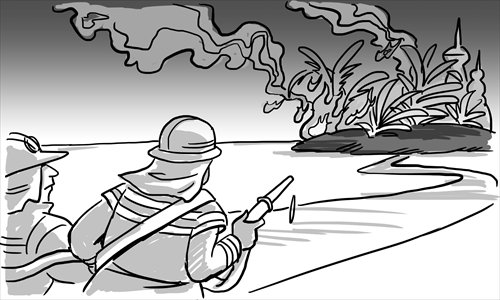
The ethnic violence between Buddhist Rakhines and Muslim Rohingyas in western Myanmar, which initially erupted in June, has not abated. The simmering tension erupted again on October 21. The government said on October 31 that 89 people were killed, 136 injured, more than 32,000 made homeless, and more than 5,000 houses were burned down between October 21 and 30.
Questions have been asked as to why the conflict has not been resolved when Myanmar has overwhelming support from the international community, from East to West, to do so. Is it because the government has no serious intention of resolving the conflict, or is it because the government does not have adequate resources or experience to handle such violence?
Recent developments indicated that both the Rakhine state and the central government have taken certain initiatives to end the violence, including the state government's use of article 144 of the criminal code of law, a colonial-era law which allows wide-ranging measures such as curfews, in some townships, and President Thein Sein's declaration of a state of emergency. But are such measures enough?
Both in Rakhine state and elsewhere, the conflicts are a consequence of inherent ethnic problems that successive central governments have failed to address since independence in 1948.
The complexity of the Rohingya problem fundamentally lies in the fact that Rohingyas are not considered citizens of Myanmar. This makes the case unique. While other ethnic minorities demand autonomy under a federal system, the Rohingyas struggle to be recognized as a national ethnic group.
Some have suggested that had Thein Sein resolved the Rohingya problem, he could have won a Nobel Peace Prize. Others opine that the opposition leader, Aung San Suu Kyi, has rarely spoken about the conflict due to fears of a backlash in the upcoming 2015 general election.
While the conflict in Rakhine state should not be viewed as an opportunity for individual glory or for acquiring political advantage, both Thein Sein and Suu Kyi have important roles to play in the emergence of a durable solution.
Many in the country, including the Rakhine people, cannot accept Rohingyas as fellow citizens of Myanmar. In fact, the government uses the term "Bengali" to refer to them. Under such circumstances, is there room for dialogue? If so, where to begin?
Another broad perception inside Myanmar is that the Rohingyas are illegal Bengali migrants from neighboring Bangladesh. However, such assertions are rejected by Bangladesh, which already hosts about 300,000 Rohingyas as refugees inside its territory.
The governments of Myanmar and Bangladesh should promote dialogue to address the issue amicably. If no bilateral agreement can be reached, perhaps both governments could approach a neutral party such as the UN for mediation or for alternative arrangement.
Thein Sein once suggested resettling the Rohingyas to third countries, which was rejected by the UN's High Commissioner for Refugees Antonio Guterres. Recently, Tomas Ojea Quintana, the UN special rapporteur on human rights in Myanmar, suggested that the government should pursue a policy of integration and reconciliation between the Rakhine and Rohingya groups.
International institutions could offer suggestions but ultimately the responsibility lies with the Myanmar government. If no third country comes forward to accept the Rohingya population, the government of Myanmar will have to come up with some sort of solution now or later.
What the Thein Sein administration and the national parliament could do is to review both previous and existing citizenship laws to assess the conditions under which citizenship can be granted. Those eligible people should not be denied their citizenship rights.
Suu Kyi could use her status as the opposition leader and chair of the parliamentary rule of law committee to help advance the reconciliation process. Such an initiative should be supported by other committee members and the parliament.
This reconciliation program will succeed only when the Rakhines and the Rohingyas are willing to compromise on their differences by respecting each other's identity. More importantly, the Myanmar government must be ready to embrace the Rohingyas if any genuine reconciliation is to be realized.
Myanmar has adequate resources and experience to handle ethnic violence. Ethnic conflicts in Myanmar remain unresolved largely because of the indifference and lack of commitment toward minority problems by successive central governments.
The problem in Rakhine state needs to be addressed simultaneously with ethnic problems in other parts of the country. As Myanmar begins to experience a fledgling democracy, the international community should continue to extend support and provide necessary assistances.
While the international community is rallying behind its democratic reform process, Myanmar should seize the opportunity to address the inherent problems of ethnic minorities, including tackling the Rakhine issue.
The author is general secretary of the US-based Kuki International Forum. opinion@globaltimes.com.cn