Scots ponder future of not-so-UK
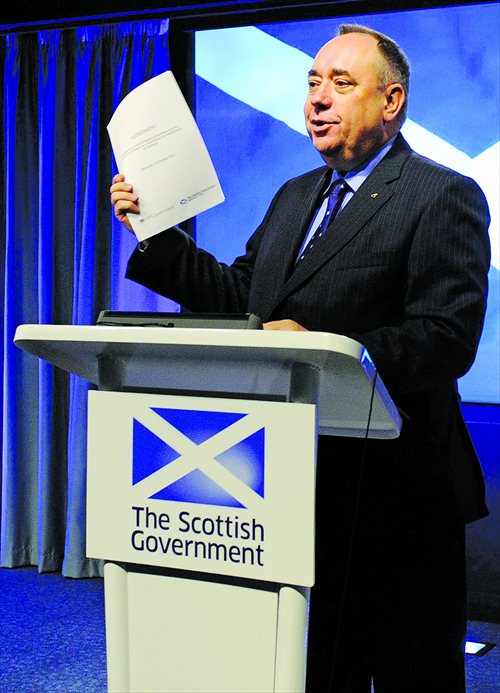
The proposed Scottish referendum question was submitted to the Electoral Commission watchdog for scrutiny on Friday.
The Scottish government wants to ask voters in the 2014 referendum, "Do you agree that Scotland should be an independent country?" The final wording will come before Holyrood, Scotland's parliament, in spring 2013.
"This marks another major step towards completing the referendum process," the Scottish Herald quoted Blair Jenkins, chief executive of pro-independence campaign Yes Scotland, as saying.
The historic Scottish independence referendum agreement was struck in Edinburgh on October 15.
Britain's Prime Minister David Cameron and Scotland's First Minister Alex Salmond signed the agreement, beating the drum for the most important vote in the 305-year history of the UK. The Act of Union in 1707 bound the kingdoms of England and Scotland.
Salmond, the 57-year old leader of the Scottish National Party (SNP), considered it a "historic day for Scotland" as it paves the way for "the most important decision our country of Scotland has made in several hundred years."
Cameron strongly opposes a Scottish breakaway, and he passionately believed "Scotland will be better off in the United Kingdom but also, crucially, the United Kingdom will be better off with Scotland." However, he also said he always wanted to show respect to the people of Scotland.
Dismantling of marriage
Though it has less than a 10th of Britain's population, Scotland enjoys significant autonomy. Cries for independence have been getting louder after the discovery of oil in the North Sea in the 1970s. Around 90 percent of Britain's oil and natural gas reserves lie off the east coast of Scotland.
For some, the oil boom offset the idea that independence would lead to a poorer Scotland. It invigorated the revival of nationalists and the pro-independence SNP's rise in power. The party won its first election in 2007 and became the first party to win an overall majority at Holyrood in the 2011 poll. Salmond claims Scotland would take control of 90 percent of the North Sea fields after independence, helping it to become one of the world's richest countries.
This is strongly disputed by the UK government, which argues that the fields were developed with British money, not Scottish. The Orkney Islands, the area closest to the oil fields, has also threatened to side with the UK.
"The purpose of independence is to make Scotland more successful and to improve the lives of people who live in Scotland," Angus Robertson, a British MP and SNP Campaigns Director, told the Global Times, adding that the key difference would be that all decisions for Scotland would be taken by a Scottish parliament and a Scottish government, and in Scotland's interests.
Robertson said that SNP has made huge achievements in many areas including free personal care, maintained 1,000 extra police officers on streets, seeing crime at a 37-year low and generating 35 percent of electricity from renewable sources.
Alex Salmond managed to get a compromise by the coalition government to allow 16 and 17 year olds to take part for the first time in a UK poll. The SNP believes that younger people are more likely to vote "Yes Scotland" because they hate rules.
According to Robertson, a recent Panel base poll in the Sunday Times put support for independence at 37 percent, rising to 44 percent under the scenario of a Labour government at Westminster, and 52 percent under a Tory government. "The Yes campaign can and will win the argument for independence, and if we win the argument we will win the referendum in autumn 2014," he said with confidence.
The referendum year of 2014 is significant as it is the 700th anniversary of the Battle of Bannockburn, a monumental victory for the Scottish forces of Robert the Bruce in a war popularized by the movie Braveheart, it is believed to be a time when Scottish nationalism is likely to be especially high, therefore increasing the chances of independence.
Hard to say goodbye
The referendum "in Scotland's interest"possibly heralds the start of the biggest shakeup in the UK since Irish independence in the 1920s. But it's hard to break up with the intertwined 300 years history.
Despite Alex Salmond trying to convince his people, all of polling organizations of YouGov's evidence from the past four years is that independence is a minority passion north of the border, according to the Guardian newspaper.
A recent Ipsos MORI poll of 1,000 Scots, the first poll since the deal, reveals that support for independence stands at 30 percent among those certain to vote, down from 35 percent in June, while some 58 percent of those polled supported staying in the union.
"The main argument against independence is that Scotland had greatly benefited from the security and prosperity that has come with the Union, and that it would be worse off if separate," Professor Malcolm Chalmers, Research Director at the Royal United Services Institute for Defense and Security Studies in London(RUSI), told the Global Times.
"If Scotland were to become independent, it would have profound implications for the UK. Although less than 9 percent of the population, Scots have always played an important role in public affairs and enterprise; and the very concept of 'British' depends on the inclusion of Scotland. The country that remained would still be the UK, but it could not be Britain," Chalmers added.
Three days after the seal of the referendum, the Foreign and Commonwealth Office warned that an independent Scotland could pose a "short-term risk" for enemies to exploit perceived uncertainty in UK foreign policy.
Besides, it would "harm the Scottish economy" by withdrawing Scotland from the UK's 14,000 treaties and global network of foreign investors, according to the statement.
Rob Shorthouse, Director of Communications at Better Together Ltd., told the Global Times that "We believe that abandoning 300 years of shared history would be extremely damaging for Scotland and for the UK as a whole. At a time of economic uncertainty, we do not think it is right to gamble with our nation's future."