Bling bling in Beijing
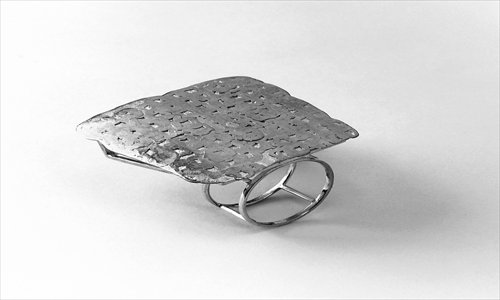
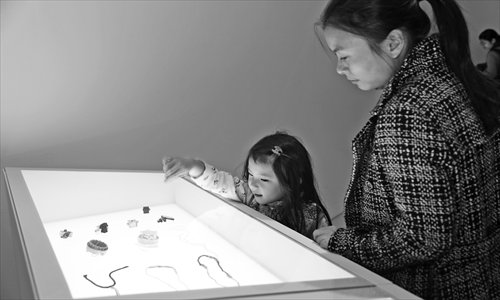
China is a country with a rich jewelry history, as evident upon visiting museums that exhibit ancient jade and silver ornaments. But the country's creation of contemporary jewelry is a less sparkling affair, having only begun a decade or so ago. A month-long contemporary jewelry exhibition titled "10 years Re: Jewelry" that opened Sunday at Central Academy of Fine Arts (CAFA) Art Museum examines the progress that has been made by Chinese jewelry designers, while also acknowledging styles of their foreign counterparts. The exhibition includes the works of 40 Chinese artists, all who are graduates of CAFA, as well as those by 24 mainly European foreign artists.
"We hosted this exhibition not only to summarize the history of the jewelry program over the past 10 years at CAFA, but also to introduce foreign contemporary jewelry art to Chinese people," said Teng Fei, a professor at CAFA and curator of the exhibition.
Journey over time
CAFA students began learning to design and make contemporary jewelry 10 years ago, when Teng became the academy's first jewelry teacher.
"We started from humble beginnings, so I have meticulously chosen 40 of the best graduates over the past decade to show how jewelry design has developed," said Teng.
Contemporary jewelry typically differs from traditional jewelry in its materials. Precious stones can be used, but often so are less orthodox materials, such as donkey skin and glass.
As contemporary jewelry is not considered a commodity compared to its more valuable, traditional form, it often focuses on artistic expression rather than appealing to the customers' taste for extravagance.
For example, Yin Xiangkun's Survival of the Fittest made in 2010 incorporates materials such as crystal, enamel and walnuts to create different shapes of fish that symbolize people.
Teng pointed out that students have become more discerning in their choice of materials over the past decade, adding that their works have also improved in quality.
"Students previously liked to contemplate grand social matters, whereas now young students are paying more attention to their personal feelings when designing jewelry," said Teng.
Wang Qian's Growing Red made in 2004, carved of resin, gold and red fibers, aims to convey that man is an integral part of nature.
Zhang Fan said her 2006 work Prolification, made of bronze, gold and agate, shows the different stages of life, yet also represents traditional Chinese metal processing techniques.
Foreign influences
Teng said although an increasing number of young students have personal inspirations reflected in their works, there are still people who stick to more serious, in-depth themes that aim to be thought-provoking to their audience.
Foreign artists' works at the exhibition offer insight into the history of contemporary jewelry outside of China from the 1930s to nowadays.
An egg-shaped brooch made of gold, silver and bronze created by Franceso Pavan, 75, from Italy, is shown at the entrance. Pavan remains one of the most important pioneers of contemporary jewelry.
Teng pointed out that jewelry by Italian artist Stefano Marchetti, 42, a student of Pavan's, is also exhibited.
Marchetti inherited his teacher's metalworking technique, which he considers the best processing technique in contemporary jewelry.
Jewelry by Dutch artist Ruudt Peters spanning from the 1970s to today is also on show.
"I asked him [Peters] to bring lots of his works because of his prominent role in contemporary jewelry. Audiences can see the development of contemporary jewelry through his works from different periods," said Teng.
Not all foreign artists are from Europe, however. Noon Passama, 29, a Thai jewelry designer, was also invited to showcase his brooch and necklace made of calf skins.
When: Until September 9
Where: CAFA Art Museum, 8 Huajiadi Nanjie, Chaoyang district
Admission: Free
Contact: 6477-1575