Tragedy without tears
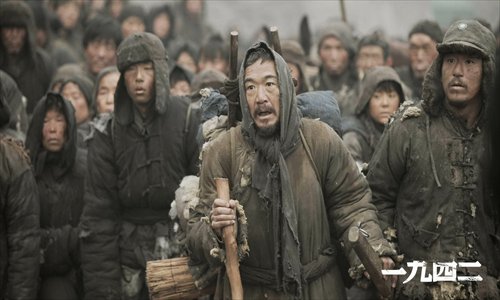
"It has been so many years and you want to write such a wretched thing. What do you want?" This is the last voice-over in Back to 1942, the latest film by domestic director Feng Xiaogang.
In the year 1942, the most serious and urgent issue for the 10 million people in China's Henan Province was how to feed themselves. Following a severe drought, a locust plague came. In less than a year, according to historical records, some 3 million people died from famine.
Yet, few people, amazingly even many victims who lived through it, still remember this tragedy.
Adapted from Liu Zhenyun's 1992 novel Wengu 1942, the film Back to 1942 reflects the widespread disaster mainly through the experiences of two families: the family of Fan, a former landlord; and the family of Xialu, Fan's tenant. Also, there are scenes depicting the reactions of the Chinese government and some foreigners.
On the way to Shaanxi Province, in an attempt to flee the famine, the two families find nothing but more famine. Moreover, they lose almost everything along the way.
Back to 1942 is a very different work for director Feng Xiaogang, who is more well-known for comedies like The Dream Factory (1997) and If You Are the One (2009).
Although Feng's 2010 work Aftershock, about a severe earthquake in Tangshan, Hebei Province in 1976, can also be labeled as a disaster film, Back to 1942 offers a better analysis on Chinese people's humanity.
In Aftershock, we see people lose members of their families and yet pull themselves up again. Audiences grieve with the characters and admire their courage. Aftershock was regarded as one of the most tear-provoking films of that year.
However, it's hard for most audiences to cry after they see Back to 1942. Crying is a way to let out strong emotions, but Back to 1942 provides no such release.
Victims of the 1942 famine that we see on the screen do not cry or shout when they lose their families. They keep silent and continue walking forward, because death has become the most common thing along the road. Sometimes, they even feel happy for those who die, for they believe the quicker you leave this world, the less you will suffer.
Audiences leave the cinema also in silence, like the victims.
Another point some people mention is that Back to 1942 is braver than Aftershock, for the former is able to point out the reality of the human condition, where the latter failed.
If we think deeper, we will realize drought and locusts alone would not cause the death of 3 million people. The truth is that China had just endured almost a century of wars and was at that time in the middle of the War of Resistance against Japanese Aggression (1937-45). The Kuomintang government, the then central government, focused their major energy on fighting battles, and with a weak foundation and rampant corruption, the government could spare little money or manpower for disaster relief.
By comparison, Aftershock gives a much lighter description of the background - the earthquake occurred in the last year of the Cultural Revolution (1966-76). It was a time most Chinese people were busy either launching public criticism activities against "counter revolutionaries" and "pro-capitalist rightists," or hiding from them.
Still, Back to 1942 contains certain elements that I believe are not necessary. For example, in two explosion scenes, people are blown up to give a stronger visual impact, but it may be too graphic for many viewers, especially young ones. And in the very end, the film reveals the final fate of certain characters with written words. It seems unnecessary and redundant, since the audience can already predict their fate.
But on the whole, Back to 1942 is certainly one of the most anticipated films of this year, and it reminds audiences not to let such issues be forgotten again.