Humanity stretching earth beyond its limits
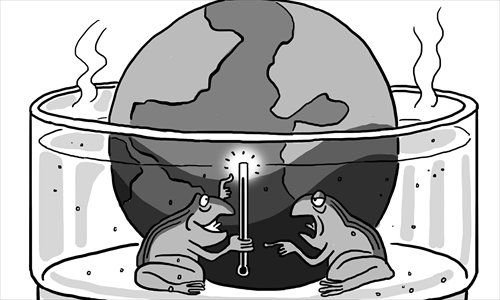
The climate conference in Doha is over. The result was, as so many times before, a disappointment. The Kyoto Protocol will continue, but we will have to wait until 2020, when a more comprehensive agreement, including all nations of the world, would come into play. That is far too late and will make it almost impossible to stay within 2 degrees Celsius of warming.
Keeping global warming within this limit is regarded by scientists as of utmost importance to keep the planet stable and thus able to support welfare and well-being in the future. The decision in Doha demonstrates once again the limitations of global governance and the need for a much more effective institutional setup at the international level.
Yet climate change is just one example of the many serious threats we pose to the complex natural systems that form the base for future welfare and well-being. We are very close to a saturation point, where the biosphere cannot handle additional stress.
There is a whole interlinked group of vital resources and processes in nature that have enabled human beings and civilization to develop, such as fresh water, forests, croplands, the oceans and biodiversity. We are now in danger of overshooting every single one, making it difficult to continue with current unsustainable lifestyles.
Moreover, the way we manage all these natural resources directly affects the climate. Resilient landscapes and marine environments are necessary to maintain carbon sinks, both with regard to keeping "old" carbon and methane stocks in the ground but, as well, to absorb parts of the anthropogenic emissions generated today.
Until the end of the 20th century the earth had a remarkable capacity to buffer the effects of human activity, like absorbing roughly half of carbon dioxide emissions, allowing apparently endless economic growth. However, this buffering capacity is weakening.
To prevent any further damage, the aim must be to strengthen the planet's resilience and its ability to continue providing a "safe space" for human development.
The concept of "planetary boundaries," elaborated on in our newly released book Bankrupting Nature, provides us with a science-based framework that can guide us through the necessary transition to sustainability. We need to adopt a more holistic approach to human development. It is no longer possible to deal with one issue at a time.
One suggestion that is often put forward is to "de-couple" the link between economic growth and the use of energy and materials, and to go for "green growth." However, this strategy also has its limitations as efficiency gains are rapidly eaten up by continued economic growth.
Resource efficiency is important. But the economy also has to be organized in a radically different way. We put forward the solution of adopting a "circular economy," based on an industrial system that is efficient and waste-free.
The circular economy would be promoted through adopting binding targets for energy and resource efficiency, increasing taxes on the use of virgin materials and lowering taxes on labor and a research policy that emphasizes sustainable innovation and design.
Such a reorientation of the production system should be beneficial to both industrial and developing countries. The prices of both energy and most commodities have increased significantly in the recent past and this development is likely to continue.
Even from a purely economic point of view a much more resource-efficient economy makes sense. The Chinese government, for instance, has been referring to the concept of a circular economy in some of its policy proposals.
While some of these changes would benefit from global agreements, the most recent failure in Doha shows the slow pace of international negotiations. Efforts to improve global governance must continue.
In the meantime we need ad hoc solutions where regions, individual governments, companies and civil society move forward and adopt sensible policies and strategies.
Countries in Asia could lead the way by adopting measures to promote a circular economy, thus showing the world a new policy direction in support of sustainability.
Johan Rockström is executive director of the Stockholm Resilience Centre. Anders Wijkman is senior advisor at the Stockholm Environment Institute, Sweden and co-president of the Club of Rome and a former MEP. The ideas in this article are developed in the recent Report to the Club of Rome Bankrupting Nature launched in Brussels. opinion@globaltimes.com.cn