Kuman nature
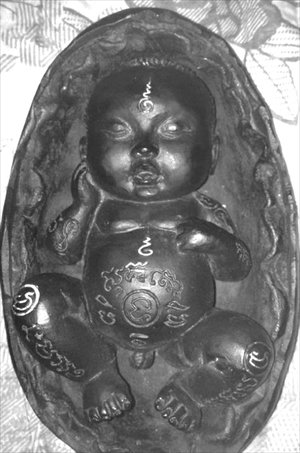
Yu Boyang's decision to "adopt" a 3-year-old "boy" from Thailand late last year was met with stiff resistance by his parents when he broke the news to them. It wasn't that they were concerned Yu, 20, was too young to be a father, but rather that his "boy" wasn't actually human - it was a kuman thong, an effigy that purportedly brings its owner prosperity.
Kuman thong, which in Thai literally means "golden boy," are believed to bring good fortune to their owners if kept in shrines at homes or businesses. Each statue is usually made and blessed by a Buddhist monk, although the ritual is considered more closely linked to Thai black magic.
In ancient times, kuman thong were made of fetuses surgically removed from a mother's womb before being roasted and covered in gold leaves, hence the translation of "golden boy."
In more modern times, kuman thong are soaked in resin oil to achieve their golden finish and fetuses are sometimes substituted with the ashes of a deceased child.
In December 2012, Yu tracked down an online dealer, surnamed Qiu, and placed his order for a kuman thong. He settled on one after viewing photos provided by Qiu and paid 600 yuan ($96.24).
Qiu used his contacts in Thailand to source Yu's desired kuman thong, which was then posted to his Beijing home in Dongcheng district.
Buying and selling products containing human ashes is illegal under Chinese law, which turns many prospective buyers overseas.
On May 17, 2012, Thai police arrested Chow Hok-kuen, a 28-year-old Taiwan man, in his Bangkok hotel room with six roasted fetuses covered with gold. Chow planned to sell the kuman thong in Taiwan for about US$6,300 each.
'Little black egg'
Yu's kuman thong contains the ashes of a deceased 3-year-old boy, but he views it as more cute than creepy.
"I don't pray to him asking for good luck. I just sympathize with him and seek to help his reincarnation," said Yu.
Yu, who works in the video game industry and lives with his parents, has a small altar at their home. Each day he burns incense, chants Buddhist scriptures and bestows it with food and drinks, much like any regular Confucian shrine.
Yu adores his 5-centimeter-long kuman thong, which he has nicknamed his "little black egg" because of its diminutive size and shape.
Yu already feels a strong telepathic connection with his kuman thong. "I feel tingling sensations in my arms, as if he wants to blow on or kiss my face," said Yu.
Like many kuman thong owners, Yu sees his talisman as a playful, innocent child. "He once wet himself," he laughed. "I picked him up and saw fluid trickling out of him."
Offering beef, alcohol or tobacco to a kuman thong shrine is taboo, Yu explained, adding that engaging in sex in its presence is also greatly offensive.
Yu, who is from a Buddhist family, said being the guardian of a kuman thong has made him a more spiritual and "compassionate" person, even if it initially caused a rift with his parents.
His parents told him to move out when he introduced them to his kuman thong, saying he could only keep one "if the family was all dead." However, gradually they have become accustomed to it and even joined in offering food at its shrine.
Quest for good fortune
Kuman thong is just one Thai, Buddhist-related custom embraced in China. Others include Somdej amulets worn to keep one safe and butterfly amulets, which are particularly popular among young women. However, only kuman thong are considered to have souls.
Amber Leung, an IT worker, owns 10 Buddhist charms, including four kuman thong. Leung claims the spirits of her kuman thong have entered her dreams, protected her from danger and even told her winning lottery numbers.
Leung, who is originally from Guangdong Province, has become an expert in the field and consults beginners interested in owning their own kuman thong.
"If you choose one with a soul, you should first consider how your family feels," Leung noted, saying that many owners recklessly discard their kuman thong if their families disapprove or they find it not as "auspicious" as they originally hoped.
"Kuman thong can help guard a home, improve business or gain popularity for their owner. Some people just own one out of curiosity, while others make ridiculous demands," Leung said.
She also warned would-be owners who can't personally go to Thailand to be scrupulous when buying one through a dealer.
"Talking to the dealer to assess how professional and reliable they are is important," said Leung.
Profiteering on superstition
Master Lijing, a professor at Buddhist Academy of China who goes by his Dharma name, told Metro Beijing that demand for such trinkets deemed to bring good fortune is purely psychological.
"In China, we also have all kinds of amulets. Domestic or foreign, they are all objects of blessing that only differ in their shapes and sizes," said Lijing.
Asked whether a kuman thong can really possess the spirit of dead infants, Lijing stressed only renowned Buddhist monks can summon souls, meaning many such shrines adorning Chinese homes are probably "no more than exquisite artworks."
Cui Yue, 25, began peddling Thai Buddhist charms and trinkets when the "industry was at its hottest point" about one year ago.
Since then, the industry has expanded from first-tier cities to surrounding rural districts and provinces, he said.
Cui, who describes himself as a "low-end dealer" who doesn't specialize in kuman thong, rakes in an average monthly income of 5,000 yuan.
"To just want good luck or fortune from kuman thong is against the [Buddhist] masters' original intentions. In my opinion, one should help living children instead," Cui told Metro Beijing.
Xiao Juma, 26, who owns an amulet store in Tongzhou district, estimates that 60 percent of Buddhist amulets on the domestic market are fake.
Speaking from personal experience, Xiao said some amulets sold for a couple of dollars in Thailand can fetch more than 1,000 yuan when resold in China.
When a master who makes amulets gets sick or dies, there will definitely be commercial speculation of their amulets, Xiao added.
"Religion shouldn't be exploited just to make money," Xiao remarked.