The f-stops here: photography buffs find a new home base for their old hobby
Every time Wang Maijun, 75, a retired PE teacher at Middle School Affiliated to Beijing Youth Politics College, would stroll down Wangfujing Dajie, he would feel a sense of loss. Though perusing these shops he could discover something new every other week, deep inside his heart, the good old days had passed, if not for good, then at least for a long time.
But happy days are here again. The state-owned Hongguang Photographic Equipment Shop first opened its doors in 1945 to sell cameras and other photography-related equipment. Indeed it shuttered business in 2007 when the government embarked on a Wangfujing redevelopment project. Luckily, though, the Hongguang shop has been restored and has recently returned to business at the same location. The previous shop was torn down and a new shopping mall just erected, but the love of photography lives on in this spot.
Located on the fourth floor of the Beijing Hotel, Phase 2, Hongguang carries all the big names in photography, such as Nikon, Canon, Sony and Chinese brands, too. People can also pick up accessories such as tripods or camera bags.
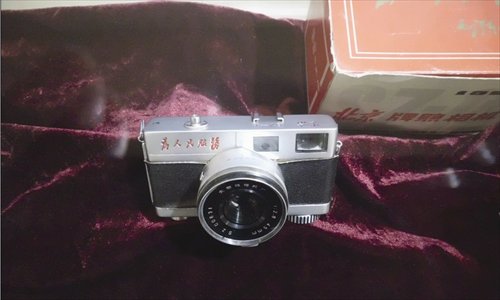
Zheng Jianguo, deputy manager of the shop, told Metro Beijing that despite the film-developing business being history, film enthusiasts can still buy film-equipped cameras here. Zheng showed off one model, made by the Beijing Camera Factory.
"It was once the big name in the field and people could not be more proud to possess one of these cameras back in the 1980s," Zheng said.
He added that this camera costs 50 yuan ($8) and the film is about 40 yuan, "but you may need to find a place where you can develop the film first," Zhang said. Production of this kind of camera has already stopped as customer demand slackened over the years with the rise of all things digital. Along with the cameras, film manufactures have disappeared, so the commodity has become rare and, as in the case of this Beijing Camera Factory model, the film can cost nearly as much as the camera.
Visitors to Hongguang can get a closer look at these old cameras with a current exhibition at the store. It highlights cameras produced in China, from the first, named Dalai in 1956, to Tiantan in 1960 and Great Wall in 1970. People can learn the brief history of China's camera industry and take a look at what the antique models look like.
Currently, there are several photography markets around Beijing, like one in Wukesong, Haidian district, and another in Maliandao, Xicheng district. People visit the markets, checking different shops one by one to compare the prices and then bargain with the sellers.
In Hongguang, no bargaining is allowed. All the cameras have non-negotiable price tags, and Zheng assures customers of their quality and authenticity. He acknowledges that cameras sold in the markets can often be cheaper than his, but emphasized that his goods come directly from the manufacturers and with warranties intact, something market sellers may not be able to offer.
Though Hongguang can't beat its market competitors in terms of price, Zheng offers a unique service which is second to none. Deep inside Hongguang, there is a small darkroom where visitors can develop their black and white film and then make prints using equipment provided by the store. This studio is currently free to use, though Zheng may charge customers about 30 to 50 yuan for use in the future.
When you enter the darkroom, you pull down the curtain and turn on the safe lights, then sit down in front of the enlarger. Place your negative inside the enlarger and adjust the size until it's just to your specifications. Adjust the timer settings and focus, and then you're ready to transfer your image to photo paper. The enlarger will flash the image onto the light-sensitive paper for a few seconds. Then it's time for a little chemistry as you dunk the paper into basins with developer, stop bath, fixer and finally running water. Slowly through this process, you will see your image come to life on the paper.
This process brings back Wang's memories of using his own black and white film and an enlarger when he developed and printed his photos at home during his three decades as photography hobbyist.
"Hongguang was the largest camera seller then and I always chatted with the salespeople. It's so good for me to hear that it is re-opened now and I am very interested in the cameras they have on display that I haven't seen before," Wang said.
Besides selling cameras and other equipment, Zheng hopes in the future to establish a photography club and hold a series of lectures.