Thinking outside the fog: pollution inspires a new wave of innovations
When hearing the phrases air pollution or gray skies, mask and Beijing cough will naturally come to mind. But business opportunities can also come from these bad conditions. Metro Beijing brings you a selection of pollution-inspired innovations.
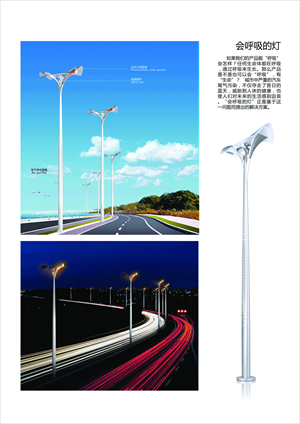
Breathing streetlight
Streetlights provide illumination during the night, but remain idle in the day. But as an item that is on many streets throughout the city, a street lamp can be used to deal with air pollution. Its street-side placement puts it in close proximity to the pollution-causing cars.
Qu Song, professor from the Academy of Art and Design, Tsinghua University, invented a kind of streetlight that can breathe in polluted air and exhale out purified air.
"I designed an in-car air purifier in 2009, and after I learned the tail pipe pollution contributed a lot to air pollution, I wanted to move air purifiers outside, to the streets," Qu said.
His 12-meter-tall streetlight has a porous body, two solar panels to accumulate sunlight and a wind wheel to gather wind energy on the top. All the gathered energy is stored and partly used to light up the energy-efficient LED lamp on the top to provide illumination and also used to provide energy for the air purification.
Inside the pole, there are two fans which can suck in polluted air from the bottom holes. The air then moves upward to two tiers of chemicals and an ozone lamp. The purified air then is exhaled out through the holes at the top of the lamppost.
"This breathing streetlight uses solar energy. There are no wires necessary, making it portable," Qu explained.
He is currently waiting for investments, so the breathing lamppost may take a while to hit the market.
Pollutant-absorbing card
The respiring streetlight can tackle the air pollution outdoors, but under the PM2.5 skies, staying indoors doesn't ensure safety. Interior contaminants such as formaldehyde and odd odors from the sewage can be problematic, too.
Normally, to tackle indoor air pollution, people try to air out the space, buy more green plants or use air purifiers. But those might cause secondary pollution. Kang Shoufang, director from Dexuan Environment Material Co., Ltd, says his invention can erase the headache.
His solution is nanocat, a B5 paper-sized card which can purify air in 1 square meter through chemical elements combined with nanotechnology. It can be used in cars, bathrooms and any other living space.
"It can absorb toxic chemical elements scattered in the air," Kang said. "For example, if you put some sheets of nanocat in a restroom that contains hydrogen sulfide and nitrogen gas, nanocat can transfer hydrogen sulfide into sulfur and nitrogen gas into nitrate, and keep them on the card in order to purify the air."
According to Kang, the best way to cleanse the air is to deduct smelly odors from the air instead of adding scents to cover them up.
"Using spray may cause harm and allergic reactions," he said.
Kang argues that nanocat is better than air purifiers since it's portable, energy efficient and noise-free.
"You can't put air purifiers into a closet, but you can put a piece of nanocat," Kang said.
After six months of use, the nanocat is biodegradable.
Currently, the nanocat is available for purchase online at the price of 200 yuan ($32) for 15 sheets. Customers can also choose nanocats with simple drawings printed on them so the sheets can be hung like a pictures on the wall.
Potpourri of pollution products
Many other artists and inventors around the world are coming up with pollution-solving products, some more successful than others.
British artist Matt Hope's invention - a breathing bike - could save your life. Hope says the bicycle has a wind generator to produce electricity when pedaling. It also attracts dust particles to the white trash bin and then the air gets clean as it travels through the pipe to the mask. One glitch: the bike could electrocute you if you ride it on rainy days.
Two college students from New York University invented a T-shirt that can detect air pollution, according to the report by New York Daily News. Nien Lam and Sue Ngo's invention comes in two designs – heart or lungs – with carbon monoxide sensors attached. The color of the organs changes according to the pollution reading, showing the organ's reaction to the foul air.
Chen Guangbiao, a philanthropist who is known for outrageous charitable gestures, invented canned fresh air, marketing them to residents who live in cities suffering from heavy pollution, Metro Beijing reported last summer. Priced at 4 to 5 yuan a can, Chen successfully sold thousands of them in many major cities in China.