Margaret Thatcher dies at 87
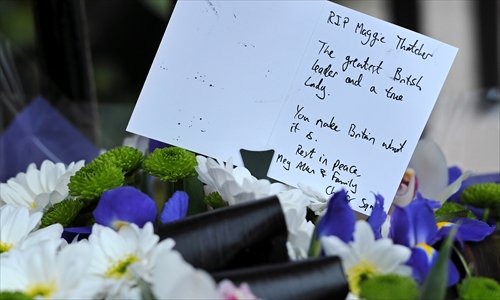
Former British prime minister Margaret Thatcher, who led the country throughout the 1980s, died Monday following a stroke at the age of 87.
"It is with great sadness that Mark and Carol Thatcher announced that their mother Baroness Thatcher died peacefully following a stroke this morning," Thatcher's spokesperson Lord Tim Bell said, AFP reported.
The former prime minister, who led Britain from 1979 to 1990, suffered from dementia and rarely appeared in public in recent years.
She was last in hospital in December for a minor operation to remove a growth from her bladder.
The former Conservative Party leader remains the only female premier in British history and was the 20th century's longest continuous occupant of Downing Street.
Thatcher visited China four times, first coming in 1977 when she was opposition leader.
Li Weiwei, a researcher with the China Institute of International Studies, told the Global Times Monday that Thatcher made a great contribution to improving Sino-British ties by removing the biggest obstacle to relations, namely sovereignty over Hong Kong.
Kerry Brown, a British expert on Sino-British relations at the Univesity of Sydney, echoed Li's opinion, saying she contributed to the successful and smooth handing back of Hong Kong to Chinese sovereignty.
In a heated discussion with Thatcher in 1982, late Chinese leader Deng Xiaoping insisted on reclaiming sovereignty of Hong Kong after June 30, 1997, and set a two-year deadline in negotiations.
In 1984, during Thatcher's third visit to China, the two countries signed a joint declaration on the question of Hong Kong, which ushered in a period of sound development in relations between China and the UK.
Ma Zhengang, who was China's ambassador to Britain from 1997 to 2002, told the Global Times Monday that by accepting Deng's concept of "one country, two systems," Thatcher and Chinese leaders set a precedent in solving the problem in a peaceful manner.
Having met Thatcher on many different occasions after the return of Hong Kong in 1997, Ma said the former prime minister repeatedly expressed appreciation of the "one country, two systems" concept, and spoke highly of the prosperous development of Hong Kong.
According to Ma, Thatcher paid great attention to the development of Sino-British ties after she left office, and met former Chinese premier Zhu Rongji during his visit to Britain in 1998.
Though Thatcher was famous for her alliance with then US president Ronald Reagan during the Cold War for bringing down the former Soviet Union, both Li and Ma said Thatcher held a pragmatic position toward China.
"She was an advocate of free-market capitalism and embraced China's development following the reform and opening-up to boost bilateral trade," said Li.
In a speech at the Hoover Institution in 2000, she said, "China should not be isolated: it is far too important for that. Indeed, it should be drawn further into the global economy."
According to AFP, her enduring legacy can be summed up as "Thatcherism" - a set of policies which supporters say promoted personal freedom and broke down the class divisions that had blighted Britain for centuries.
"She was an important leader and one who contributed greatly to global stability and peace, and was much admired," Brown told the Global Times.
"Thatcher is an iconic leader for Tories, and she did great things such as break the man-dominated political arena. But she also did bad things. She took money out of minority working class' pockets and left the country divided," Ian Stewart, a bodyguard working in London, told the Global Times.
Thatcher was skeptical of European integration and fought against the powers of Brussels, which ultimately led to her downfall due to disputes with pro-European members in her party.
According to the BBC, Thatcher will not have a state funeral but will be accorded the same status as Princess Diana and the Queen Mother. The ceremony, with full military honors, will take place at London's St Paul's Cathedral.
Agencies contributed to this story