Air of uncertainty
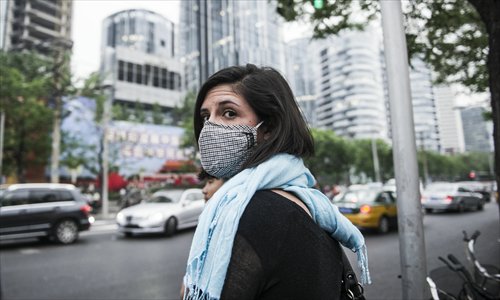
When Beijing spluttered through choking bouts of smog in January, about the only thing that appeared clear was the resolve of many expats to leave the city. Enough was enough, or so it was widely reported by foreign news outlets, which predicted a mass exodus of senior executives, diplomats and entrepreneurial heavyweights.
Fast-forward four months and the expat labor market remains competitive, with foreign talent abundant at multinational companies. Why? Part of the answer lies in firms luring and, more importantly, retaining their expat workers by offering packages sweetened with "hardship pay" for their respiratory rues.
"The average annual expat package starts at 2 million yuan ($325,400) plus benefits, with this going up to between 3 and 5 million yuan for large multinational corporations," says Victor Hu, director of employment agency China Internship Solutions Corporation.
Hazy employment hangover
These "benefits" vary depending on the scale of the company, but can include housing in an exclusive neighborhood, cross-cultural training and family bonuses, such as arrangement of a spouse's visa and enrollment for children at high-end international schools.
Administrators at Dulwich College Beijing, a British international school located in the city's northeast villa-lined Shunyi district, know the value of keeping students' parents, many of whom are on expat packages, satisfied with their postings in Beijing.
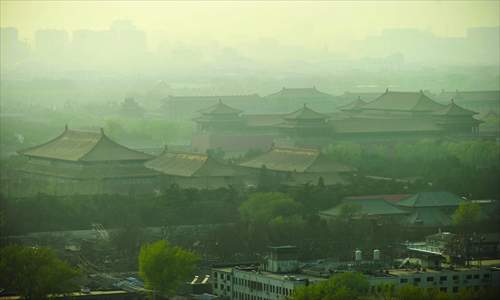
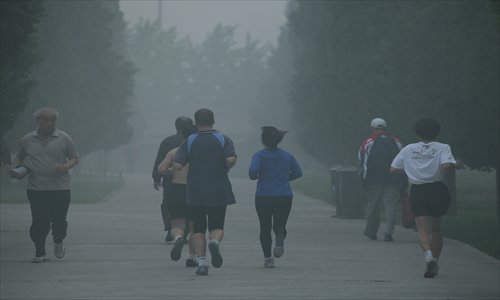
During January, pupils held sports activities inside a 5,500-square-meter dome. Students use the bubble-like facility, which cost $650,000, when air quality index (AQI) readings hit 250 or higher. On January 13, the AQI peaked at 900 - nearly 40 times higher than levels considered healthy by the World Health Organization.
"International schools are more sensitive to the air pollution issue because students and their parents have lived abroad for many years. They compare the air quality of Beijing to their hometowns," says Mary Ren, product director at the Beijing headquarters of Yeadon Air Domes.
But headmasters at Beijing's elite schools aren't the only ones worried the city's "airpocalypse" could drive foreigners away.
"If you are looking for candidates who have a choice of working in many places globally, I would argue that China is still not the most attractive destination," says Jon Edwards, senior executive at the Shanghai office of global recruitment firm Antal International China.
Despite poor air quality, gridlocked traffic and a steady stream of food safety scandals fueling China's reputation as the "wild East" in the eyes of job-seekers, Edwards insists the country is still a valuable pivot on the corporate career path.
"It (China) is a great selling point. Many people are struggling to find good jobs in Europe," he says. "China has become a more attractive destination in recent years, especially considering senior management salaries are comparable here to those overseas."

Thinning expat packages?
Even if the days of the "fat expat package" in Beijing are numbered, there is no shortage of ambitious foreign graduates queuing up to come to China and try their luck.
Hu told Metropolitan this year his agency has seen a 30-percent year-on-year surge in internship and job applicants, with Shanghai and Beijing still favored as top cities.
"We're still seeing a steady growth of foreign students and graduates from the UK, US, Canada and Australia coming to China to pursue internships and job opportunities," says Hu.
However, those with minimal experience who have expectations of landing a cushy job with a comfortable expat package are destined for disappointment.
"Their (entry-level foreign workers') packages are more or less the same as local employees," Hu notes.
In a December 2012 interview with Metropolitan before his return to the US, public relations stalwart and longtime China blogger Will Moss lamented he "was never on a full expat package."
"People on middle-class, Western salaries have it pretty good in Beijing in most respects," he said. "I came to China on my own and was always a 'local hire.' The same is true of many of my friends. The number of people I knew who were on full expat packages was pretty small."
For many of those on "fat expat packages" a decade or so ago, it was largely a case of being in the right place at the right time. Competition for jobs was weak compared to current standards, and speaking Chinese was usually enough to get a foot in the door at many companies.
But a surge of returning Chinese graduates educated abroad have been hired in favor of foreign professionals at many domestic and multinational companies in recent years.
More than 186,000 Chinese students had returned home by the end of 2011, up more than 38 percent from the previous year, the People's Daily reported in March 2012.
Impact of visa reform
In contrast to North America and Europe where job prospects in management across a wide range of sectors remain bleak, China is still riding a boom that is the envy of the rest of the world.
A 2001 survey conducted by professional services giant Ernst & Young found 42 percent of company leaders said filling jobs abroad with suitable candidates was one of their toughest challenges.
China has also acknowledged an identical need to fill jobs with foreign experts, making a concerted push to lure them to the country by devising a multiple-entry, five-year visa set to be introduced on July 1.
"It definitely won't hurt," Max Price, a partner at Antal International China's Beijing office, says of the new permit. "The main complaint I get from expats is that they just start to see the rewards after two years of hard work, only to be forced to look for something new."
Moss, on the other hand, is less optimistic about whether the new visa will deliver tangible benefits to expat professionals.
"I don't think visa availability is the driving factor. Plain old residence permits worked well for me, and I expect they do for the majority of expats," he says.
Future prospects
Price says media hype over the capital's air quality woes is to blame for giving expat job-seekers cold feet about making the move.
"There is no point hiding that there are pollution issues in Beijing, but the thing stopping some professionals moving [to China] is that their knowledge of the issue is from sensationalist articles and online forums," he says, adding foreigners considering including a China stint to their résumé should visit beforehand.
Daniel Anders made such a reconnaissance trip when he left home in London for Tianjin in 2007, deciding the following year to settle in Beijing. Aged in his 30s, Anders was well-aware of the environment - both in an ecological and labor market sense - before he settled here.
"When I moved to China, I had considered health factors linked to the air quality. I don't think it (air pollution) came as a sudden revelation. If people come here and are surprised, they probably need to beef-up their diligence," says Anders, who works at a consultancy firm. "In any case, an expat package is offered by companies that want you to go over and not the other way around."
Asked his predictions for the expat labor market over the next decade, Price forecast a "slight increase" in the number of foreigners coming to China for work.
"There will be some outflow among the current group of expats, and some of their positions will be replaced by locals. But the increase [of expats] will be driven by new companies coming to China," he says. "There are many companies waiting to enter China in numerous sectors, including the software, retail, hi-tech and luxury goods industries. All [these companies] will bring foreigners with them."
Hu echoed this sentiment, saying as long as China's economic growth remains steady it will be a hub for expat workers from the entry to corporate level.
"In terms of the next five to 10 years, China's [annual] GDP growth rate is still increasing at 7.5 percent, causing all sectors to continue strong growth," he notes.