Space invaders
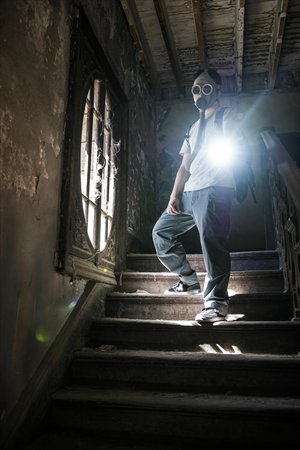
Urban explorer Zhao Yang wears a gas mask as he delves into the abandoned No.81 house, situated right on busy Chaoyangmennei Dajie. Photo: Li Hao/GT
The tall, imposing Cinderella tower that served as a beacon for Beijing's 120-acre Wonderland Amusement Park in Changping district was finally demolished last month, having languished, abandoned and unloved for 15 years.
But to a certain demographic, the news was met with sadness. The derelict site had become a popular destination for urban explorers in the city as an eerie treasure trove of adventure and discovery.
"Urban exploration is an extremely exciting activity," says Qian Ting (online user name), a six-year urban explorer and founder of the China Exploration Forum, which connects local explorers who visit abandoned sites around the capital in their spare time.
"It also offers an inside look into a city's development," he tells Metropolitan.
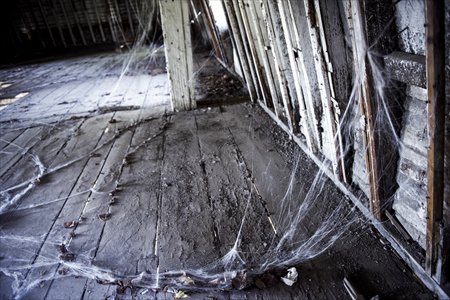
No.81 Haunted House
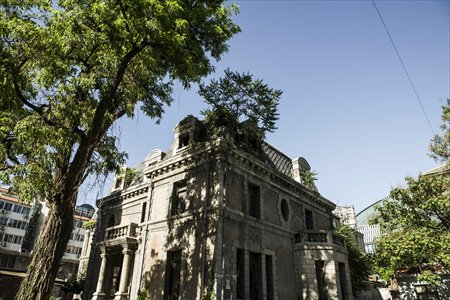
Mined for many local ghost tales, No.81 on Chaoyangmennei Dajie is full of haunting,
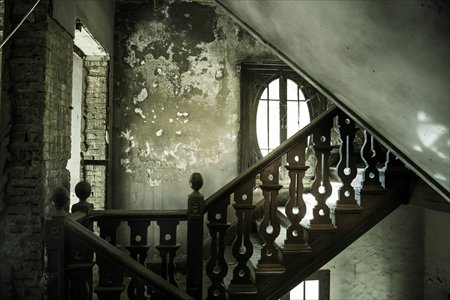
European-style flourishes now in disrepair, such as this staircase. Photos: Li Hao/GT
A community of explorers
By definition, the term urban exploration, Urbex or UE is the practice of infiltrating abandoned man-made structures in urban areas.
China's fast-paced industrial age means that dilapidated buildings and vacant, forgotten structures like Wonderland are an inevitable by-product of its rapid development.
Cities such as Shanghai and Nanjing in Jiangsu Province have already experienced an emergence of localized urban exploration groups.
In Beijing, the hobby seems to be on the rise, too. Speaking with the Global Times in May last year, Liu Nan, 34, a Beijinger and prominent member of the China Urban Exploration Forum, says that up until that point, the group had around 70 members. The forum now boasts an impressive 4,263 members with new subscribers joining almost daily.
In February 2012, the Beijing Supernatural City Exploration established itself as a group, organizing outings every 10 days to mysterious places throughout the city. "Unknown world, unknown future," declares the group's motto. The group now has more than 100 dedicated online followers.
Exploring abandoned urban landscapes in the capital can be done in a group setting or alone. It's a low-cost way to inject a little adventure into a weekend afternoon.
On any day of the week, Chaoyangmennei Dajie, in Dongcheng district, is just another unassuming street in Beijing. Cars, bicycles, rickshaws and pedestrians make up the bustling concrete strip it is today.
But sitting quietly detached from the swirling modern life that surrounds it is building No.81 - Beijing's most notorious haunted house. Unless you knew it was there to begin with, you could walk right by it. Wild overgrowth pierces through and above the third story windows, creating a unique but creepy picture, like a scene out of a Tim Burton movie.
According to Metropolitan's research, the two multilevel, dilapidated buildings that occupy the compound at No.81 were built in the early 1900s.
Current ownership belongs to the Beijing Catholic Diocese and the buildings are on the protection list for Beijing's Excellent Architecture, which means they can be renovated and restored, but never demolished.
According to Chinese movie website mtime.com, both houses will provide an appropriate backdrop to the upcoming 80 million yuan ($13 million) Chinese 3D suspense-horror movie Inward 81, which started filming as recently as June 3.
Nevertheless, both buildings' immunity from wrecking crews is good news for explorers who haven't yet "discovered" No.81. Inward 81 will no doubt open up the houses to a much wider audience but that's if they can stomach the haunting tales of its lore.
For years, ghost stories have circulated that a concubine hanged herself after her resident Kuomintang officer-cum-lover fled to Taiwan to evade the communists. Another ghostly legend suggests that a group of renovators simply vanished while working on the building. More recently, in 2007, an urban explorer was said to have disappeared while investigating the houses.
None of this perturbs urban explorer Zhao Yang in the slightest.
"Last time I was here was in April," says Zhao, 26, as he climbs headfirst into the blackness of a partially boarded-up window on the ground floor of No.81.
Once inside, he gestures for Metropolitan to follow. Suddenly we're in front of an old mantelpiece in what seems to be the living room.
"I don't really believe in ghosts," Zhao says.
History's remains
Zhao, a Beijing native, is a professional food website photographer and full-fledged city explorer. In 2008, Zhao formed his own city exploration group with a handful of his classmates called the "The Lurkers."
The group disbanded when members graduated and entered full-time employment, but as the most enthusiastic ex-leader, Zhao kept up the pastime, establishing what he calls the "Cooling Project", a solo venture consisting of Zhao taking pictures of abandoned sites in Beijing by himself. He's also kept a photo blog called Whitez since 2006 to chronicle his journeys into the urban unknown.
"I've been to a lot of abandoned places to explore and take pictures," Zhao muses. "I just love the feeling of running away from crowded, noisy urban life."
According to Zhao, one of the most popular sites for Beijing-based explorers is Shougang Industrial Heritage Park, northwest of Beijing in Shijingshan district. Built in 1919, Shougang is a veritable gold mine for explorers with intricate housing structures, mazy paths, empty mills and old factory equipment. In its pomp, the large-scale steel manufacturer employed up to 80,000 people producing over 15 million tons of steel annually. The space now has tour groups going through it, but there are still unregulated spaces worth exploring - until developer's plans to turn it into an art hub kick in.
Zhao visited the site again in April to take photos for his blog. Captivated by the surroundings, Zhao imagined the magnitude of the park's full-scale operation.
Zhao laments the fast pace of development in the capital, saying that places worth exploring are quickly disappearing.
He describes being "incredibly fascinated" with the discarded medical paraphernalia, sickbeds, medicinal bottles and empty syringes that once littered Xiaotangshan, a makeshift SARS hospital in Changping district built in 2003 but demolished in 2010.
"I really had a sense of time and history when I was there," Zhao says.
Into the unknown
As we brush past the thick cotton candy cobwebs of No.81's creaky staircase, Zhao proceeds to don a large gas mask for a photo op. It makes him look like a cross between an elephant on two legs and a glass eyed fly.
"I wear a mask because I don't want to be in the scene," Zhao muffles from within the fascia.
As we make our way to the top of the building, Zhao suggests that walking in alignment with the ceiling beams below might be a good idea to avoid falling through the floor. He's right. The weathered wooden flooring seems to be incredibly precarious in parts. This is not the sort of place you want to have an accident.
On the walls are graffiti inscriptions in Chinese. One says, "Forbidden. Go in and you will die." Another reads, "It's getting cold, bring clothes for me." There's even a quote from Mao's Snow, a rallying poem from 1936: "All are past and gone! For truly great men, look to this age alone."
Flashlight in hand, Zhao leads Metropolitan into the huge basement, announcing that there is rumored to be an underground tunnel leading all the way to Tuanjiehu Lake. We soon discover a hole in the ground in one of the many dank basement rooms. As the more experienced explorer, Zhao volunteers to descend first.
Lowering ourselves in carefully, we tread bent double about 5 meters forward until we reach a turn. The ceiling of the tunnel is incredibly moist. As we turn, a bricked up wall greets us. There's no tunnel to Tuanjiehu Lake after all.
We emerge from the mouth of the basement's concrete burrow and onto the street.
"It's enjoyable to get a sense of the past but it's not the main significance for me," Zhao concludes.
"Sometimes when you're standing in a large discarded place," he says, then pauses for a moment. "It's just a fantastic feeling."
Top 3 urban exploration sites in Beijing
No.81 Haunted House
Built: 1900 in Dongcheng district - Emperor's faith gift to British colonists
Directions: Take Subway Line 2 to Chaoyangmen Station. From exit H take the underpass across Chaoyangmennei Dajie and head east until you reach No.81.
Access level: Medium - guarded compound but easy climb through ground floor window
309 Catholic Hospital
Built: About 1919 in Haidian district - China's first Catholic teacher training college
Directions: Take Subway Line 4 to Anheqiao North Station. Then take bus 697, 112, 718 or 330 to Baiwangshan. Walk 280 meters to the hospital.
Access level: Easy - just walk around the back and into the building
Shougang Industrial Heritage Park
Built: 1919 in Shijingshan district
Directions: Travel to the end of Subway Line 1 to Pingguoyuan Station. Head west on Chang'an Avenue until you see the large industrial zone.
Access level: Difficult - areas not sanctioned for tour groups have guarded and padlocked gates