HOME >> METRO BEIJING
Dripping With Menace
By Yin Lu Source:Global Times Published: 2013-7-2 18:58:01
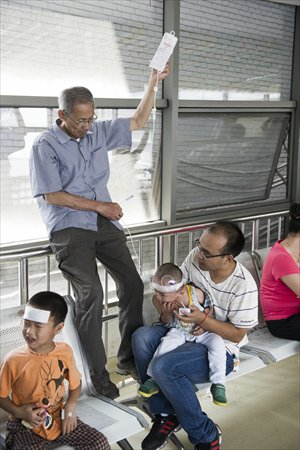
For many patients, a trip to the hospital isn't complete without an IV drip. Photo: Li Hao/GT
"Getting intravenous drips is equivalent to suicide."
Seeing the antibiotics flowing into her 1-year-old daughter through an IV tube in her head, Yuki Ge, 31, was haunted by these words from an article that has been circulating on the Internet recently, warning against the use of IV drips.
"Foreigners see IV infusions as minor surgery," the article says, adding that intravenous therapy puts patients at risk of electrolyte imbalance, fever, convulsions and even death.
A 9-year-old boy from Jilin Province died after getting IV drips last December, the City Evening News reported. On baidu.com, a search for the term "children's deaths caused by IV drips" brings up thousands of results.
The risks are not as terrible as the article claims, said Xia Qing, pediatrician at Aerospace Central Hospital.
"It's an exaggeration," agrees Li Fan, director of the department of pediatrics at Amcare Women's & Children's Hospital. "But IV can increase cardiac output, and there are risks of phlebitis, drug extravasation, drug pollution, and although rare, anaphylaxis that leads to shock or death."
Statistics from the World Health Organization (WHO) show that no other country relies on IV therapy to the extent that China does. According to China-WHO Country Cooperation Strategy (CCS) 2013-2015, the irrational use of medicines, including the over-prescription of glucose intravenous infusions, is a big problem in China.
In 2009, as many as 10.4 billion doses of IV medicine were administered in China, averaging eight per person, far beyond the international average of 2.5 to 3.3 doses per person, said Zhu Zhixin, deputy director of the National Development and Reform Commission.
Pediatricians say the Chinese enthusiasm for IV treatment can be attributed to the desire for instant results, and the linkage between doctors' incomes and the expensive medicines they subscribe.
"Drugs can act quicker, entering the bloodstream directly, and circulating in the body within 20 seconds," said Li. "When concerned parents and grandparents crowd the office, requesting IV treatment immediately, that puts a lot of pressure on a doctor."
Ge says that her parents have a "superstitious belief in drips" that can be traced back to her own childhood, when they requested "the best drips" for her.
Xia confirms that she sees overuse of IV drips at work, "especially parents from other provinces, requesting an IV for their kids who just have a cough."
Many go to the other extreme. "Some parents, usually white-collar professionals who have lived overseas, refuse drips even the diagnosis and the doctor call for it. They say children in other countries wouldn't be given drips for such diseases," said Li.
So does your child need IV drips or not?
"If the situation allows, choose oral medicine over intramuscular injection, and injections over IV - that should be our principle," said Li.
Xia usually makes a determination based on the levels of white blood cells, C-reactive protein and other indices of infection in the blood. Other factors come into play as well, including the child's mood. "A kid who's frequently vomiting should get a drip going before dehydration causes damage to organs; however, if the kid is eating well, the parents might consider using oral medicine, even the doctor recommends an IV," Xia added.
After all, the parents have the final say, said Li. "The role of a doctor is to provide balance between the positive effects of treating the diseases and the side effects of drugs."
Posted in: Metro Beijing