Their last meal was not just a ‘free meal’
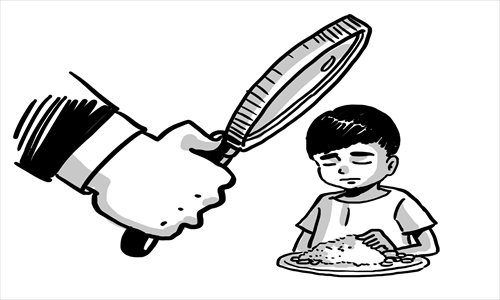
Illustration: Liu Rui/GT
This month Malala Yousafzai gave her maiden speech at the UN and said, "One child, one teacher, one pen and one book can change the world. Education is the only solution." I believe she struck all the right notes in her speech.
The deaths of more than 20 children between the ages of four and 12 last week in a remote village of India's eastern state of Bihar have reignited the discussion over the world's largest school nutrition program.
The children died in a government primary school after eating a free meal offered to them as part of the nationwide free lunch program.
The school's playground has now turned into a graveyard. This tragedy is likely to discourage parents from sending their children to school in a country where nearly half of all children are undernourished and don't have access to better education.
What is still not known is whether the food or the cooking oil was accidentally or deliberately poisoned. The forensic science lab report says monocrotophos, a pesticide used for agricultural purposes was present in the samples of oil from the container and food remains on the platter.
Free meals are part of a social program to support children of poor or low-income families who live below the poverty threshold. While our sympathy goes out to the families, the question remains: could these deaths have been avoided?
As more information has become available, it is clear that the answer to this question is sadly yes.
In some states, the public distribution system is plagued by inefficiency, corruption and leakages exploited by middlemen. This distressing example has raised concerns among the public who say that there is no accountability to make the system more efficient as corruption is built into the very delivery mechanisms of the state.
But in some other parts of the country, non-governmental organizations have set a new benchmark for providing quality food.
The free lunch scheme has been running for more than 10 years nationwide across 1.2 million schools, and aims to provide specified levels of calories and protein to 120 million pre-primary and primary school children.
The scheme, according to policymakers, has increased the rate of attendance in schools and has enabled children to transcend barriers of race, caste, religion and gender by sharing a meal together.
It could be argued that such tragedies could cripple the government's objective of improving the health of its children until the government brings in a stronger system of checks and balances for accountability and transparency.
That some parts of our country are much more prone to disasters tells a saga of development which is biased and not uniform. Nobel Laureate Amartya Sen and economist Jean Dreze have the right of in their recent book An Uncertain Glory: India and its Contradictions. In it, they argue India's development model which they say has divided the country into islands of California amid a sea of sub-Saharan Africa.
India needs greater state intervention in certain areas of social development, given the yawning achievement gap between the privileged and the poor. For implementation of schemes in rural areas, schools should be given sufficient space in a decent location for cooking and storage of foodstuffs. The staff who handle food must be supervised and trained to work safely as well as maintain a good level of personal hygiene.
This tragedy is a reminder that planning a leading role in the fight against hunger remains a challenge for a country still banking on an ambitious food security bill mired in political wrangling in parliament. It is vital to strengthen monitoring institutions at the grass-roots level because subsidies are simply not reaching the intended beneficiaries.
Every kid deserves a good start in life. We need to ask ourselves a tough question: What is the legacy we want to leave behind for our children and grand-children?
The author is a Master's candidate in Global Business Journalism at Tsinghua University. himanshu28102000@gmail.com