Grape expectations
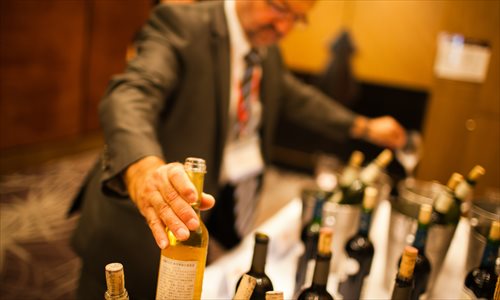
At a blind tasting, Ningxia wines beat bottles at a similar cost from Bordeaux. Photo: Li Hao/GT
Emma Gao says she was surprised when she learned from the news that Ningxia wines beats their Bordeaux counterparts in a blind taste. And she was one of the winning Chinese wine producers.
On a December evening in 2011, a panel of ten wines experts, half French and half Chinese, gathered at Zun Club in Beijing for a wine contest. After a one-hour tasting and discussion, they reached the verdict. Of the total of 10 wines made in Ningxia Hui Autonomous Region in China and Bordeaux in France, four out of the top five were Ningxia reds.
"It was exciting. The 2009 Silver Heights Summit ranked second," recalls Gao, who runs Silver Heights, a tiny family-owned winery she founded in the 2000s.
The results alerted the wine world of the potential of Ningxia reds. A landlocked area located about 1,200 kilometers west of Beijing, the impoverished and remote region has merely decades of winemaking history. How then could their products comparable with the distinguished Bordeaux reds?
Why Ningxia?
It is meaningful to compare wines produced in Ningxia and Bordeaux, according to Canadian Jim Boyce, expert in Chinese wines and founder of the Grape Wall of China blog.
Boyce was the originator of the Ningxia vs Bordeaux Challenge. In his opinion, Ningxia wines, which have won several international awards, represent the best of Chinese winemaking, while wines from Bordeaux are among the most coveted by Chinese consumers. The two also share similarities because many Ningxia winemakers have studied Bordeaux oenology.
The organizers picked five wines from each region with retail prices ranging from 220 yuan ($35) to 490 yuan. Eventually, 2009 Chairman's Reserve from China's Grace Vineyards topped the best five list. The only Bordeaux winner was a 2009 Saga Medoc from the Barons de Rothschild Collection.
Not all are convinced by the contest. Lu Jiang, wine expert and an independent wine writer, criticizes the challenge as unfair. "The wine samples didn't represent wines on the same level," he says, indicting the organizers are using the top Chinese wines to compare with the products of Bordeaux's mass brands.
According to Boyce's records, the five Chinese wines come from China's top wineries: Helan Qing Xue, Silver Heights and Shanxi-based Grace Vineyard, which has wineries in Ningxia. Their Bordeaux included Barons de Rothschild Collection Saga Medoc 2009 and Calvet Reserve De L'Estey Medoc 2009.
"The manufacturing cost of Chinese wines is much higher," says Lu. "French wines are often laden with high extra costs during the distribution process before being priced in stores."
Emma Gao agrees with Lu. "In all conscience, the wines are not comparable," she explained to Metropolitan in a telephone interview.
"Wines produced in only limited quantities are always superior. Our wines are limited products made by my family, but the Bordeaux wines were mass-market brands, produced industrially in large quantities."
Boyce believes the results are informative to consumers, who want to spend their money wisely. "It showed that Ningxia wines do well in terms of quality and value," he says.
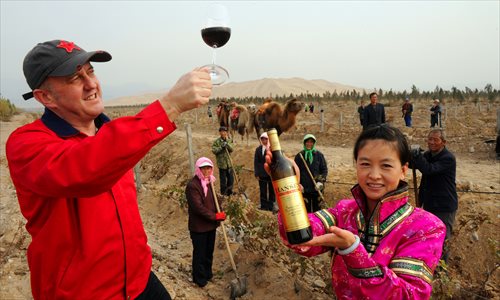
Paumard Bruno, a French winemaker who has moved to China. Photo: Courtesy of Paumard Bruno
The triumph of small wineries
Despite debates over the blind tasting, no one would deny the fact that Ningxia has become a promising newcomer joining the global players in the wine world.
In 2008, French drinks giant Pernod Ricard signed a contract with one of the earliest Ningxia vineyards, Helan Mountain, to produce wines mainly targeting the growing Chinese wine market. Before that, LVMH had started cooperating with Xi Xia King in making sparkling wines and champagnes.
Major domestic winemakers from other regions including Changyu and Cofco also came to Ningxia, building large chateaux not only for expanding their wine manufacturing but also for wine tourism.
The area keeps winning awards. In 2011, Helan Qing Xue's Jabeilan Reserve 2009 won a trophy from the Decanter World Wine Awards.
In August 2013, Chateau Changyu Moser XV, produced in Ningxia, became the first Chinese wine to be permanently stocked on the shelves of Berry Bros & Rudd, one of the most prestigious wine sellers in Europe.
Heavy investment from local governments is a major causes of the rise of Ningxia wines. Lu says that Ningxia is not the earliest region in China to develop winemaking, but authorities have made long-term and preferential policies to support local vineries and wineries.
What's more, Boyce and Lu note that the fame of Ningxia wines also depends on small-scale family-owned wineries that are concentrating on improving wine quality. The small wineries have drawn on foreign oenology experts and Chinese who studied winemaking overseas and returned to settle down, helping to bring advanced winemaking techniques to China.
While some of the big wine producers boost their products by setting prices high and using luxury packaging, small wineries are using quality to win the market, says Lu.
Gao's Silver Heights is among the family wines that have gained attention domestically and internationally.
It all started from the tiny cellar her father Gao Lin dug at home by himself. In 1997, Gao Lin, an employee with a State-owned enterprise, made his first vineyard, because he was told the natural conditions are suitable for grape growing. The vineyards, located on the eastern slopes of the Helan Mountains, were blessed with ample sunshine, and the stony soils are ideal for viticulture.
He then went on a business trip to France and Germany for better observation of wineries, and sent his daughter, who just finished her studies in economics at St. Petersburg, Russia, to France to be trained as a professional winemaker.
Emma Gao was admitted to a Bordeaux wine academy where 95 percent of students were French. In her first wine tasting course she vomited. "I didn't know tasters do not swallow wines," she giggles. Years later, she married Thierry Courtade, who came from a French winemaker's family.
"In 2007, we started making wines in father's tiny cellar," says Emma Gao. The Gao family only produces three types of wines, all blended with Cabernet Gernischt grapes. By cooperating with a Spanish wine distributor, their wines managed to go on the dinner tables of five-star hotels and Michelin-starred restaurants in China.
Silver Heights presently employs only three regular workers: Emma Gao, her husband and an apprentice.
But a lot of wine enthusiasts from in and out of China volunteer to work there during the harvest season every year.
"All the best wineries in France are family managed, because the family members can strictly oversee the winemaking process, guaranteeing wine quality," she says.
Her wines also stand out due to their advantage of being environmentally responsible and pollution-free. "I never use pesticide. Even vineyards in Bordeaux spray chemicals seven or eight times every year, and some other regions use pesticide 15 or 16 times a year," she adds.
In terms of disadvantages, in 2012, Jancis Robinson wrote in her story "Châteaux China" in the Financial Times that she found "one very strong, unfamiliar flavor," like "a green streak accompanied by something peppery," in some of the Ningxia wines.
She believes it comes from "the local grape specialty known as Cabernet Gernischt." She considers it to be one of the problems with Ningxia wines.
The high-end and mass market
The fame of Ningxia wines is growing by leaps, but so far their market is still small.
It is difficult to find a bottle in general supermarkets given their limited production. If you want to have a taste of the best of Chinese wines, you have to order at a fancy dinner in luxury hotels or at high-end restaurants.
Chinese wine producers are not ambitiously eying the international markets, because they would have to lower their prices hugely to compete overseas.
But according to Paumard Bruno, a French winemaker from Château Hansen based in the Inner Mongolia Autonomous Region, it is still necessary to sell wines to the overseas markets, "not for business, but for our image."
"It will boost the Chinese market, which really appreciates wine from overseas," he says.
Nevertheless, the central government's anti-corruption campaign, which is leading to austerity in spending at banquets and gift giving, may lead Ningxia wine producers to shift away from the high end to the mass market, predicts Lu.
A toast to the future
Silver Heights produced a total of 30,000 bottles in 2012. Currently, Emma Gao is preparing to increase production for a wider market.
Having bought large vineries, tracts of land and new French equipment, she plans to produce 200,000 bottles of wines annually after five years.
Bruno, who relocated himself in China, is confident about Chinese wines and the market demand.
In his words, "Chinese people are gradually dropping baijiu for wine while toasting at dinners."
"I guess the next five years will see challenges between the best of Ningxia wines and the best of Bordeaux, [Château] Lafite [Rothschild]," Bruno predicts.
In Lu's opinion, Ningxia wines cannot dominate the Chinese market in the coming 10 years.
However, there is no doubt that Ningxia will become one of the regions with reputable products on the world wine map, he says.