Turn on, log in, zone out
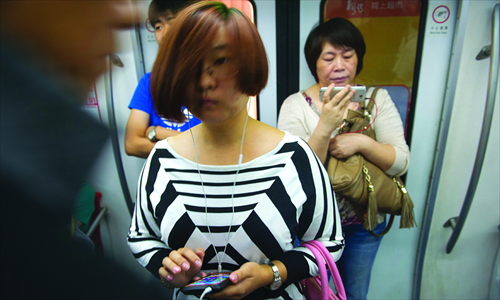
Glassy-eyed commuters may be simply tired, or might be mobile phone addicts. Photo: Li Hao/ GT
Zhang Yanqiu, 45, is worried about her daughter, who just returned home for the first time during her freshman year. "During the Mid-Autumn Festival, she just fixed her eyes on her new smart phone almost every minute. Even when she was in bed, she would play with it in the darkness for over one hour until exhausted," says Zhang. "She does not like to talk with anyone in the family when she has the phone in her hands."
Obsession with smart phones is not limited to young people. Li Fengying, 73, says her middle-aged children are addicts. "When my family [sons, daughters-in-law and grandchildren] come to see me and their father over the weekend, each of them grab a phone and begin to slide and stab the screen with their fingers. We used to talk, drink tea and watch TV together. Now family reunions are ruined by the phones," says Li.
These scenes are now common. Recently, zhaopin.com, a famous recruitment website in China, released results for a survey on mobile phone use among over 10,000 white-collar workers from 28 cities in China. Nearly 80 percent of the interviewees admitted a severe addiction to their phone, 79.4 percent keep their phone on during the night, 78.86 percent like to kill time with it, 60.39 percent indicated that they cut down face-to-face communication with others, 68.56 percent said they grab their phone first thing after they wake up, and 63.59 percent use their phone before going to sleep. The respondents used their mobile phones an average of 3.93 hours a day. Beijing white-collar workers are the heaviest users, at 6.72 hours a day.
Touch screen finger
Sun Xinghe, a clinician at Beijing Anzhen Hospital, says people tend to neglect their feelings of fatigue when using their smart phones. Watching the screen for a long time may cause eyestrain, and neck and arm pain. Additionally, smart phones are ruining people's sleep patterns. People like to use their phones before going to sleep, refreshing their Weibo microblog pages and chatting with others until very late in the night, disrupting their natural rhythms, leading to a deterioration of their immunity systems and emotional states.
Using a touch screen a long time may injure tendons in the fingers and wrists.
"There have been a lot of people suffering from computer-related injuries like 'mouse hand' and 'keyboard elbow'. And now comes 'touch screen finger'," said Sun.
Smart phones may also harm sociability and interpersonal relationships. Su Pengfei, a 28-year-old designer, says 90 percent of people he sees during his subway commute every day are using their mobile phones. "My girlfriend and I are almost the same. For example, when we go out for a date, if I drive, she plays with her phone in the passenger seat. If we go by subway or bus, we use our phones separately. If I could choose, I would prefer to do what we used to, just hold each other's hands and whisper to each other."
A 24-year-old student surnamed Zhang describes herself as obsessive-compulsive when it comes to her phone. "I check WeChat and Sino Weibo every half hour, because I don't want to miss any information about my friends. Sometimes I feel lonely and pathetic about myself after I quickly slide the screen to unlock my phone and find there is an advertisement instead of a message from my friends." She also uses the phone as a crutch. "When I feel embarrassed in front of strangers or on public occasions, I tend to pull my phone out of my pocket and began to play with it. Sometimes I pretend to use it to show them that I am too busy to talk, because I don't know what to say to people I just met." Zhang is working as an intern in a law office. Even though she works on a computer, she still checks her phone over and over again.
Unwired and unglued
In 2011, a study by University of Maryland researchers deprived almost 1,000 university students from 12 campuses in 10 countries including Britain, America and China of access to modern technology including their mobile phones. The result was that the students admitted that they were "addicted" to their mobile phones and laptops, as well as social networking such as Facebook and Twitter. The study, entitled The World Unplugged, also found students used "virtually the same words to describe their reactions." These included emotions such as fretful, confused, anxious, irritable, insecure, nervous, restless, crazy, addicted, panicked, jealous, angry, lonely, dependent, depressed, jittery and paranoid. One unnamed American college student told of overwhelming cravings, which the student confessed was similar to "itching like a crackhead (crack cocaine addict)."
"It's time to drop your phone for a while," said Luo Xiaonian, a psychiatrist at Beijing Anding Hospital. He told Metropolitan that phone addiction is a modern psychological problem. People addicted to their phones can experience withdrawal symptoms.
Luo says phone addiction has not been listed as a mental disorder, but according to the definition of substance abuse and addiction in the standard Diagnostic and Statistical Manual of Mental Disorders (DSM-IV-TR) released in 2000 by the American Psychiatric Association (APA), severe addiction to anything should be regarded as a mental disorder.
However, people who spend too much time on their phones are not beyond help. People are thinking of ways to solve the problem. Su Pengfei says one of the most effective ways is to buy a non-smart phone. "I am thinking of buying a Nokia low-end phone, which is very cheap, only several hundred yuan. Now many of my workmates are using that kind of phone. For one thing, it's kind of vintage. For another, it is very useful in fighting against smart phone addiction because the phone cannot be connected to the Internet."
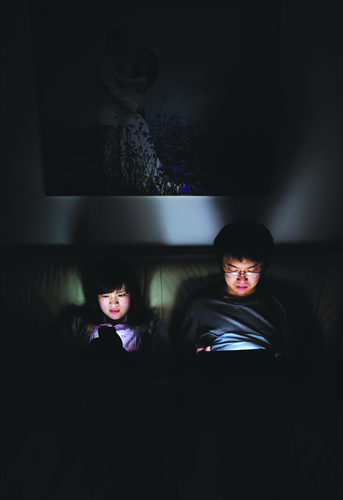
Lovers who used to whisper sweet nothings to each other now play with their phones instead. Photo: CFP
Jailbroken
New Yorker Ike Shutton devised an even more clever way to control smart phone addiction. The father of six children hates how smart phones invade family time. So he invented Cell Lock-up, a cute toy jail cell where iPhones, BlackBerrys and Galaxys - up to six at a time - can be imprisoned for 15 to 60 minutes. If anyone wants to force it open early, it raises the alarm "Alert! Alert! Break-out in progress!" With this jail cell, the phones can be temporarily ignored and family and friends can happily sit together, laugh and talk face to face. Cell Lock-up can be purchased in China. On taobao.com, it is sold for 349 yuan ($57).
"In the final analysis, it depends on the users. Self control and willpower are important to help resist phone addiction," says Luo. "For most people, it has not been so serious as to become a disease. They should give themselves mental hints that living with no smart phone is wonderful. When you want to play with the phone, try to get other things to do, for example reading a book, doing some physical exercise, listening to music or making some delicious dishes for you and your family."
Are you an addict?
A small test: if more than half of the answers to the following questions are yes, you may be addicted to your phone.
Is your phone always with you?
Do you feel distracted and annoyed if you are without your phone?
Do you feel uncomfortable when your phone has not rung for a period of time, and investigate why?
Do you often have the illusion that your phone is ringing and even mistake calls to other people as yours?
Do you often subconsciously look for your phone ?
Do you have your phone on all day long, including your sleeping hours?
Do you feel anxious, powerless and irritable when your phone is out of service or fails to receive Wi-Fi?