Bubble trouble
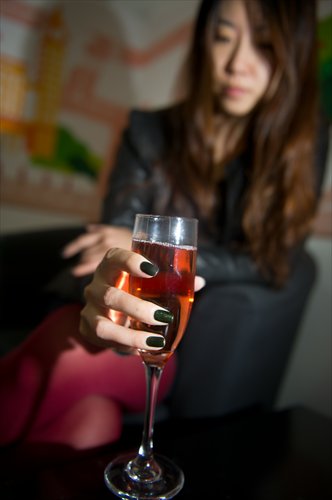
A consumer drinks sparkling wine. Photo: Li Hao/GT
China has been the rising dragon of the liquor world for the past decade as the fastest growing wine consumption market, but sparkling wine has been left behind in this boom by accounting for less than 1 percent of total wine sales in the country.
A March study by wine and spirits trade fair organizer Vinexpo found that between 2007 and 2011 wine consumption in China grew a staggering 142.1 percent to hit nearly 160 million cases, or 1.91 billion bottles.
But local wine experts and retailers blame poor marketing and low awareness among consumers for sparkling wine's struggle to seduce palates at home.
Domestic wineries hope to make sparkling wine a quaffable drink among the masses, but whether Chinese consumers are ready to pay hundreds of yuan per bottle for a luxury beverage still largely confined to banquets remains to be seen.
Suited to local tastes
As a sparkling wine connoisseur, Feng Nan is a rarity in Chinese vino circles. The 27-year-old spends about 3,000 yuan ($492) a year buying alcohol, about half of which is spent on sparkling wine.
"Most ceremonies in China serve sparkling wine. It has a low percentage of alcohol and a light, sweet taste, so even ladies who don't have a high tolerance of alcohol can accept it," he said.
Feng was introduced to the allure of sparkling wine as a boy watching winning motorsport drivers shower each other and crowds in champagne from the podium. He has made it his habit since high school to buy a bottle of sparkling wine every autumn and spring, even though his friends don't understand his obsession.
Although still a drink reserved for special occasions in China, sparkling wine is making a bubbly, albeit slow, rise in popularity. Vinexpo's report predicted sparkling wine consumption to increase by nearly 27 percent in China between 2012 and 2016.
Jim Boyce, a Canadian wine expert and founder of the Grape Wall of China blog, said the promotion of white and sparkling wines has been largely overlooked in favor of red wines for "reasons of status and health."
"I think as you see consumers trying more wines and choosing them based on taste, you will see more marketing of white still wines and sparkling wines," he said.
Lu Jiang, a Chinese wine expert and an independent wine writer, said sparkling wine has strong growth potential because its sweeter taste "suits Chinese palates."
"Even people who don't drink red wine can get used to the taste of sparkling wine," he said. "It's not like red wine, which is comparatively bitter and can make people reluctant to try other wines."
Sales of sparkling wine spike seasonally in China, Lu said, noting it is often in highest demand during summer. The most popular and widely sold variety in China is champagne, which exclusively refers to the sparkling wine produced in France's Champagne region.
Confusion among Chinese consumers about champagne and sparkling wine could be to blame for thwarting its growth in the country, Lu said.
In May, Chinese authorities registered champagne as an official label to limit the use of the name to sparkling wine made in the French region of Champagne, a move Lu said should help deliver more clarity.
"People might not know the different varieties of sparkling wine and just consider all to be champagne. Because champagne is more expensive, this might lead some people to believe that all sparkling wine is expensive when there are in fact some decent cheap varieties of sparkling wine," he said.
Photo: IC
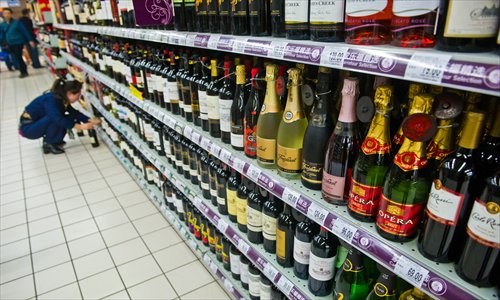
Sparkling wine sales are growing, but slowly. Photo: Li Hao/GT
Grape leap forward at home
Northwest China's Ningxia Hui Autonomous Region has emerged as the country's wine heartland in recent years, producing a variety of award-winning reds that have earned acclaim on the world stage. Boyce said luxury wine giant Moet Hennessey's Chandon project in the region is poised to release its first sparkling wines that could uncork a new era for the national wine industry.
"Next year should be an exciting one for sparkling wine in China. Given the success of [Moet Hennessey's] sibling wineries in Australia and the US, not to mention the parent company in France, there are high hopes this will represent a breakthrough, especially since Chandon is a well-known international brand," Boyce said, adding it might take time for Ningxia winemakers to realize the full potential of this "promising project."
Another region to watch is Shanxi Province, where Grace Vineyard, 40 kilometers south of Taiyuan, has a range of sparkling wines among its production of 400,000 bottles per year.
"This project has been in the works since 2009. I got a sample from the winery and did a taste test with chefs from some top Beijing restaurants earlier this year, and they were impressed," said Boyce. "There won't be a lot of it, maybe 3,000 bottles, and [at 300 yuan per bottle] it won't be cheap. But I think it will make a splash."
Sales and promotion
Taobao.com, China's largest e-commerce website, has been a growing marketplace for buying sparkling wine. European varieties are often more expensive than those from South America, Australia or Canada, Feng said, adding that cost isn't a key barrier because most Chinese who buy sparkling wines usually have a good understanding about what separates a good drop from a bad one.
Once a rare sight at run-of-the-mill supermarkets in Beijing, bottles of sparkling wine today line shelves at many big- and small-name chains. At a Carrefour supermarket in Shijingshan district, there are three types of sparkling wine among other red and white wines.
However, a salesperson at the supermarket told Metropolitan that few customers buy sparkling wine, and Carrefour seldom has promotions to boost its sales.
Feng buys his sparkling wine from an imported goods store in Wudaoying Hutong, Dongcheng district. Prices for sparkling wine range from 100 yuan to 300 yuan per bottle. Feng considers it a good deal, although concedes those who aren't wine connoisseurs might balk at such prices.
"At parties, it seems that beer and gin are more popular. Restaurants that offer imported wines are more expensive," he said. "Just like Chinese spirits will never be mainstream in foreign countries, it's the same situation here regarding sparkling wine."
Jim Yang, a Chaoyang district wine shop owner, imports about 600 bottles of wine from 16 countries annually. Of these wines, about 5 percent are champagne or other types of sparkling wine.
Bottles range in price from 100 yuan to more than 3,000 yuan, Yang said. Customers who come to his shop often already know what they want to buy, or at least have a fair idea.
Boyce attributed high prices of imported sparkling wine in China, about 72 percent of which comes from France based on 2012 statistics from the General Administration of Customs, to hefty duties and taxes.
"There are also costs for clearing customs and for transportation to get the wine to China and around this huge country. There's a niche of consumers in China that doesn't know a great deal about wine but associates quality with price, and sometimes they end up paying a lot of money for wines that are far cheaper overseas," he said.
Toll of low awareness
Yang said Chinese consumers are paying a heavy price for their overall low awareness about sparkling wine.
"Most people still only use sparkling wine for special occasions. China doesn't know much about it yet," he said. "In Western countries, these wines can be used for all sorts of occasions - for daily purposes, vacations and so on. But this isn't the case in China yet."
Lu believes proper consumer education is needed. Once consumers get a taste of sparkling wine, they will be willing to buy it more often, he said.