Start them up
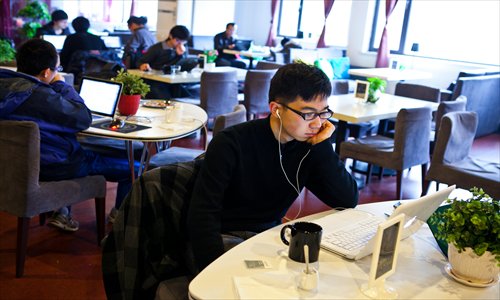
Garage Cafe is a hub for aspiring business owners in China's Silicon Valley. Photo: Li Hao/GT
In late November, Garage Cafe, a Zhongguancun coffeeshop that was designed to help reduce the cost of starting up enterprises, opened a branch in California's Silicon Valley.
With its two far-flung locations, Garage Cafe plans to use videoconferencing to facilitate communication between domestic and overseas entrepreneurs. The aim is to keep Chinese students abroad apprised of the business environment back home, and vice versa.
The Beijing-based cafe already has an impressive record of spawning domestic startups.
For providing workspace for entrepreneurs at a low price (15 yuan or $2.5 a day), hosting activities related to venture capital, and inviting investors to meet with entrepreneurs, Garage Cafe was named an "innovative incubator" by Haidian district authorities. Since its founding in 2011, more than 40 entrepreneur teams have "graduated" from the cafe by obtaining investment from angel investors.
Liu Hui, a 34-year-old entrepreneur who has spent time at Garage Cafe, recently got his first purchase order of 50,000 yuan for the cloud computing service product developed by his team. Before year's end, he will travel to the US to visit similar companies and seek investment.
Just 18 months ago, Liu was sitting in Garage Cafe. His startup had just failed and he was immersed in frustration. Then he heard someone in the cafe saying that they needed a salesperson. Liu spoke up. It was the beginning of a successful partnership.
"This place brought me into contact with my business partner, which I really value," Liu said.
Even though his team, which now consists of nearly 10 people, eventually moved out of the cafe because they needed an environment more suitable for the crew to do research, Liu frequently visits the cafe to seek sales opportunities, potential business partners and resources, as well as investors.
For nearly eight months, Yang Xianjin worked on his fashion glasses venture in his CBD "office" - which was nothing more than a seat in Jianwai SOHO's Big Bang Cafe, another space that has been designated an "innovative incubator." He preferred to pay 700 yuan per month for the space instead of dealing with the expense and red tape of renting a whole office. Also, he felt that working alone can create mental blocks.
"Interacting with other entrepreneurs in the cafe gave me lots of ideas for my own business," Yang said. "The cafe also held free lectures on startups almost every week - another good opportunity to improve myself." In September, he finally opened his own brick-and-mortar store.
Both Liu and Yang said that finding investors is not the most important thing for a startup. Instead, an entrepreneur must keep honing his or her business plan by absorbing different ideas. "Once your project becomes more mature, you can bring more chips to the table when you meet with investors," said Yang.
Indeed, once entrepreneurs set aside the idea that the sole purpose of an "incubator" cafe is to find investors, other possibilities open up.
"Startup owners need a 'home,' a certain kind of atmosphere that embraces them and encourages them to stay on the path," said Wang Fan (pseudonym), who first tried out Garage Cafe when it opened in 2011, but then watched his new business go belly-up. He came back and started all over again in April on a brand-new business project - an app that connects families with local services. Wang says coding is nearly complete and he is confident he can launch his new business soon.