Nature’s joy riders
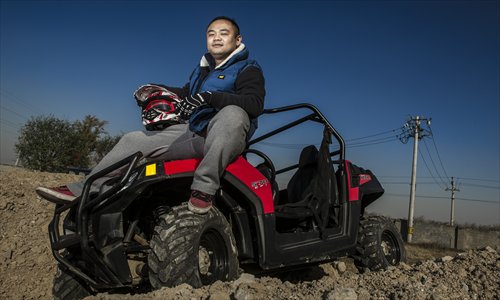
Peng Shan has spent around 5,000 yuan on safety equipment, including a helmet and gloves, to ensure he doesn't injure himself when riding his Polaris ATV. Photos: Li Hao/GT
Leaving a trail of flying sand and petrol fumes in his wake, Yan Jun leans upright on his handlebars as his all-terrain vehicle (ATV) roars up sand dunes in the Inner Mongolia Autonomous Region.
The grunt of Yan's ATV, a 50-horsepower KTM525, shatters the normal silence of the desert most weekends when he ascends up steep dunes at around 40 kilometers per hour.
Yan eases his grip on the throttle as he reaches the top, but only for a fleeting moment. With a flick of his wrists, his ATV lunges forward and careens down the sand dune at almost 100 kilometers per hour.
"The desert is my favorite place to ride my ATV. When I race down dunes, I feel like I have conquered a mountain," says Yan, 34, China's first professional ATV rider and the founder of the Ivy Cross-country ATV Club.
With more than 20 championships to his credit including the 2010 Taklimakan Rally, Yan is the fledgling sport's homegrown star and founding father.
Since ATVs were officially introduced to China in 2010, a growing number of people have tried their hand at riding them either in the name of tourism, leisure or sport. But high costs of buying and renting ATVs have earned them an unfavorable reputation as playthings of the wealthy that leave a destructive impact on the environment.

Peng Shan has spent around 5,000 yuan on safety equipment, including a helmet and gloves, to ensure he doesn't injure himself when riding his Polaris ATV. Photos: Li Hao/GT
Four-wheeled fun
Peng Shan, 31, was among China's first ATV pioneers in 2010. He remembers feeling awestruck at the unlimited sense of adventure upon first witnessing an ATV in action.
"When I first saw ATVs, I was immediately enchanted. The fact they could spin 90 degrees with ease amazed me," says Peng.
About a year after his first ATV encounter, Peng bought his own one, made by American ATV manufacturer Polaris, which set him back more than 140,000 yuan ($23,060).
"I tried to convince my family that ATVs are great, but they weren't interested. I once took my wife out for a ride, but she was terrified," Peng sighs.
Peng claims the beauty of ATVs lies in going "where cars cannot."
"Have you ever thought about climbing the Fragrant Hills not via its stairs but by riding straight up the mountain?" Peng asks, alluding to one of his proudest achievements about two years ago when he and four friends rode their ATVs up the mountain one night.
"It was beautiful. I felt free and accomplished," adds Peng, who since bought a second Polaris ATV, an XP900, valued at more than 250,000 yuan.
Peng rides his ATVs at least once a week. He most frequently visits sites in Beijing's rural outskirts, including Guanting Reservoir in Changping district and the Yongding Dam in Mentougou district.
"When I'm riding my ATV, my heart and mind are focused. It's so different from playing basketball or fishing. When I used to fish, I could never stop thinking about work," Yan says.
Before becoming a professional ATV rider, Yan was an entrepreneur who found his hobby on four wheels as the best way to escape pressure.
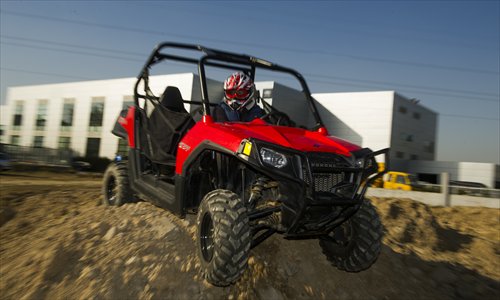
ATVs have driven into the hearts of wealthy outdoors enthusiasts in China since being introduced to the country in 2010. Photo: Li Hao/GT
Barriers to growthYan first began riding ATVs in 2006, well before there was a professional scene or any clubs in China. With no instructors, he was left to learn how to master the vehicle on his own.
"I had to resort to videos and materials from overseas to learn how to ride," says Yan, who estimates there are around 20,000 active ATV riders in China. Yan's goal is to one day compete in the Dakar Rally, the world's most prestigious annual off-road race.
Shi Zhong, an experienced ATV rider and licensed Polaris dealer in Beijing, said that many people consider ATVs as "big toys" that aren't worth the money.
"Prices of Polaris ATVs range from 70,000 yuan to more than 300,000 yuan. When we have sales promotions, often buyers with purchasing power don't like ATVs and people who do like them don't have the finances to buy one," says Shi, adding that the main demographic of buyers are men aged between 35 and 50.
Hefty taxes mean imported ATVs on average cost three times the price as Chinese brands, like Chunfeng and Huansong. Nevertheless, most buyers prefer paying extra for foreign-made ATVs, such as Polaris, Honda and Yamaha.
"In other countries, there are many children riding ATVs. But in China, we don't have this culture. Compared to foreign countries, we lag behind with ATVs," notes Yan, one of around 60 Chinese professional ATV riders.
On a professional level, the two main factors hindering development are insufficient financial support and low public support, according to Yan.
"Every time I enter a competition, I lose around 100,000 yuan because I need to take a team of seven or eight people, including a driver and mechanic. It's hard to get sponsorship," he says. "Even if I win, the rewards are usually a new ATV or equipment rather than actual prize money."

Peng Shan has spent around 5,000 yuan on safety equipment, including a helmet and gloves, to ensure he doesn't injure himself when riding his Polaris ATV. Photos: Li Hao/GT
For all the thrills linked to riding ATVs, there are also plenty of spills. No figures are available for how many injuries or deaths are linked to ATV accidents in China. But in the US, the world's largest ATV market, 327 deaths were reported in 2011, the latest year statistics were available, according to a March report by the Consumer Product Safety Commission, an independent US government agency.
Yan has experienced his fair share of accidents, with his most severe ATV-related injury a fractured ankle.
"[The ankle injury] occurred last year when I was participating in an ATV competition in Fangshan district. I was too cocky and didn't wear my proper riding boots. During a jump, my ATV became lopsided midair and landed awkwardly. My ankle was in a plaster cast for a month after the accident," Yan recalls. "It's a dangerous sport, but the enjoyment it brings outweighs the risks."
Peng counts himself lucky that he has escaped unscathed from his ATV adventures, but knows of one rider who suffered a severe head injury and another who broke several vertebrae after his ATV rolled onto him as he tried to climb a rocky mountain.
"I usually ride at a slow speed to ensure safety," says Peng, adding that he has spent around 5,000 yuan on safety equipment, including a helmet and motorcycle armor.
Environmental concern
ATVs might only have a short history in China, but they have already driven a storm of criticism over the harm they cause to the environment. Increased erosion, destruction of ground and disturbance to wildlife are just some of the complaints voiced by environmental activists about ATVs.
Feng Yongfeng, founder of Beijing-based environmental NGO Green Beagle, is also concerned that efforts made to curb desertification could be undone by ATV riders.
"ATVs damage the soil surface, which accelerates erosion and leads to more sandstorms. ATVs' heavy wheels cause vegetation damage, and the noise spooks wildlife," says Feng.
When pressed about environmental damage caused by ATVs, Yan said it was an issue he hadn't considered.
"The ATV scene in China is small. It's not like we're chopping down trees. I believe there's no bad influence on the environment caused by ATVs," says Yan.