HOME >> OP-ED
Abe dreams of reviving previous power
By Ding Gang Source:Global Times Published: 2013-12-18 19:53:01
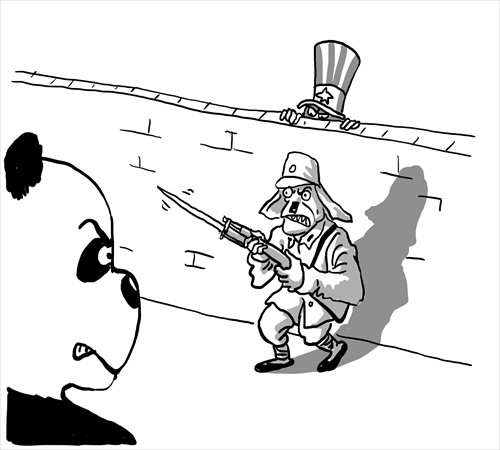
Illustration:Liu Rui/GT
Shinzo Abe's cabinet approved Tuesday a critical defense policy package comprising new defense program guidelines, a five-year defense buildup plan and the national security strategy.A Japanese media outlet commented on the new package, saying it was "three arrows of security." It also said Japan has made a historic step in turning itself into a great military power.
The Japanese government defined the basic principle of the new guidelines as "the construction of highly efficient and comprehensive defensive power" with the major purpose of asserting more control over the air and maritime military maneuvers.
It seems that Tokyo is attempting to lay the foundations to compete for the leadership of Asia, as a long-term goal.
Abe's short-term objective - to break free of the post-war regime and acquire an equal position with the US in terms of the US-Japan alliance - is far more important for now.
Abe's maneuver reflects the so-called "pursuit" of his grandfather Nobusuke Kishi, a "Class A" war criminal. Kishi spared no effort to rebuild Japan into a proud military power by attempting to revise the "peace constitution" drafted by the US after WWII.
Abe has inherited his grandfather's notorious goals as both of them are convinced that a politically independent power should be a great nation economically and militarily.
Consequently, Japan must possess the same political position with other Asian nations and first of all gain an equal footing with Washington in order to become a "normal state."
That is why Abe has chosen to amend the peace constitution as his primary method, with a concreted political goal of embracing the right to engage in collective self-defense, under which Japan has the right to counterattack when its allies are under attack by foreign countries and an attack on an ally is regarded as an attack against Japan.
This can be likened to the collective defense mechanism launched by the parties to the North Atlantic Treaty Organization — when a party is at war with an external state, other parties will provide assistance including military forces.
There will thus be a fundamental change in US-Japan ties in the future. The US-dominated relationship where Japan plays a role of "servant" will gradually lose its momentum.
Regarding the "roadmap" toward building up a powerful military country that Abe is vigorously advancing, we can see the shadow of Kishi who escaped prosecution on charges of war crimes.
During the 1950s and 1960s, Kishi once took advantage of the sharp conflict between the US and the former Soviet Union to serve as a "pawn" of Washington in its Soviet Union strategy as well as the "two Chinas" policy. In this way Japan acquired US military support, on the basis of which the Japanese government has been trying every means to renounce the constitution and make Japan a military power.
However, will Abe be able to realize the dream that his grandfather failed to fulfill? At least the current geopolitical changes coupled with the US "rebalancing" strategy to Asia have offered Abe an opportunity to boost Japan's military might.
The security architecture in Asia is encountering drastic changes at present, prompting the US to shape a new framework where it can maintain the dominant position to hedge against a rising China.
Despite concerns over Tokyo's rightist and nationalist policies, Washington still expects to counterbalance Beijing to relieve its military burden in the Asia-Pacific region with Japan's increasing military capacities.
Abe has a full understanding of Washington's goals, since he remarked last year that Japan and the US were dependent on each other at this critical moment, when the latter was adjusting its deployment in the Asia-Pacific area.
How far Japan will go on this aggressive road will depend on how much trust the US has in it, as well as the attitudes regional powers including China and South Korea adopt toward it. Nevertheless, it must be noted that we cannot place our hopes on the US to stop Japan revising the peace constitution.
Once Tokyo achieves its goal of a military buildup, Washington will make adjustments to its obligations to Japan, and furthermore, the trilateral relationship among China, Japan and the US will change correspondingly. Perhaps it is high time for Beijing to ponder carefully how to maintain a balanced situation in this region.
The author is a senior editor with the People's Daily. He is now stationed in Brazil. dinggang@globaltimes.com.cn. Follow him on Twitter at @dinggangchina