HOME >> METRO BEIJING
Grape leap forward
By Li Ying Source:Global Times Published: 2014-1-2 19:08:01
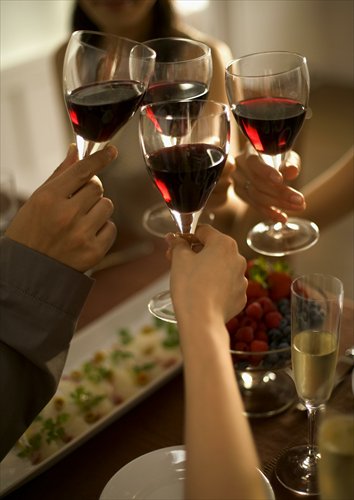
As China's premium wine market cools, sales of affordable domestic wines are booming and winning acclaim with tasters. Photo: IC
China's high-end wine market might be suffering a sales hangover from the government's anti-extravagance crackdown, but domestic makers of competitively-priced wines have had plenty of reason to raise their glasses amid growing profits driven by middle-class consumers.Jim Boyce, a local wine writer who runs the blog grapewallofchina.com, regularly holds blind wine tastings in Beijing. The biggest contest he organizes is the annual Grape Wall Challenge, which was held on December 27, 2013. A panel of 13 wine consumers - three men and 10 women - gathered for last week's contest held at Temple Restaurant in Dongcheng district.
"This contest is different because it is the only wine tasting in which judges are casual consumers, specifically those who enjoy and occasionally drink wine instead of wine experts," Boyce said as he introduced the contest.
"We want consumers to feel confident when talking about wine. Most people can easily argue why they like a particular kind of pizza or Peking duck, but wine tends to be intimidating. We hope to make it less so by making consumers judges."
Rising up to the challenge
The Grape Wall Challenge has featured both imported and domestic wines for the past four years, but last week Boyce prepared 20 exclusively Chinese wines equally divided between reds and whites. The wines were all priced at 150 yuan ($24) or less per bottle.
The contest's premise was simple: Participants tasted 20 wines and graded each as "love," "like," "dislike," or "hate." The 20 wines were divided into four flights for tasters to compare and discuss.
Boyce is a firm believer that Chinese wines can match it with the rest of the world in terms of quality. He organized a contest in 2011 dubbed the Ningxia vs. Bordeaux Challenge, which invited wine experts to rank 10 wines priced between 260-490 yuan per bottle from China's Ningxia Hui Autonomous Region and France's Bordeaux. The results caused a stir, with four out of the top five wines being Ningxia reds.
"We have proven that China can produce good wines. Next, China needs to show they can produce well-priced wines," Boyce said.
Surprising quality
During the two-hour tasting, verdicts from the panel of tasters revealed most Chinese wines were easy on the palate. Only four tasters had fewer "like/love" votes than "dislike/hate" votes, according to Boyce.
The most popular wine was Grace Chardonnay, which was "disliked" by just one taster. Runners-up with 10 votes each were Grace Vineyard Premium Chardonnay, which polled four "loves," six "likes" and three "dislikes," and Helan Mountain Premium Cabernet Sauvignon, with one "love," nine "likes" and three "dislikes."
A taster, surnamed Yang, said she was surprised by the high standards of homegrown wines on offer. "I was impressed by the quality of the Chinese wines, which were all reasonably priced," said Yang, who works for an event planning company.
"When my company organizes parties or dinners, we always buy imported wines because we don't associate Chinese wines with fine taste," she said, adding she would try some Chinese wines in the future.
Ma Huiqin, a professor of agriculture and biotechnology at China Agricultural University and vice secretary of the Chinese Society for Viticulture, was one of the experts in attendance at Friday's tasting.
"The tasters didn't expect so many wines to be of such high quality. Many said they could buy the ones they liked most," Ma noted.
In the wake of the anti-extravagance crackdown, the future of the wine market will be driven more by regular consumers. Good wines at good prices will be more welcome in the market compared with high-end ones, she said.
Market in constant evolution
According to marketing research company S&P Consulting, in 2013 the sales volume of the Bordeaux-based Château Lafite Rothschild, the most popular premium wine brand in China, dropped by 40 percent compared to 2011 when the wine market in China boomed, China Economic Net reported.
In 2010, China overtook the UK and Germany to become the largest foreign wine market for Bordeaux wines.
Zong Ruixue, a wine distributor based in Jiangsu Province, confirmed that premium imported wines have fallen on hard times in China over the past year.
"High-end wines, specifically those priced at more than 2,000 yuan per bottle, experienced a sharp decrease of about 50 percent in 2013 at my company due to government budget cutbacks and tighter scrutiny of the expenditure of public funds for banquets," said Zong.
However, the sales volume of wines priced between 100 yuan and 300 yuan per bottle have seen an increase as the number of middle-class consumers rises, said Zong.
"This is due to two reasons. Firstly, wine booms in past years have fostered an appreciation for wine culture among ordinary Chinese," explained Zong. "Secondly, Chinese have started paying more attention to raising their lifestyle standards as their livelihoods improve. Many are also convinced that drinking wine in moderation is good for their health."
Changing consumption trends within the wine market have pushed Zong and other wine distributors to adapt their market strategies.
"In the past, we spent time trying to maintain relationships with government departments and big companies, but now we are directly dealing with individual consumers," he said.
The slump of premium wines has also forced a lot of small distributors out of the industry, but Zong believes the situation is good for China's wine market overall because it will lead to a "more sensible and regulated market."
Diverse tastes among consumers
Although Boyce conceded that wines sampled for the Grape Wall Challenge aren't representative of the Chinese wine market in general, he is hopeful that their quality indicate the direction the industry is heading.
Ma believes that it's only a matter of time before Chinese winemakers are held in the same esteem as their counterparts from Europe, Australia and the US.
"Wine tastings that involve consumers are insightful for the development of China's vineries," she said.
"Experts and consumers usually have different opinions on what makes a good wine. It is necessary for winemakers to better understand consumers' tastes," she said. For example, the blind tasting showed that sweetness in aroma is appreciated. This extends to a sense of sweetness in taste, usually due to ripe fruit, even when a wine is dry.
Results also suggest that Chinese consumers' tastes are diverse because no one variety of wine is considered an overwhelming favorite.
Among five Chinese wines priced over 150 yuan sampled by tasters at the Grape Wall Challenge, all polled at least 11 "likes" or "loves" out of a possible 13 votes. Two contrasting chardonnays - the Grace Tasya's Reserve and Helan Mountain Special Reserve - were "liked" or "loved" by all judges. "This shouldn't be a shock, but the point is often lost because it is far easier to generalize about a billion-plus people and seek … a single kind of wine than to deal with the complexity of the Chinese market," said Boyce.

Once considered popular only among the elite, wine in China is riding a new boom driven by middle-class consumers with discerning palates. Photo: IC
2013 Grape Wall Challenge winesFlight 1
Grace Chardonnay 2011 (Shanxi, 72 yuan, Torres)
Silver Series Chardonnay 2010 (Xinjiang, 98 yuan, 1421)
Grace People's Chardonnay 2011 (Shanxi, 99 yuan, Torres)
Admiral's Reserve' Chardonnay 2010 (Xinjiang, 118 yuan, 1421)
Flight 2
Helan Mountain Premium Chardonnay 2012 (Ningxia, 138 yuan, Pernod Ricard)
Great River Hill Chateau Nine Peaks Chardonnay 2012 (Shandong, 150 yuan, East Meets West)
Grace Premium Chardonnay 2010 (Shanxi, 125 yuan, Torres)
Hansen Semillion Riesling 2009 (Gansu, 138 yuan, China Wines & Spirits)
Flight 3
Silver Series Cabernet Sauvignon 2008 (Xinjiang, 98 yuan, 1421)
Grace Cabernet Merlot 2012 (Shanxi, 72 yuan, Torres)
Helan Mountain Classic Merlot 2011 (Ningxia, 98 yuan, Pernod Ricard)
Grace People's Cabernet Sauvignon 2011 (Ningxia, 99 yuan, Torres)
Flight 4
Hansen Cabernet-Gernischt 2011 (Inner Mongolia, 138 yuan, China Wines & Spirits)
Helan Mountain Premium Cabernet Sauvignon 2010 (Ningxia, 138 yuan, Pernod Ricard)
Great River Hill Chateau Nine Peaks Cabernet Sauvignon 2011 (Shandong, 150 yuan, East Meets West)
Admiral's Reserve Cabernet Sauvignon 2010 (Xinjiang, 118 yuan, 1421)
Posted in: Metro Beijing