UK decision day
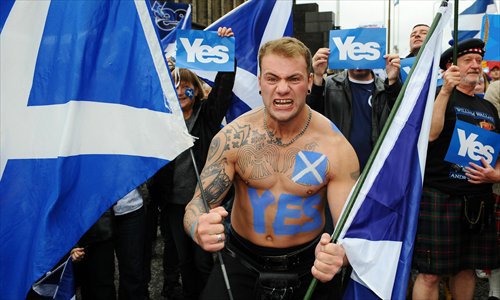
Pro-independence supporters gather in Edinburgh on September 21, 2013 for a march and rally in support of a yes vote in the Scottish Referendum to be held on September 18, 2014. Photo: CFP
Scottish independence would "diminish us all," UK Foreign Secretary William Hague said on January 17, when he launched the latest Scotland Analysis paper.
He believes Scotland is financially better off, more secure and has more influence in the world as part of the United Kingdom.
The paper came out just after the "Scotland's Future" White Paper was unveiled on November 26, 2013. Scotland's First Minister Alex Salmond launched his government's 670-page independence blueprint, promising a "revolution" in social policy.
"Our vision is of an independent Scotland regaining its place as an equal member of the family of nations," Salmond said. "However, we do not seek independence as an end in itself, but rather as a means to changing Scotland for the better."
Scots are to vote in an independence referendum on September 18 that could end the 306-year-old union with England.
David Cameron used his new year's message to plead with Scots to stay in the UK. In a televised statement, the prime minister said 2014 was a historic year because of the vote on Scottish independence, which could "change our country forever."
"This year, let the message go out from England, Wales and Northern Ireland to everyone in Scotland … we want you to stay and together we can build an even stronger United Kingdom for our children and grandchildren."
Economic matters
As Scottish independence seems more likely than ever, whether the Scottish economy would perform better as an independent country has become a central concern for Scots.
According to ScotCen's latest annual Scottish Social Attitudes Survey, voters are more likely than ever to base their decision in September's referendum on whether they think independence will be good for the economy and their own wallet.
When voters are asked what they would do if they thought they would be 500 pounds a year better off as a result of independence, 52 percent indicated that they would support the idea. On the other hand, only 15 percent said they would do so if they thought they would be 500 pounds a year worse off.
It sounds a bit heartless that independence referendum results hinge on whether people will be 500 pounds a year better off. It can't be denied the economic consequences of independence are clearly a key factor, just as the economy played a critical role in the Scots' original decision to join the Union.
The Acts of Union between Scotland and England took effect on May 1, 1707, when "the Scots needed financial help following an economically disastrous scheme to attempt to colonize the Isthmus of Panama in the late 1690s," the Daily Telegraph reported.
Now economic incentives have become one of the driving factors again in Scotland's leaving the Union. Among them, the issue of who owns the oil and gas in the waters off Scotland's coast is a big one.
Scotland's North Sea oil and gas has been a hotly debated asset since its discovery in the 1970s. "It's Scotland's Oil," a pro-independence slogan helped the Scottish National Party achieve their best-ever result in a Westminster General Election in 1974. And now it continues to help them get closer to their independence dream.
The Yes Scotland campaign says, "International law makes clear that fields generating around 90 percent of the revenues will be in Scottish waters."
The campaign for independence also suggests that Scotland follow Norway's model, which uses its oil and gas to become not only one of the wealthiest countries on Earth in terms of GDP per head of population but also now sits at the top of world wellbeing and equality league tables.
Those who oppose independence argued against the idea.
BBC quoted the Better Together campaign's Alistair Darling as saying, "betting a country's economic future on such a volatile and declining resource just isn't credible. It is time that the nationalists were straight on this."
Braveheart moment
The year 2014 will witness the 700th anniversary of the Battle of Bannockburn, the Scottish king Robert Bruce's iconic victory over England in the 14th century. Scotland will also host the 2014 Commonwealth Games and the 2014 Ryder Cup. Salmond himself admitted that the presence of these events made 2014 a "good year to hold a referendum," according to the Economist magazine.
Peter Kellner of YouGov, an international Internet-based market research company, told the Global Times, "Alex Salmond is probably Britain's most formidable political campaigner. If anybody can make a difference, he can. However, the Better Together campaign is quite effective in raising a lot of fears about the consequences of independence."
With the historic moment approaching, the two sides are intensifying their campaigns, explaining the merits or pitfalls to voters by holding public meetings, participating in debates and distributing information.
Blair Jenkins, chief executive of Yes Scotland, told the Global Times, "Already in public debates and in millions of conversations our activists are having with their friends, family and colleagues we are finding that the more people hear about the benefits to them and their loved ones of independence, the more inclined they are to vote 'yes.'"
Rob Shorthouse, director of Communications at Better Together, told the Global Times, "In these tough and turbulent times, the size, strength and stability of the UK economy is a huge advantage for Scotland's businesses. Scotland's security will be strengthened as part of the United Kingdom."
Hague warned Scots face a "pay more get less" deal with Europe if they vote for independence. Scotland would face an extra bill of between 1.65-3.5 billion pounds ($2.73-5.8 billion) as more powerful EU states forced it to accept tougher terms of membership after independence. Scotland would also be forced to accept the euro.
With so many uncertainties clouding the future of independence, a recent YouGov poll shows support for separation stagnating at 30 percent after the marathon 18-month referendum campaign.