World Cup may prove own goal for Brazil
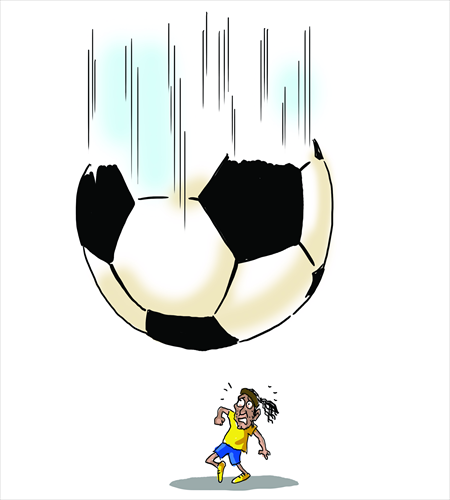
Illustration: Liu Rui/GT
This year is a big one for soccer fans, as the countdown begins to the World Cup in Brazil that kicks off this June. But the soccer-crazy nation may prove a disappointment to tourists, given the chaotic state of preparations.
On January 27, thousands of Brazilians demonstrated against FIFA, the international soccer association, on the streets. The protests escalated into violence, with police cars set ablaze, bank doors broken down, and over 120 people detained.
It was the first anti-FIFA demonstration this year, but there have been countless others since construction for the World Cup started in 2007.
FIFA has been criticized by soccer fans worldwide for its corruption and incompetence, but its monopoly on the game has yet to be broken.
The granting of the 2022 World Cup to Qatar, a blazing hot Middle East country, raised hackles across the world amid accusations of bribery.
In Brazil, FIFA's ineptitude has merged with local corruption to produce massive budget overruns that bite into the public budget.
In 2007, the Brazilian government pledged to spend $1.1 billion on the stadiums for the World Cup, and to seek most of the investment from the private sector.
Nonetheless, spending has so far reached $3.7 billion, 90 percent of which comes from the public purse. This is not the end of the story - another $11 billion is needed on other World Cup related expenses.
Huge spending has taxed public nerves. For a developing country where 30 percent of the population lives in poverty, this is unbearable, especially after GDP growth slowed to just 0.9 percent in 2012 from 7.5 percent in 2010.
Moreover, public healthcare and education needs capital injections that instead are going to fund a sporting extravaganza. Ordinary Brazilians want better lives, not grand stadiums.
And despite the huge investment, the projects are not running smoothly. Only seven stadiums out of the planned dozen meet safety standards.
Curitiba, the capital of the southern state of Parana, is so behind with its renovations that the FIFA committee could strip it of its host status if they don't meet the new deadline on February 18.
The most expensive stadium, which cost more than $500 million, was built in the capital Brasilia, but has a leaking roof less than eight months after being finished.
With an underdeveloped transportation infrastructure, hotels in short supply, and struggling telecommunications in small cities, soccer fans may face many inconveniences.
Broadcast fees for radio and TV have been jacked up, scaring away many media outlets, while hotels and air tickets have got so pricey that they may force fans to watch games at home.
Soccer fans enjoy the zealous atmosphere on the spot, but if that means too high costs, many will choose to watch and yell in front of the TV screens, rather than fly all the way to the venue.
Such worries are commonplace in the run-up to global sporting events.
In some other countries, online criticism and sports fans' complaints are often heard before big sporting events. Even in 2008 in Beijing where the preparation work for the Olympic Games was so well done, social anxiety and complaints were not rare.
But with only four months to go, Brazil still has many stadiums that need to be finished and services made available.
And this is not going to be an easy task, since so many thorny issues are involved which have triggered social tension.
The World Cup will go on, but this society may be left divided, rather than united, if the nation doesn't step up its game.
The author is a news editor at China Radio International. opinion@globaltimes.com.cn