Secure cooperation can break down wariness over pipelines
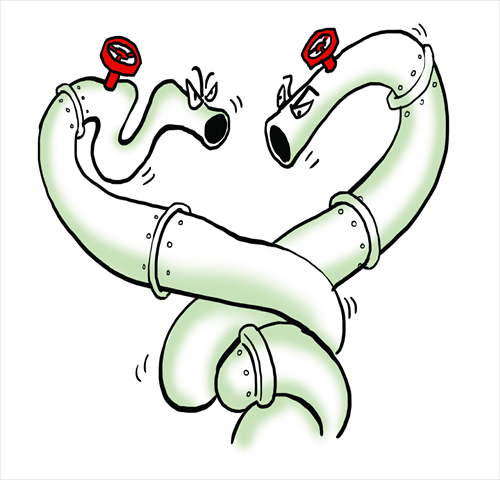
Illustration: Liu Rui/GT
China and India, both newly emerged developing economies, seem to be natural rivals in scrambling for global energy resources.
The two countries share similar trends of energy demands and consumption structure.
Both are highly populous, and their industries are developing rapidly despite relative low efficiency at the moment.
In both countries, coal is the main source of energy, and pollution is severe. Both are short of resources like oil and natural gas, so they are highly dependent on imports.
Meanwhile, both are in a weak position in the international energy market, since they have neither a solid energy foundation nor a say in the international energy pricing system.
Therefore, the two have adopted similar overseas oil and gas strategies, under which government-backed oil companies go abroad to seek resources, enhancing cooperation with energy-rich countries and building long-distance pipelines to transport energies.
The specific trajectories of the two seeking overseas oil and gas resources are almost the same; they started with the Middle East and Africa, followed by Russia, Central Asia, North America and Latin America. As a result, there has been a lot of attention on competition between the two.
We do not avoid talking about competition with India. Oil companies from both countries have battled in Angola and Ecuador for the right to exploit oil. The two also contended in the purchase of oil and gas in Kazakhstan.
But we should also not forget about the close cooperation of oil companies over the Nile. The two also boost promising cooperation prospects in projects in Iran, Myanmar and Russia.
The current problem lies in how to avoid unnecessary competition and excessive speculation between the two and how to establish a coordinating mechanism for bilateral cooperation.
Frankly speaking, in the head-on competition between Chinese and Indian companies, Chinese companies have won most of the time. This has made the Indian side so sensitive toward competition with China that they often used fighting words.
Yet some cool-headed watchers have insisted we analyze why Chinese firms often beat Indian ones. To put it simple, it is because Chinese companies can offer more favorable returns. The returns include not only fund, technology and infrastructure construction, but also management experience and staff training.
Admittedly, overseas Chinese oil and gas companies often pay a high premium. As a result, in order to make a profit, Chinese companies have tried their best to boost the efficiency of exploitation and operation. While Chinese companies won global competence, they also have to pay this high premium.
But this is not sustainable for Chinese firms. And Indian companies also need to avoid too much competition to save money. This offers room for cooperation between China and India.
Although political trust and business correlation between China and India are not enough for the two to become allies, it is still likely that companies from both sides can cooperate to seek for common interest. The two governments have the responsibility and capability to promote a cooperation and coordination mechanism through bilateral or multilateral talks.
Currently, both China and India are wary of each other's pipelines. The under-planned Turkmenistan-Afghanistan-Pakistan-India Pipeline has raised particular concern that the two may compete for natural gas in Turkmenistan.
And given that Asian countries are eager to end the current situation where Asian countries have to pay higher import prices for liquefied natural gas products compared with their US and European counterparts, Asian countries that consume a great deal of LNG like China, India, South Korea and Japan should cooperate.
But the premise for China and India cooperating in energy is that each must respect the core interests of the other. If India insists on exploiting the resources in the South China Sea with Vietnam regardless of warnings from China, it is hard to see how China can be motivated to cooperate with India.
The author is an assistant research fellow at the Academy of Chinese Energy Strategy with the China University of Petroleum, Beijing. opinion@globaltimes.com.cn