Sino-Indian boundary issues edging toward answers
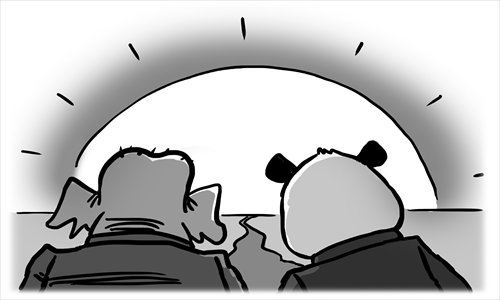
Illustration: Liu Rui/GT
Suddenly, India and China are talking more and bickering, at least in public, less. In the 60th year of the Panchsheel Treaty, known in China as the Five Principles of Peaceful Coexistence, negotiations on the contentious boundary have not witnessed significant breakthrough, but New Delhi and Beijing are at least talking frequently at various levels to try to find common ground.
In less than four months after Indian Prime Minister Manmohan Singh visited Beijing, the special representatives (SR) from both sides met in Delhi for the 17th time since the mechanism was put in place in 2003. This was followed up by the Annual Defense Dialogue (ADD) between the two countries in New Delhi last week. In both cases, the talks were extensive, covering a wide range of issues from boundary to more defense exchanges and from Afghanistan to the contentious issues in Southeast Asia.
But what came as a surprise to the Indian side was a formal Chinese proposal during the SR level talks to put in place a new code of conduct on the border. This was made despite there already being a series of arrangements between the two armies since the 1980s when the confidence-building measures were first put in place along the undemarcated borders, the last one coming in October 2013 under the Border Defense Cooperation Agreement (BDCA).
Indeed, the BDCA has yet to be fully implemented. New Delhi has not formally responded to the new proposal but asked for more details during the ADD.
Following these two exchanges, the assessment in the Indian establishment is that the Chinese want the momentum on border talks to be maintained and to avoid risks of an unpleasant incident, like the one in the Depsang area in April 2013, which could derail the overall relationship. But no one is talking of any big breakthrough at the moment.
Indian analysts see a slight change in the Chinese approach. Instead of dwelling on the well-known differences on the border, the Chinese now want to explore the commonalities. This, the Indian assessment says, is because China now recognizes that Indian military presence on the boundary, despite infrastructural problems, has increased and so have the chances of a standoff. One way of avoiding any "accident" on the long boundary, both sides agreed, is to have more tactical level exchanges between the forces on the ground.
India is also cautious about China's offer to create a "Maritime Silk Road" connecting the Indian and the Pacific oceans, since it is seen as serving the Chinese interests more than being beneficial to other Asian nations, including India. India's former foreign secretary Kanwal Sibal commented in India's media last week that "China's maritime silk route proposal is too self-serving to receive our support."
As for the overall role that both countries could play in shaping the regional security architecture in Asia, Beijing and New Delhi seem to have agreed that it is in everybody's interest to avoid confrontation in a crowded geopolitical space like the Asia-Pacific region.
One indication of India's stance came at an Asian Security conference organized by the Institute of Defence Studies and Analyses this month where India's National Security Advisor Shivshankar Menon said: "The commons, on the high seas, in air space and in cyber space should be safe and open to all lawful civilian users. That is why maritime security and freedom of navigation is so important and should be one of the first orders of business."
Menon also described "openness about doctrines and defense, and increased military contacts" as prerequisites to take some of the edge off uncertainty, although confidence-building can only hold the ring until the hard work of solving disputes and agreeing a rule based legal order is done.
New Delhi and Beijing are nowhere close to solving the boundary issue, since the political parameters of any eventual border settlement are as yet unclear and are unlikely to be finalized in the near future. Until then, frequent and open dialogue appears to be the only way forward.
The author is security & strategic affairs editor with Indian broadcaster NDTV. opinion@globaltimes.com.cn