HOME >> OP-ED
Peace priority in Myanmar’s political shift
By Marie Lall Source:Global Times Published: 2014-3-30 22:33:01
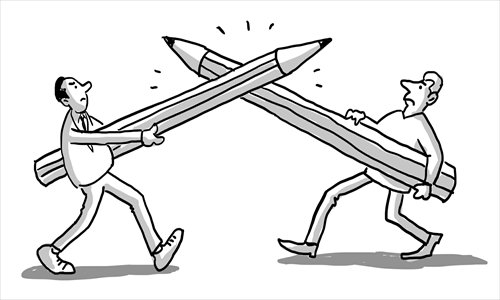
Illustration: Liu Rui/GT
Myanmar's Constitutional Joint Review Committee recently reported back on potential constitutional reforms. The 109-member committee made up of ruling party and opposition MPs received 28,000 suggestions for amendments, and also claimed to have received a petition signed by over 100,000 people who did not want to see the constitution changed.
Changing the constitution has been one of the most important debates that emerged after the 2010 elections and was brought to the fore when Aung San Suu Kyi's National League for Democracy (NLD) joined parliament in 2012.
At that time, the NLD MPs, under the leadership of Suu Kyi, refused to take the oath that required them to protect the 2008 constitution. A compromise was found eventually and the MPs took their seats, but the NLD has continually argued that the constitution needs to be revised.
The heart of the debate lies around Article 59-f which forbids any of the president's family from being foreigners and bars Suu Kyi from the presidency due to her two sons by her late English husband.
Article 59-f is indeed discriminatory and it needs revising not because of Suu Kyi specifically, but because many other young Myanmar people who now have ties to foreign countries. Focusing the debate specifically on Suu Kyi's potential presidency has personalized the dispute and been less than helpful.
The NLD also opposes Article 109 that guarantees 25 percent of the seats in parliament are reserved for the army. This is especially important, because according to Article 436 any constitutional amendment requires 75 percent support in parliament, and therefore in practice the support of the military MPs.
So far the committee doesn't want to change either article. And there is now a stalemate between what the NLD wants and what the committee suggested.
Suu Kyi has been touring the country, speaking at rallies that support her wishes of constitutional amendment and garnering support from the wider public.
Suu Kyi has reportedly threatened to boycott the next elections unless her demands are heard. There is now a smaller committee of 31 MPs who have to make the official recommendations to parliament based on the committee's report. It remains to be seen if they will deal with the issues raised by the NLD.
Leaders of the ruling party in government have had different views on changing the constitution. It seemed that Suu Kyi had brought Myanmar parliament speaker U Shwe Mann on her side, as he declared his support of changing Article 59-f saying "I would personally be glad if Ama Gyi [i.e. Suu Kyi] becomes president."
But more recently, Shwe Mann has explained that changing Article 59-f is not the first priority. Clearly he would be the biggest beneficiary if Suu Kyi were not allowed to stand for president, as he has expressed interest in the post himself.
Nonetheless, he does have a point. There are more urgent revisions needed in light of the peace process.
Much more important are suggested amendments regarding power sharing between the states and the center, as already brought forward by the parliamentary committee. This is indeed essential, as the government is negotiating a national cease-fire agreement with all non-state armed groups (NSAGs).
One of the main demands of the ethnic armies has been a greater level of federalism, especially regarding power over natural resources located in the ethnic states and issues pertaining to the use of mother tongue languages.
A lot of progress has been made, but a country-wide cease-fire is still elusive, and the government can use constitutional change to underlie the peace process and show good will.
The sticking point remains that of a "federal army" that is opposed by the military leadership.
This should be the focus of constitutional change in the short term. Peace between the NSAGs and the government is the only way to guarantee that the government leading the country after the next elections, whether headed by Suu Kyi or not, will successfully be able to continue the reform process.
The author is a South Asia expert with the Yangon-based Myanmar Egress, a non-profit organization founded by Myanmar scholars and social workers. opinion@globaltimes.com.cn
Posted in: Viewpoint