Tatar population faces uncertainty in Crimea
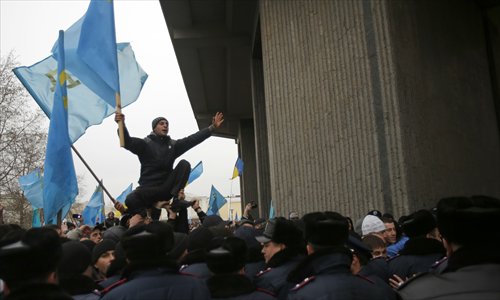
A Crimean Tatar waves the ethnic flag of the Crimean Tatars during a protest in front of a local government building in Simferopol, Crimea, February 26, 2014. Photo: IC
As the world speculates on the political trajectory of the Crimea peninsular, the local indigenous population wonders how it will change the fate of their ethnicity.
Three weeks after the referendum in Crimea, Russian control over the region, from sending troops to control main sectors of the peninsula to supporting the local pro-Moscow government, has become the status quo that Western powers still refuse to recognize.
Accounting for only 12 percent of the Crimean population, the Tatars have been under the spotlight throughout the regional transition process, as they are the group in Crimea opposing Russia's incorporation of the peninsula.
Crimean Tatars chose not to participate in the referendum that changed the region's political status. The Tatars boycotted the March 16 vote, which they say was against the law of the Ukraine and illegitimate due to its haste.
Oppressed history
As a minority of the population, the choice of the Tatars in the referendum would have changed little as pro-Russian votes won by a landslide 96.77 percent.
However, the unusual decision of the Tatars to abstain makes their reasons for doing so interesting.
The Tatars first settled in Crimea along with Mongolian conquerors that took over the peninsula in the early 13th century. They have flourished since.
The relationship between Crimean Tatars and their post-1783 Russian rulers didn't descend to incurable conditions until 1945 when Stalin expelled the Tatar people from Crimea to Central Asia, blaming them for colluding with Adolf Hitler during World War II.
Tatars only returned to their motherland in the early 1990s during the chaotic era following the collapse of the Soviet Union. By that time, Crimea had become part of Ukraine.
Since then the Tatars have vigorously struggled to restore their social status to where they were before being persecuted.
Mistrust of Russia
Mistrust toward Russia and the current Crimean government, which they see as a "puppet government" of Moscow, is widespread among the Tatar population.
The referendum, as Tatars saw it, was nothing more than a staged show by Crimean authorities under the direction of Moscow.
Aider Abdelhamid, 27, Tatar resident who works in the city of Yevpatoriya in Crimea, told the Global Times it was illegitimate because the move was both against Ukrainian law and held too hastily to be effective.
The date of the referendum was expedited twice by the government before it was set for March 16, 10 days after the announcement. The change of date shows that "they are afraid and in a hurry for something," said Abdelhamid.
According to Abdelhamid, in the run-up to the referendum, secret acts like the kidnapping of activists and journalists, as well as threatening, torturing and killing them, were recorded. So-called "self-defense" forces comprising of local pro-Russian militia members became actively visible on the streets of Simferopol, the Crimean capital.
"No free, democratic referendum can be done while there are so many army and people with guns are walking on the streets," said Abdelhamid.
The harassment of activists could not be verified by Crimean authorities.
According to official statistics, 180,000 among the total of 280,000 Tatars were eligible to vote for the referendum, but only about 1,000 of them cast their vote.
Uncertainty for the Tatars
Chubarove Refat, Chairman of Crimean Tatar Megis (an organization in the Tatar community) said that he was worried that once the deepening conflict between Russia and Ukraine gets out of control, the Tatars, as a minority group, would face an uncertain future.
Refat demanded the deeper participation of the international community in resolving the Crimea issue.
A number of Russian-speaking residents and local government officials including Igor Chichkin, a deputy of residents working in the township council of Gvardeyskoye, said it seemed that Tatar people are not interested in social affairs.
For Crimean authorities, the uncooperative move by Tatars in the referendum was out of their consistent stance of being indifferent to political and social involvement.
Grigoriy A. Ioffe, first vice-chairman of the Crimean parliament, blamed community leaders for promoting estrangement between ordinary Tatar people and the government, saying the authorities had made great effort to incorporate the Tatar community in vain.
In early March, the Crimean Parliament approved a new bill that secures 20 percent of government positions for the Tatar people. The community account for just 12 percent of the Crimean population.
However, Abdelhamid refuted the charge, saying community leaders had full support from the people and that the Tatar community became even more unified during the ongoing Crimean crisis. He also refutes the new parliament bill as an attempt to please the Tatars ahead of the referendum.
He doesn't attach much hope on the prospect of the improvement of the living environment of ordinary Tatars, not while Tatars ultimately pursue greater recognition of the suffering the people endured and restoring the social status they enjoyed before their persecution.
An immediate move the Tatars would like to see is a new structure of government that includes all indigenous people of Crimea and in all sectors of government and at all levels, according to Abdelhamid.
"Any important issues, especially such as separation from one country and joining another country should not be made without the consent of the indigenous people of Crimea," he said.
Read more in Special Coverage: