Run for it
Despite boom in popularity, running events still face hurdles in China
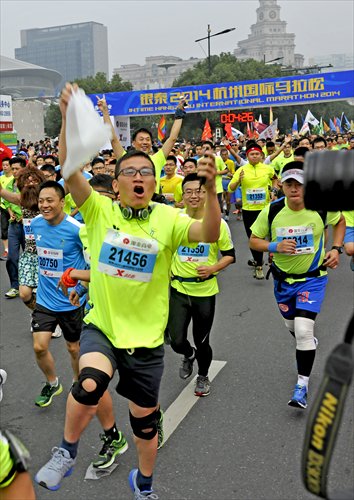
Runners participate in the 2014 Hangzhou International Marathon in Hangzhou, Zhejiang Province, on November 2. Photo: CFP
Lei Zongyang has been running all over the country.
Not as part of a single run however. Ever since his first marathon in 2012, in his hometown of Guangzhou, Guangdong Province, Lei has loved the thrill of marathons and other runs.
But Lei, 25, who works in the training industry in Beijing, also pays attention to the details behind the organization of such events. "In Qinhuangdao (a coastal city in Hebei Province), you can feel that the city attaches great importance to the event, with a large number of support staff and soldiers along the course. Plus it's nice to run along the coastline."
As a craze for running events sweeps China, Lei is not the only Chinese runner whose schedule has been packed with a variety of events. He has met many like-minded marathon enthusiasts involved in both domestic and international events. According to the runners and organizers of the marathons, although a growing number of second-tier and even third-tier cities are holding marathons in China, there is still a lot of room for them to improve.
More, and merrier
Lei is among the many experienced Chinese runners who have witnessed the development of all sorts of running events, and the blooming running culture in China. From the beginning, when runs struggled to meet their participant quotas, to the current situation, where the marathons are so popular that sometimes lotteries are required to whittle down the number of entrants.
In 2010, it took five months for the Beijing Marathon to receive enough participants, but this year's quota of 30,000 people filled up within one day. A lottery was even required - with just a 14 percent possibility of getting selected - for the half marathon. The website of the Shanghai International Marathon saw around 700,000 visits each hour this year, with people competing for the opportunity to run.
According to the official website of the Chinese Athletic Association, 22 marathons were approved by the association and held in 2011, and 50 have been approved in 2014. More second-tier and even third-tier cities are getting involved in these kinds of events, such as Shuifu in Yunnan Province, a county which only has around 100,000 residents.
But despite this boom, the quality and quantity of China's events still lagged behind the US in 2013. According to data from Running USA, an American organization that advances the growth of the running industry, more than 1,100 marathon runs were held in 2013 across the US with 541,000 instances of people finishing running events - as opposed to just participating in them. Meanwhile, according to research by sports blogger Wang Dong, based on a list of events by the Chinese Athletic Association and relevant media release reports, there were only about 75,000 instances of people finishing marathons in China in 2014.
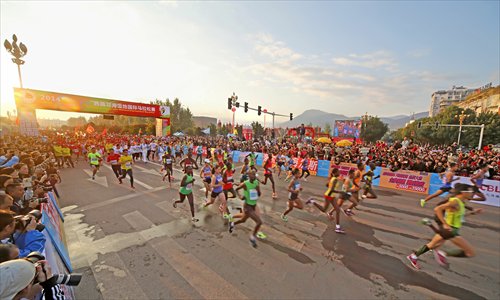
The Xichang International Marathon, held on November 9, is considered by experts to be a good example of a small city holding a successful marathon, as it prominently featured local sights. Photo: CFP
On the run
Two of the major factors that have an influence on runners like Lei when deciding whether to travel all the way to a city especially for its running event, are whether the running course goes past special cultural or scenic spots, as well as the reputation of the host city.
"In some events I participated in runners were often jammed together at the starting line after the race started, and it took more than 15 minutes for people in the rear to finally be able to get going. When I was in Singapore (for a marathon), participants were divided into different groups based on their estimated time of finishing the course. Each group had a different time to start the race."
Wang Yangxing, 27, has run in marathons in more than a dozen cities around China in the past two years. He has also been to Japan, South Korea and Cambodia for international marathon events.
Wang has noticed that many cities know how to host an influential marathon which can boost their image. "For example, they chose to host last year's marathon in Yangzhou, Jiangsu Province, in April, the most beautiful month of year," he said. Wang agreed with Lei by saying the first important factor to consider when deciding whether to go a marathon or not, is what the local course is like. "If it's just another run passing all kinds of buildings in the city, it's not special," he said.
"One of the major problems (for the Yangzhou race) was that they didn't have good transportation at the finish line. People had to wait a long time for the bus. And it was in the middle of nowhere so it was impossible to get food. That experience taught me to always bring food when going to second-tier cities for marathons."
Other aspects that sometimes damage events include being unable to ensure every competitor gets a T-shirt of the right size, chaotic scenes at the starting lines, and lack of supporting seminars and exhibitions ahead of the run.
Time to grow
These marathons tend to lag behind due to a lack of experience on the part of organizers, and an underdeveloped running culture, said Wang, who works for an online platform that helps to organize running events in Shenzhen, Guangdong Province.
According to the National Sporting Goods Association, the US has more than 50 million running enthusiasts, accounting for 16 percent of the country's population. However, in China, "most of the runners are still a small amount of white collar workers," Wang said.
Wang thinks that in future, running events will become more specialized. "The marathons in major cities will become more and more professional. There will be lotteries to determine entry, and shorter courses such as mini-marathons and family marathons will be canceled. And there will be more themed running events with shorter courses to cater more to the general public."
"I believe there is still 10 times more space for growth compared to our current accomplishments," said Huang Xinjing, the CEO of the Beijing Erun Information Technology Company, which has organized assorted online and offline running events in and out of Beijing since 2012. "The coming few years will be a golden age (for running events) in China, a period of booming growth."
"For smaller cities, the running events need to be combined with that city's unique culture and tourism industry, which represents the main attraction for new events," Huang said. For example, the Xichang International Marathon in Sichuan Province, on November 9, took advantage of the local resources and had its course spread out over the beautiful natural scenery of the Qionghai Wetlands.
Song Hongfei, the general manager of Wisdom Sports, has co-organized a dozen marathons in cities across the country. He said that emphasizing the local features involves more than just locating the running course alongside certain city landmarks. "For example, the Xichang marathon is themed around its diverse local minority cultures, with exotic views and minority totems along the course, as well as the torch festivals and minority food exhibitions prepared for the runners to participate in."
Distant finish line
It takes months of work, preparation and training, as well as cooperation from organizers, the city and participants, to stage one-day running events.
According to Huang, the major difficulties often relate to the local government's level of commitment, as it requires a lot of the city's resources to hold a major event like a marathon. And going through the approval procedures can be a challenge too.
"There are many thresholds for smaller cities to hold marathons, including finance, publicity and organizing abilities. Some events were even left unsettled in the end, without drawing any public attention," said Song. "But the good news is that there have been a rising number of professionals experienced at organizing marathons in recent years."
To learn from more international events, Huang participated in and studied the top marathon events in the world, including the Berlin Marathon and the Tokyo Marathon. He realized one way to improve the events would be to turn running events into festivals involving more people. There should be assorted supporting activities before and after the city marathon day, to gain more understanding and support from city residents, he said.