HOME >> OP-ED
Corporate criminals deserve real jail time
By James Palmer Source:Global Times Published: 2015-2-11 19:33:31
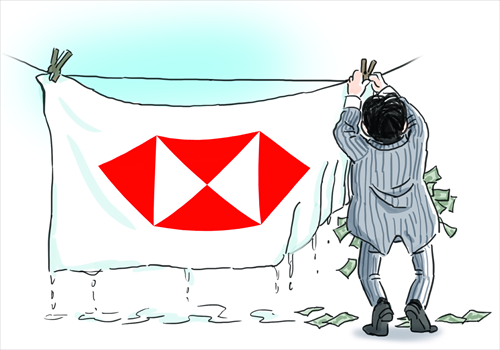
Illustration: Liu Rui/GT
British bank HSBC is facing a massive public embarrassment after leaked files revealed its Swiss subsidiary has been engaged in questionable, perhaps illegal practices including hiding accounts from domestic authorities and advising international criminals and corrupt businesspeople.But this is only one in a long run of scandals for HSBC. Chinese readers might remember that the bank, originally a Hong Kong enterprise, made its initial money off the opium trade. But it's still in the narcotics business, albeit a little less directly. In 2012, HSBC was fined $1.9 billion over its massive involvement in money-laundering, including deliberately aiding Central American drug lords in hiding their blood money. And the record of other banks is equally bad. There was the Libor scandal that broke in 2012, under which banks systematically manipulated inter-bank lending rates on a daily basis, reaping massive profits for themselves while costing the public billions.
Then there was the PPI scandal later in 2012, where it was revealed that banks in the UK and the US had systematically deceived British account holders into paying for useless insurance plans. That one is still playing out, with another $1.8 billion in compensation likely to be handed out in the next few months. And the aftermath of the 2008 global financial crisis is still revealing numerous cases of massive financial fraud. Despite being bailed out with public funds, bankers can't even play within the rules of a system set up to benefit them.
But here's the bitterest part of it all. In the vast majority of these cases, the banks have avoided criminal charges, the government instead opting for "settlements" that might take out a chunk of profit but do nothing to actually change the deeply toxic internal culture.
Criminal actions by London banks alone have bankrupted hundreds of thousands of people, left the economy tottering, empowered drug traffickers and terrorists and caused numerous suicides - but with virtually no consequences to the perpetrators. Imagine if a mafia prosecution was settled with nothing but a hefty fine and a promise on the part of the gangsters never to do such wicked things again.
This doesn't go just for banks. Brandon Garrett's recent book, Too Big to Jail, details the US version of this process, under which corporate fraudsters, such as pharmaceutical giant Pfizer, get "deferred prosecution" deals that substitute compensation and vague promises of reform. Garrett shows how the reform process, trumpeted by both the prosecution and the government, almost inevitably fails. Pfizer, which paid penalties of $2.3 billion in 2002 for medical bribery, was promptly caught engaging in exactly the same behavior in 2009 - and got another no-prosecution deal out of it.
Such fines might seem large, but they often represent only a fraction of the profit made from illegal activities. The reluctance to prosecute is in some ways understandable; jobs - which for politicians means votes - are at stake. But the last two decades have proven that toothless punishments only empower corporate criminals to repeat the same behavior, inflicting a much heavier cost on society.
Given the international scope of modern corporations, it's not just their host countries which pay the price. Countries with weaker institutions are particularly vulnerable. HSBC helped corrupt officials and businessmen from the developing world hide their stolen funds. As the pharmaceutical scandal in China demonstrated, plenty of companies play dirty overseas. Pfizer, coming off its 2002 and 2009 scandals, got another sweetheart, non-prosecution deal in 2012 for bribing officials in Central Asia and Eastern Europe.
Like any large institution, banks and other corporations can't police themselves. They've shown again and again that they can't be trusted. Criminal behavior by corporations can't just be pushed under the carpet and covered up with fines. The individuals who signed off on illegal behavior need to be prosecuted, and the corporate entities forcibly restructured and genuinely sanctioned.
In China, criminal CEOs face a real danger of execution. It'd be nice to see those in other parts of the world dragged into court to face charges, instead of departing with fat retirement packages.
The author is an editor with the Global Times. jamespalmer@globaltimes.com.cn
Posted in: Viewpoint