Divorce unnoticed
To avoid social judgment, some separated couples in China pretend they are still married

Experts say that the phenomenon of people concealing their divorces reflects the tension between traditional and modern attitudes toward marriage. Photo: Li Hao/GT
Chinese actor Chen He's recent admission on Sina Weibo that he had concealed his divorce for the past six months has prompted a feverish discussion in the country about the emerging social phenomenon of yinli, or "invisible divorce" - referring to mutual arrangements in which a couple who are legally divorced continue to pretend that they are married for the benefit of their friends, family members and colleagues.
In some cases, the divorced couple might continue to live together, either to maintain the illusion that they are married, or because they cannot afford another apartment.
While it is difficult to ascertain precisely how common invisible divorces are in China, their existence is well-known, and the fact that a specific term has emerged to describe the arrangement speaks to their prevalence.
Like acting in a play
Lin Huan, 41, told the Beijing Evening News that she has been secretly divorced for three years.
She said that she ended her 20-year-long marriage due to her husband's extramarital indiscretions, but perpetuated in the ruse of still being married for the sake of her 15-year-old daughter.
Lin said she did not want her daughter to grow up with the experience of being in a "broken family," or to be negatively affected in her future relationships due to her parents' divorce.
"An invisible divorce is like acting in a play," she said. "You get sucked in deeper and deeper."
Lin said that every weekend, when their daughter returned from boarding school, she and her ex-husband would put on a "show" that all was still well with their marriage.
Lin said that she and her husband had not told their parents that they were divorced either, out of fear that they would not be able to handle such a blow in their old age, and to avoid having to repel attempts to persuade them to get back together. She said that they continue to regularly visit their parents' houses as if they were a happily married couple.
"It's better to let them live out their twilight years in the blissful ignorance of a white lie," said Lin.
Chen Zhilin, a Chonqing-based psychologist and marriage counselor said that in his experience, arrangements like Lin's were not uncommon. There were also those who told their family members, but kept the information of their divorce from their friends and colleagues, said Chen.
As to the psychological reasons for keeping one's divorce a secret, Chen gave the example of a woman in her 20s he had treated, who had kept the fact of her divorce from her colleagues for more than a year.
Chen said she did this out of fear of being slandered or ridiculed.
"Deep down, she still thinks of divorce in the traditional way, as something that is immoral," said Chen. "In public, she still talks about her ex-husband and feigns affection for him as if they are still married."
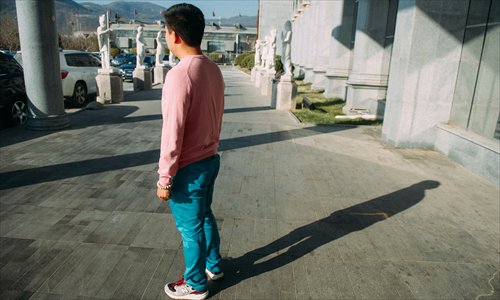

Between protecting the feelings of their family members and avoiding social embarrassment, people who choose to keep their divorces secret carry a heavy psychological burden. Photos: Li Hao/GT
Reasons for concealment
Chen said that it was more often the woman in a relationship that pressed for an invisible divorce, and that it was more common in older women, who were more likely to hold traditional views with regard to fears of what others will think of them.
"Chinese women tend to consider being hurt in a relationship to be a shameful thing, so they have a strong sense of wanting to guard against other people's judgment," said Chen. "As the saying goes: A divorced man is like found treasure; a divorced woman is like discarded trash. [Chinese society] is still dominated by patriarchal values."
Chen said that many women have been hurt before by gossip or ridicule, so they were less likely to trust people to give them the benefit of the doubt about their divorce.
Wang Xiuquan, a lawyer at Beijing Jihe Law Firm which specializes in divorces, echoed Chen's comments that the fear of gossip-mongering and public shaming was a significant factor in why some couples chose to conceal their breakup from others.
"In China, even if people say that their divorce was due to 'irreconcilable differences,' the assumption and the reality are often that it was because of an extramarital affair," said Wang. "To avoid having their dirty laundry aired out in public, people prefer to hide their divorce to avoid embarrassment and negative judgment."
Wang said that in six to seven out of every 100 divorce cases handled by the law firm, the couple clearly stated that they planned to conceal the fact of the divorce. "In metropolises like Beijing, attitudes are shifting, but for most people the idea that marriage is 'until death do us part' is still very strong and a divorce is still thought of as a shameful thing," said Wang.
Besides the fear of embarrassment, public knowledge of one's divorce could affect one's career prospects, said Wang. "Celebrities, civil servants, and people who work for major State-owned companies will have a greater tendency to keep their divorce secret, because in Chinese culture, it is still considered essential to have a stable family in order to have a successful career," he said.
Finally, said Wang, some couples chose to hide their divorces for the benefit of their children. "Perhaps their child is preparing for a major exam, such as the college entrance examination, which is seen as a crucial phase for the family in China. In such instances, most parents would hide their divorce," said Wang.
A changing society
In 2013, 3.5 million couples were divorced, a 12.8 percent increase over the previous year, according to the Ministry of Civil Affairs. The divorce rate in China has been steadily increasing since 2004.
Wang said that an additional trend was that people were getting divorced at a younger and younger age.
Young people these days tend to be more impulsive and more individualistic, which is a challenge to building a stable family life, said Wang. "They aren't taught how to identify and solve relationship problems, which is a shortcoming in our education system."
Chen said that from a social perspective, invisible divorces represented a clash between traditional values and modern attitudes toward marriage.
"Invisible divorces reveal a paradox," said Chen. "On the one hand, younger generations have a modern attitude toward marriage in that they will seek a divorce if they feel trapped in an unhappy relationship. But on the other hand, they still have the traditional fear of not wanting to lose face."
Yan Qiao, a writer who last month published a novel exploring changing attitudes toward divorce in Chinese society, said that the multitude of cultural memes like yinli to describe different marriage and divorce arrangements showed that society was becoming more tolerant.
These memes include shanhun ("flash marriage"), shanli ("flash divorce"), xinghun (a marriage between a gay man and a lesbian to conceal their sexual orientation), yinhun ("invisible marriage"), yinli ("invisible divorce"), and luohun (a marriage in which neither party possesses much in the way of material possessions).
Yan said that at a divorce office in Xuzhou, Jiangsu Province, he saw a sign saying "You'll still be happy without me."
"It shows the notion that divorce is shameful is gradually disappearing, even in second-tier and third-tier cities."
Yan said that unlike the way it is depicted in Lu Xun's short story Divorce, marriages are no longer purely utilitarian and based on the common material interests of the families involved. Lu's story shows the tragic struggle of a woman who is denied a divorce because of the family's meddling.
"Marriage in China has been de-sanctified now," said Yan. "To the younger generations, a marriage is like a bowl of instant noodles, a kind of fast food."
He said that he knew of people who had "flash marriages" and "flash divorces" without their parents ever knowing.
As for the matter of invisible divorces, Yan said that it was a practical choice.
"In the West, divorce is a philosophical problem, but in China, divorce is a technical, arithmetical problem," said Yan. "Divorce is about public relations. You need to handle your parents, and to protect your reputation from gossip and scandal."
A double-edged sword
"I think there are a lot of people around us who are secretly divorced," said a technical school teacher surnamed Tong who suspects one of her colleagues of being divorced. "I feel sorry for [my colleague]."
Chen said that invisible divorces could produce a heavy psychological burden on its participants.
"After a divorce, they are back to being single," said Chen. "They should treat this period as an opportunity to reflect upon themselves, to socialize and to read so that they can have a better understanding of marriage and learn more about how to preserve a marriage in the future."
Chen said friends of family members who know of an invisible divorce should adopt an understanding and gentle approach toward invisible divorces.
"Don't ask whether and why they divorced, but talk about your understanding of marriage," said Chen. "Don't make it sound as if you are judging them [for concealing their divorced]."
Wang also warned invisible divorces, as it could lead to legal complications when it came to dividing property.
"If two people continue living together after they are legally divorced, and if they continue to publicly display affection for each other until they announce their divorce some years later, the wealth accumulated in the intervening period should technically be divided equally," said Wang.
"Of course, this will usually end in a dispute."