Frost-bite
Chinese fisheries venture to ends of the earth in hopes that Arctic and Antarctic seafood will catch on
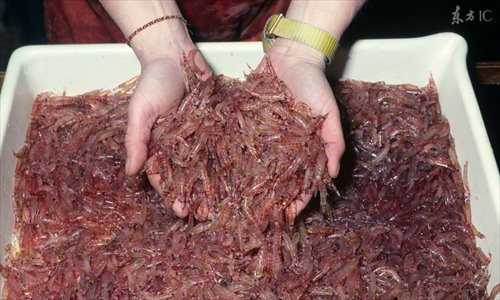
China's Antarctic Krill Group has announced plans to significantly expand industrial fishing operations in Antarctica. Photo: IC
Ever wondered what shrimp from the South Pole tastes like?
A group that was part of China's 31st Antarctic expedition recently announced plans to significantly expand industrial fishing operations to bring Antarctic krill - a species of small, semi-transparent crustaceans that look like rainbow-colored shrimp - to diners in China.
With the biomass estimated at 500 million tons, Antarctic krill is responsible for supporting much of the region's ecosystem, providing an invaluable food source for other animals including seals, whales and penguins.
China's Antarctic Krill Group, which was founded in April 2012 as part of the country's 28th Antarctic expedition, is hoping to add humans to the list.
"Eaten raw, they taste quite sweet," said Ying Yiping, a researcher at the Yellow Sea Fishery Research Institute, who sampled fresh Antarctic krill on a scientific expedition to Antarctica in 2013. "Boiled, they taste like fresh river shrimp."
However, concerns have been raised that industrial harvesting operations could destabilize the natural ecology of the region.
Since 2004, marine ecologist Angus Atkinson, formerly of the British Antarctic Survey in Cambridge, has expressed fears over declining Antarctic krill populations due to global warming and commercial fishing industries, which poses a significant threat to other animal populations.
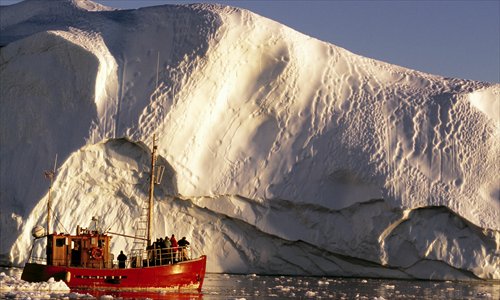
Concerns have been raised that the announced plans will have a detrimental effect on the ecosystem of Antarctica. Photo: IC
Commercializing krill
Ying said while the market for Antarctic krill in China is currently small, a commercial industry for it already exists, as it is used as an ingredient in some oils, pastas and sauces.
According to news website guancha.com, China was granted permission by the Commission for the Conservation of Antarctic Marine Living Resources (CCAMLR) to begin commercial fishing of Antarctic krill in 2010.
The CCAMLR 2012 Statistical Bulletin lists Norway, South Korea and Japan as the largest fishers of Antarctic krill, with a combined yield of 159,492 tons in 2011. In the same year, China took 16,014 tons of Antarctic krill, according to the report.
Li Lingzhi, a researcher at the East China Sea Fishery Research Institute, told guancha.com that the announced plans to ramp up fishing of Antarctic krill by Chinese fisheries could be seen as part of broader strategy to explore high sea resources, in order to alleviate offshore fishing resources which have depleted in recent years.
Shi Jie, a Beijing-based nutritionist, said that Antarctic krill was high in protein and low in fat, as well as being a rich source of amino acids and antioxidants.
"From a nutritional point of view, I think the best way to eat fresh krill would be raw, or sashimi-style," she said.
Shi said it is crucial that it is rapidly processed through quick-freezing, as Antarctic krill deteriorates very quickly.
Besides Antarctic krill, Ying said there were two other species found in Antarctica that could be a valuable food resource in the future: the Patagonian toothfish (more commonly known as "Chilean Seabass") and the crocodile icefish.
"Both fish are larger and have a high commercial value, but China currently does not have permission to commercially fish these two species," said Ying.
In 2010, Greenpeace International added the Patagonian toothfish to its "red list" - a list of common foods whose sourcing is likely to be unsustainable.
Shrimp from the Arctic
On the other side of the globe, in the Arctic, is another prized shrimp: the pandalus borealis, commonly known as northern prawn, deep-sea prawn or crevette nordique. Fan Xubing, president of Beijing Seabridge Marketing, which is one of the major importers of northern prawn in China, said that compared to Antarctic krill, northern prawn was already a common dish on dining tables in North America and Europe.
Like Antarctic krill, northern prawn is high in protein and had a low fat content, said Fan.
It also contains various vitamins, calcium, iron and magnesium, and is best eaten raw.
"If correctly defrosted and washed, it is completely safe to eat raw," said Fan. "The major fishing regions are Canada, Greenland and Denmark."
According to Fan, the average global annual yield for northern prawn is around 450,000 tons.
He said that when he initially founded his company, he sold around 5,000 tons in the first year. Last year, his company's sales volume for northern prawn in China was above 40,000 tons.
Shi said that other sought-after delicacies in China from the Arctic include black cod, a fish that is rich in omega 3 fatty acids, and nanjibingsun, a bamboo-shoot like algae, which is high in calcium and iodine, and can help prevent cardiovascular diseases.
Ecological fears
Professor Bert Wouters of the glaciology department at University of Bristol told China Youth Daily in 2013 that the sea ice around Greenland and Antarctica was disappearing at a rate of 300 billions tons per year, jeopardizing animal life on both regions.
Responding to fears that intensified fishing of Antarctic krill could cause irrevocable damage to the ecosystem of the region, Ying said that the CCAMLR has strict regulations regarding the resources that could be taken from the area.
"The CCAMLR assesses the volume of the Antarctic's natural resources each year, and sets a threshold of catch that will not jeopardize the ecology of the region," said Ying. "It's difficult for countries to get permission to fish in the Antarctic, and enforcement of the regulations is strict."
Ying attributed China's permission to fish in the Antarctic to the country's contributions to research in the region, including the establishment of the Antarctic Great Wall Station in 1985.
Fan, who has worked in the fisheries industry for more than 20 years, said that concerns over the environmental impact of commercial fishing, especially in areas like the Arctic and the Antarctic, were well-founded.
"Take black cod for an example," said Fan. "It's a very popular fish to eat, especially in the West. The population of this fish has nearly entirely been depleted."
Even when fisheries abide by regulations, and are declared to be sustainable, said Fan, the damage to the ecosystem caused by the fishing industry is real and increasing. "It is a dilemma," said Fan. "We want to eat delicious food, and we want to develop the fishing industry in the Arctic and Antarctic, but the first priority should always be protecting our environment."