HOME >> OP-ED
Ordinary Japanese workers need help to get economy started again
By Chen Yang Source:Global Times Published: 2015-6-9 22:18:02
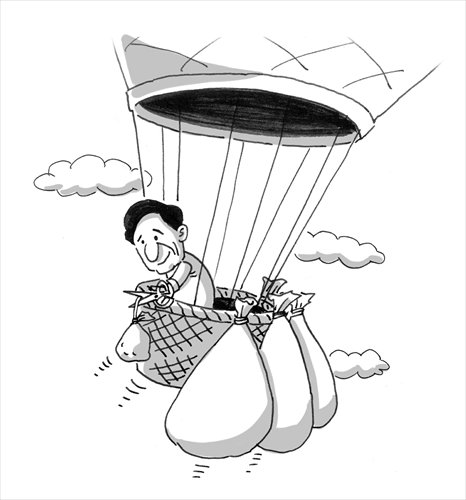
Illustration: Liu Rui/GT
Japan's "Dankai Generation," the equivalent of the US "baby boomers," born between 1947 and 1949, was a powerful driving force for the country's economic take-off in the 1960s. Traditional scholarship on Japan's boom has focused on the diligence of that generation, and a culture that came to regard their workplaces as home.
But Japanese companies have not yet found a method to cope with the bursting of the bubble in the 1990s and the subsequent long-term economic slump. Japan's culture of working overtime hours as a heritage of the Dankai Generation has been playing an irreplaceable role in society, but it has also brought other social issues, including inefficiency, death from overwork, and a surge in the number of employees committing suicide. The business culture that once made Japanese so proud is now showing its drawbacks, which are starting to frustrate Japan's economic development.
In order to reinvigorate the country's economy and change its inefficient business culture, the administration of Japanese Prime Minister Shinzo Abe came up with a new approach last year - the "Zero Overtime Bill," which is one of the proposed amendment to Japanese Labor Standards Act. Under the bill, white collar workers who make 10.75 million yen ($85,824) a year or more will no longer be covered by overtime pay, and they will be paid based on their actual working performance, instead of working hours. According to Japanese media, the ruling party of Japan, the Liberal Democratic Party, is vigorously pushing the bill through congress, in order to bring it into operation by April 2016.
The number of Japanese, whose annual payment is over 10.75 million yen, is around 1.8 million, only 4 percent of private-sector employees, most of whom are at the management level. Therefore, canceling overtime pay for those people will prove to have little practical effect. After all, compared with their high incomes, overtime pay is only the tip of the iceberg. In contrast, those who actually bear the heavy workload and keep the enterprises functioning are ordinary "salarymen."
Thus, the proposal of Abe's government of cutting long working hours to improve efficiency will not help, because it does not cover ordinary workers. At the same time, it is not hard to discover the bill was a decision made by big companies, monopolies and politicians, where nobody stood up for ordinary people. If passed, the bill will undoubtedly be good news for Japanese enterprises, but will enlarge the growing gulf between rich and poor.
The "Zero Overtime Bill" was introduced to boost efficiency, stimulate the economy and help Japan get rid of deflation, but the fundamental problem remained untouched. Ending deflation requires expanding consumption, the prerequisite of which is improvement of workers' income and shortened working hours. In this regard, removing the overtime pay for the companies' executives without uprooting the business culture of working overtime will not have any effect.
The Asahi Shimbun newspaper has examined the results of Abenomics for the past two years in November 2014, on the occasion of Japan's lower house elections. Abenomics has created around 1 million jobs in Japan, but at a cost of the introduction of 1.23 million non-regular positions and a reduction of 220,000 regular employees. Meanwhile, the number of workers who make less than 2 million yen annually has increased by 300,000, and those who can earn over 10 million yen has risen by 140,000. In the end, even though Abenomics has expanded the country's employment, it has widened the wealth gap.
Consequently, instead of focusing on the overtime pay, what the Abe government really should do is to change Japan's business culture, raise the income of workers, and look to especially increase the number of regular positions, which can boost its citizens' sense of security. Regular and stable jobs will not only provide guarantee and reassurance, but will also raise confidence in consumption. And only by doing so can Japan extricate itself from deflation.
The author is a PhD candidate at the Graduate School of Sociology at Toyo University. opinion@globaltimes.com.cn
Posted in: Viewpoint