HOME >> OP-ED
Good relations with neighbors in everyone’s best interests
By Zhu Zhenming Source:Global Times Published: 2015-6-15 22:43:01
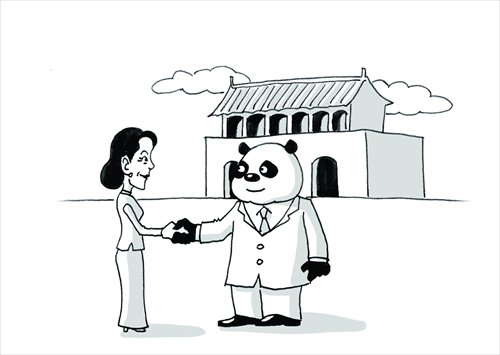
Illustration: Liu Rui/G
Aung San Suu Kyi, chairperson of the National League for Democracy (NLD) in Myanmar, wrapped up her first China visit on Sunday. By means of inter-party exchanges, her meetings with the leadership of the CPC, especially Xi Jinping, General Secretary of the Central Committee of the CPC, was most highlighted. She also engaged in several cultural activities such as touring the Great Wall in Beijing and practicing calligraphy, and visited Shanghai as well as Yunnan Province which shares border with Myanmar.During a meeting with Li Jiheng, the current Party chief of Yunnan, Suu Kyi spoke highly of the province's experience in economic development, saying both sides should strengthen communication and cooperation.
Suu Kyi's compliment of China's economic achievements reflects Myanmar's endorsement of China's reform in the past 37 years. Myanmar's inclination to draw experiences from the Chinese development path even started before China's reform and opening-up had shown its full strength.
Both the new government and the former junta attached importance to China's reform experiences and sent delegations to visit China, especially coastal cities such as Shanghai and Shenzhen, to understand and learn from China's experiences.
Therefore, no matter which path the Myanmese will choose in the upcoming general election, their views about China's reform will remain positive. In the past decades, China has been committed to support Myanmar's development and the country's exploration of its own way, even though it might be different from China's.
Both nations not only share a long border, but also share the same culture, languages and customs around the border areas. Myanmar's stability and welfare matters immediate effect on China's security. Therefore, China always pays attention to changes in China-Myanmar border areas, and hopes maintaining peace and stability there.
Troubled by complicated ethnic problems among many others, Myanmar faces high risks of instability and stagnation of development, which in the end will victimize China's own interests near the border.
Border trade between China and Myanmar has doubled in the last four fiscal years, reaching $589 million in 2014 according to the Myanmese Ministry of Commerce. In Myanmar's total volume of import and export trade, border trade with China accounts for 21.6 percent, and Myanmar has a favorable balance of trade with China, in which exports amount to $371 million and imports amount to $218 million. Therefore, Sino-Myanmese border trade has greatly boosted Myanmar's economic growth and reinvigorated local economies.
Suu Kyi said that we cannot choose neighboring countries, and it is best to develop good relationships with neighbors. The current stage of Sino-Myanmese relations has seen both positive and negative elements. In the past when Myanmar was isolated by the West, China's presence in Myanmar through investments and aid projects was large, but now Myanmar has greatly improved its relationship with the Western world. Besides, the rising tensions between the Myanmese government and ethnic minorities have produced some negative influence on the Sino-Myanmese relationship.
Above all, we should be flexible and insightful in face of the trajectory of the Sino-Myanmese relationship, sorting out the positive and negative elements from the complicated situation. Both countries need to overcome difficulties and reinforce their common ground. As neighbors, China and Myanmar need profound communication on all levels. Suu Kyi's visit signals China's commitment and open-mindedness to embrace all walks of life in Myanmar, as long as they are willing to contribute to the positive bilateral relations.
The author is a research fellow at Yunnan Academy of Southeast Asian and South Asian Studies, Yunnan Academy of Social Sciences. opinion@globaltimes.com.cn
Posted in: Viewpoint