Greater nuke transparency helps improve China’s global reputation
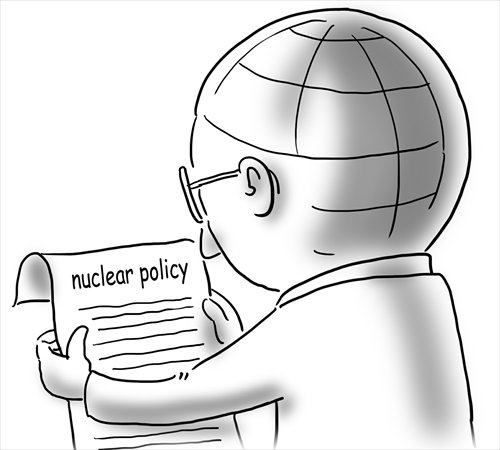
Illustration: Liu Rui/GT
Editor's Note:
US President Barack Obama hosts the fourth and final Nuclear Security Summit in Washington, DC on Thursday and Friday. China's development of nuclear weapons has caught increasing attention and is often criticized for lack of transparency. Why is China's nuclear strategy seen as opaque? What is China's philosophy in nuclear development? At the book launch of Understanding Chinese Nuclear Thinking, compiled by prominent strategists in China, several experts shared their insights.
Wu Riqiang, associate professor at the School of International Studies, Renmin University of China
China's nuclear transparency is a focal point of argument in China-US strategic dialogues and also the target of criticism. There have always been two channels for China to release nuclear-related information.
Officially, the Chinese government releases information on its nuclear weapons development by means of documents, publications, military parade, and by inviting visits of foreigners.
But the official releases are relatively small compared with the large amount of information exposed in an unofficial way. Some information is disclosed by unintentional media reports. Some is leaked by unofficial parties, as shown in the disclosure of J-20 stealth fighter. Now nuclear transparency is often promoted by social forces given the rapid development of information technology.
China takes a holistic approach to nuclear transparency, which differs from the US. In its nuclear exchanges with the US, China tends to build strategic trust before bringing out more information, while the US does the other way around. This has led to some misunderstandings between the two nuclear powerhouses. Besides, China sticks to its traditional political culture and applies high levels of confidentiality to a large variety of information, a result of the unfavorable security landscape it has been facing in the past decades.
In recent years, China has made progress in improving nuclear transparency. For instance, missiles are elaborately introduced in military parades.
But this is far from enough. Other countries may find it hardly acceptable that China continues to show a vulnerable image while its strength keeps rising.
Lack of transparency jeopardizes China's national image and bars China from taking the moral high ground in the nuclear sector as the US does.
To improve it requires more efforts. Specifically, China can release a white paper on its nuclear power that clarifies the models of its nuclear weapons under research and in service. It also needs to make public the information on the majority of ballistic missile tests. These measures have no cost, but can help considerably improve China's image.
Li Bin, professor with the Institute of Modern International Relations, Tsinghua University
In terms of nuclear policy, there are many differences between China and Western nuclear-states. This is explained in two ways. For one thing, some say that China doesn't have enough resources to do what the US does. China's unique nuclear thinking produces different policies. This poses a real question: as China grows financially capable, should it spend more money catching up with the US in nuclear weapons or is China confident enough in sticking to its nuclear policy?
In nuclear talks with the US and other countries, there are often misunderstandings between each other on specific issues such as nuclear deterrence. We want to figure these out in the book.
Major General Pan Zhenqiang, senior adviser to the China Reform Forum
In my decades of foreign exchanges experience, I often feel it difficult to talk about nuclear issues with Americans and in particular to get China's nuclear strategic thinking through to them. These talks usually have little impact and the US is also disappointed at failing to truly understand China's strategic thinking.
This is brought about by a variety of reasons such as the two sides' divergence on each other's strategic intent, cultural differences and strategic thinking. In this sense, it is very important to work out a systemic elaboration of China's development and use of China's nuclear weapons. This will help Western scholars better understand China's nuclear thinking and the political and cultural factors behind it.