African players honing talents in China
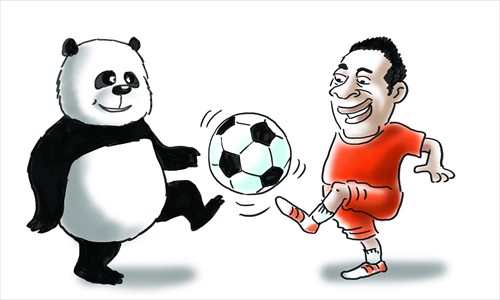
Illustration: Liu Rui/GT
China is becoming a new arena for African footballers to exploit their talents. This is a huge shift from recent times when the continent's players would dream chiefly of flying and playing in the English Premier League.
Unlike the American Major League Soccer where relatively old African, European and Latin American players go to play as they await retirement, like the famous David Beckham, Steven Gerrard, among others, China's Super League, awash in cash, seems to be the place of choice for the youthful, upcoming, energetic and talented soccer players.
So far, the Super League has attracted some of Africa's finest from the Premier League such as Cote d'Ivoire's Gervais Yao Kouassi, better known as Gervinho, who plays for Hebei China Fortune, Malian Mohamed 'Momo' Sissoko of Shanghai Shenhua, Ghana's Asamoah Gyan of Shanhai SIPG and Senegal's goal machine Demba Ba, also of Shanghai Shenhua.
Gervinho usually takes a more attacking role than a typical midfielder. He is a fast, powerful and an agile player who possesses solid ball control and dribbling skills. Often compared to former French midfielder Patrick Vieira, Sissoko is combative, physically strong with ball-winning abilities and powerful striking ability from distance.
Perhaps it was Demba Ba's arrival in China in June 2015 that reverberated across the world on how lucrative and competitive the Chinese league is turning out to be. Ba was seen as a hot player in the Premier League. Indeed, he was voted the Premier League Player of the month in December 2011. His presence in China has already been felt; he was recognized as the Chinese FA Cup Most Valuable Player in 2015. The same year, he was the Chinese FA Cup's top scorer.
Besides better pay and attractive perquisites, the apparent attraction of world's top soccer players to the Chinese league is being driven by the government's deliberate efforts to match its peers - Europe and the US - led by Xi Jinping, coincidentally, a big soccer fan.
This is a massive development to many youths out there who have been struggling to actualize their football talents. It is no secret that Africans entering European Leagues was a tall order with multiple barriers on their way, from racism to cultural and linguistic differences. As such, they would end up frustrated in their countries where football is either in its infancy or poorly managed.
It is encouraging, though, that China is not just starting from the top by poaching Africa's super talents. Beijing has been laying down football infrastructure through the construction of stadiums in African countries. Sometimes referred to as stadium diplomacy, the construction of sports facilities has been financed through low interest rates, concessional loans or built in partnership between China and the host nation. In Angola, where China's presence is heavy, four stadiums were built in the year 2010 financed by a credit line provided by China. A year before, China had constructed the Yaounde Stadium in Cameroon to be used in hosting sports and cultural events.
"Stadium diplomacy" did not start in the 21st century. In 1987, China built the 60,000-seat Moi International Sports Center to enable Kenya host the All Africa Games. Later on between 2010 and 2012, China provided a grant of $12.8 million to aid the refurbishment of the facility by the Shengli Engineering Construction. In the football powerhouse Cote d'Ivoire, China is also financing the construction of a 60,000-seat stadium as the country prepares to host the 2021 Africa Cup of Nations. The new facility, the Olympic stadium of Ebimpe, is located in Abidjan, and will be completed in January 2018.
Modern stadiums may be necessary but are not sufficient to exploit potentially massive football talent in Africa. China, in partnership with African countries, should now step in and start spotting youthful soccer players who show hunger for the sport. This can start from the lowest point such as in primary schools and then secondary and tertiary institutions. Importantly, African countries' local and national leagues should also be nurtured to provide a fertile ground for those players who want to play at the international scene.
China can sponsor these leagues, or even assist in the hiring of world-class football coaches to provide cutting-edge training to African youth. Given the poor history of how most African countries' football federations manage their finances, and the rampant corruption that has long haunted both global and Chinese soccer, China should provide tough conditions on how funds are used so as to cut out misappropriation in the case where financial support is given out. Given that there are still deep-seated cultural differences between the Chinese and Africans, soccer will no doubt play an integral role in integrating these two regions, whose engagement in the last decade has turned around Africa's fortunes and international image.
But even as it seeks to be competitive to African players, the barrier to entry for more of Africa's players in their prime is the Super League's foreign player quota. As it is, only five foreigners are allowed to sign for one club at any time and only four of them are allowed on the pitch simultaneously. Besides relaxing the quota to allow more African players into their league, China could well start an ambitious China-Africa football competition to be played every four years.
Such a competition could have juicy rewards, like the European Champions League, so as to ensure that African players who do not make it to the Super League still hone their football potential.
The author is a journalist on African issues based in Nairobi, Kenya. mkapchanga@gmail.com